







Last Updated: October 31, 2026
Quick Summary
To bleed radiators, turn off the heating, wait at least 30 minutes for them to cool, then open the bleed valve at the top corner with a radiator key, turning it anticlockwise no more than a quarter to half a turn. Close the valve as soon as water runs steadily, and check the boiler pressure afterwards.
- Bleeding one radiator takes around 20 to 60 seconds, so stop the moment water runs in a steady stream.
- Work through the radiators one at a time, starting with the upstairs ones and finishing downstairs.
- A radiator that is cold at the bottom and hot at the top points to sludge, which bleeding will not fix.
- Never work on a hot radiator, and never remove a bleed screw completely.
- If the key slips on the first turn, stop, because a rounded bleed screw needs replacing.
Table of Contents
- Why Radiators Need Bleeding and How to Spot the Signs
- What You Need Before You Start
- Step by Step: How to Bleed a Radiator Safely
- How Long to Bleed a Radiator and When to Stop
- Boiler Pressure After Bleeding Radiators: What to Check
- When Bleeding Doesn’t Work: Cold Spots, Leaks and Stuck Valves
- Book a Heating Check with a Gas Safe Registered Engineer
- Frequently Asked Questions
Why Radiators Need Bleeding and How to Spot the Signs
If your radiator is hot at the bottom and cold at the top, trapped air is the likely culprit, and knowing how to bleed radiators is the fix.
Air gets into a heating system in several ways. It enters when you top up the boiler pressure, when pumps draw in tiny amounts, and when corrosion produces gas inside the pipes.
Radiator Cold at the Top? What Trapped Air Actually Does
A radiator works by filling completely with hot water. When air sits at the top, water cannot reach that section, so the panel stays cool while the bottom heats up. The result is uneven heating and a boiler working harder than it needs to.
Watch for these signs:
- The top of the radiator feels cold while the bottom is hot
- Radiators take longer to warm up than they used to
- You hear gurgling, ticking or hissing when the heating comes on
One common mistake is assuming a cold radiator means a broken boiler. In practice, trapped air is far more often the cause.
What You Need Before You Start
Gather everything before you touch a valve, because the job is quick only if you are not hunting for a key halfway through. The basics are a radiator bleeding key, an old towel, a small bowl or cup, and a few minutes of patience. A second person helps on tall towel rails and on radiators set low to the floor.
Here is your checklist:
- Radiator bleeding key, sometimes called a bleed key
- Old towel or cloth to protect the floor and catch drips
- Small bowl or cup to catch water
Choosing the right radiator bleeding key
Most modern panel radiators and towel rails use a small square bleed screw, and a standard radiator key fits it. Some valves have a hexagonal fitting instead, which needs a different key or a small spanner of the right size. A radiator bleeding key is inexpensive and it is worth keeping one in the house, the moment you need one is usually the moment you cannot find one.
If you do not have a radiator key
A missing key is the most common reason people abandon the job. The safe options are to buy one, borrow one, or use a correctly sized tool that grips the square properly. What you should not do is improvise with pliers, a screwdriver, a knife or anything that does not fit the square exactly. A bleed screw is soft brass or steel, and a tool that slips will round the corners.
If the key slips even slightly on the first turn, stop. A rounded bleed screw turns a ten-minute job into a call-out, and the screw often has to be replaced rather than re-tightened.
Awkward valves and hard-to-reach fittings
Some valves are simply difficult to get to. A radiator set close to the floor, a towel rail in a narrow bathroom, or a valve tucked behind pipework can make it hard to keep the key square on the screw.
If the valve will not turn at all, do not apply more force. A seized bleed screw can shear, and a sheared screw means the radiator cannot be bled until it is replaced.
Know your system before you start
Most homes have a sealed system, usually with a combi boiler and a pressure gauge on the front. Sealed systems are straightforward to bleed, but the pressure will drop slightly afterwards, so it is worth knowing where the gauge and the filling loop are before you begin. Older open-vented systems, with a feed and expansion tank in the loft, behave differently and can draw air in if the tank level is low.
Safety limits worth respecting
Bleeding is a safe job when done properly, but there are limits. Never work on a hot radiator, let the system cool for at least 30 minutes. Never remove a valve or a bleed screw completely. Never force a fitting that will not move. And if water will not stop after you close the valve, isolate the radiator and call an engineer rather than running the heating with a leak.
Step by Step: How to Bleed a Radiator Safely
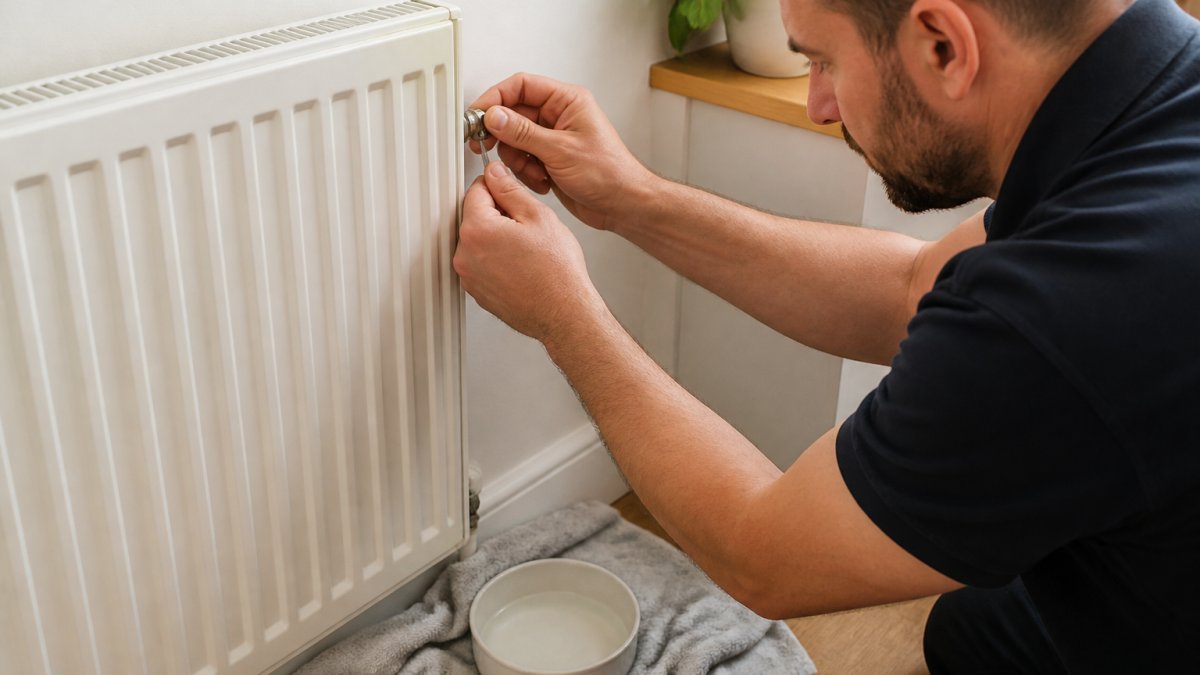
Follow these seven steps in order. Work through the radiators one at a time, starting with the upstairs ones.
- Turn the heating off. Switch off the central heating at the controls and let the system stop running.
- Wait for the radiators to cool. Give them at least 30 minutes. Hot water can scald, and cool radiators are safer to work on.
- Find the bleed valve. Look at the top corner of the radiator, usually at one end. It is a small square or hexagonal nut.
- Protect the floor. Lay a towel underneath and place a small bowl below the valve.
- Fit the key and turn anticlockwise. Turn the radiator key slowly, no more than a quarter to half a turn.
- Listen for the hiss. You will hear air escaping. Hold the cloth near the valve as water follows.
- Close the valve as soon as water runs steadily. Turn the key clockwise to shut it. Do not over-tighten.
Repeat on each radiator, working from upstairs down. If some rooms still heat unevenly afterwards, the system may need balancing rather than just bleeding, and our guide on how to balance radiators explains that next step room by room.
How Long to Bleed a Radiator and When to Stop
Bleeding one radiator takes around 20 to 60 seconds. The exact time depends on how much air is trapped inside.
Do not keep the valve open once water flows freely. Leaving it open wastes water and drops the system pressure.
A few drips are normal. A constant trickle after you have closed the valve means the screw is not seating properly, and it needs attention before you run the heating again.
Boiler Pressure After Bleeding Radiators: What to Check
When you bleed radiators, water is released, so the boiler pressure will drop slightly. Check the pressure gauge on the front of the boiler once you have finished every radiator.
On most combi boilers the needle should sit in the green zone marked on the gauge. Our guide on how to maintain gas boiler pressure covers checking and repressurising step by step.
Watch out: never top up a hot system. Let the boiler cool first, then refill to the correct mark. Overfilling causes its own problems, including pressure relief valve discharge.
When Bleeding Doesn’t Work: Cold Spots, Leaks and Stuck Valves
Bleeding removes air. It does not remove sludge, free a seized valve or cure a circulation fault, so it is worth knowing what a radiator is telling you before you reach for the key a second time.
Diagnose by where the radiator is cold
The position of the cold area is the single most useful clue:
- Cold at the top, hot at the bottom. Air. This is the one bleeding fixes. If it returns within days or weeks, air is being drawn in somewhere and the system needs investigating rather than bleeding again.
- Cold at the bottom, hot at the top. Sludge and magnetite settling in the lower part of the panel. Bleeding will not shift it. The radiator needs removing and flushing, or the system needs a clean.
- Cold in patches or in the middle. Sludge or corrosion debris sitting in the panel, often worse on older steel panel radiators. A power flush assessment is the usual next step.
Check the simple things first
Before assuming the worst, confirm the obvious. Make sure the thermostatic radiator valve is turned up and that the pin under the head is free, with the heating off, press the pin gently; it should spring back. Check that the lockshield valve at the other end has not been closed. On a system with a hot water cylinder, confirm the heating is actually being called for rather than hot water only.
What each fault usually means
| Symptom | Likely cause | Sensible next step |
|---|---|---|
| Cold at the bottom | Sludge or magnetite build-up | System clean or power flush assessment |
| Cold patches in the middle | Sludge settling in the panel | Power flush assessment |
| Cold throughout, pipes hot | Closed valve or stuck TRV pin | Free the pin or have the valve checked |
| Cold throughout, pipes cold | Balancing or circulation fault | Balance the system, then review |
| Water will not stop after closing | Worn or damaged bleed screw | Engineer replacement |
| Needs bleeding repeatedly | Air being drawn in, or a pressure fault | System pressure and leak check |
Radiators that keep pulling in air
A radiator that needs bleeding every few weeks is not normal. A sealed system should hold its air. Recurring air usually points to one of a small number of causes: a falling system pressure with a slow leak somewhere, corrosion producing gas inside the system, or air being drawn in at a pump or joint. None of these are fixed by bleeding, and left alone they tend to worsen.
If you find water weeping from a valve body, a joint or the radiator itself, do not keep tightening it. Isolate the radiator at both valves if you can, and arrange for an engineer to attend.
If cold spots keep coming back after bleeding, sludge is often the reason. Our article on whether power flushing can fix cold spots on radiators explains how the process works and when it helps. For a wider look at other causes, read our guide to troubleshooting common central heating problems.
Book a Heating Check with a Gas Safe Registered Engineer
Some jobs are best handed over. If a valve is stuck, a bleed screw is damaged, or your radiators keep pulling in air, a Gas Safe registered engineer can diagnose the cause properly.
At Apex Gas & Heating Ltd, our engineers cover homes across Sussex and Surrey from our base in Crawley.
If your system needs more than a bleed, you can book a boiler repair or heating check with our team.
Frequently Asked Questions
Should the heating be on or off when bleeding a radiator?
Turn the central heating off and let the radiators cool completely before you start. Bleeding a hot radiator risks scalding from water escaping at temperature, and the system needs to be off so air is not being pushed around while you work. Give it at least 20 to 30 minutes after switching off. Once every radiator is bled and closed, you can switch the heating back on and check for even warmth across each panel.
How can you tell if a radiator needs bleeding?
The clearest sign is a radiator that is cold at the top but warm at the bottom, which points to trapped air sitting above the water. You may also hear gurgling or clanking when the heating comes on, or notice some radiators taking far longer to heat up than others. If the whole radiator stays cold, that is usually a valve or circulation problem rather than air, so check the valves are open before reaching for a radiator key.
Do you need to check boiler pressure after bleeding radiators?
Yes. Releasing air lets a small amount of water out too, so the system pressure can drop. Check the pressure gauge on your boiler once you have finished and compare it with the level in your boiler manual, which is typically between 1 and 1.5 bar when the system is cold. If it has fallen below that, top up using the filling loop and recheck. If pressure keeps dropping after topping up, stop and call a Gas Safe registered engineer, as it can indicate a leak.
When should you call a Gas Safe registered engineer about a radiator?
Call an engineer if a radiator stays cold at the bottom or in patches after bleeding, if it needs bleeding repeatedly within weeks, if the bleed valve will not turn or leaks when closed, or if boiler pressure will not hold. These point to sludge, a failed valve or a system fault that bleeding will not fix. Work on the boiler itself, including pressure-related repairs, should only be carried out by a Gas Safe registered engineer.
Bleeding your radiators is a quick job that keeps your heating running efficiently. But when cold spots persist or pressure keeps dropping, the underlying cause needs a proper look. Get started with Apex Gas & Heating Ltd and have a Gas Safe registered engineer check your system, so your home stays warm and safe through the colder months.
