









Table of Contents
- What an Annual Boiler Service Plan Includes
- What Affects the Cost of an Annual Boiler Service Plan
- Boiler Service vs Boiler Cover: What’s the Difference?
- How Often Should a Boiler Be Serviced?
- Landlord Gas Safety Requirements and Service Records
- Warranty Implications: DIY vs Professional Servicing
- Conclusion: Choosing the Right Boiler Service Plan
- Frequently Asked Questions
Last Updated: September 19, 2026
What an Annual Boiler Service Plan Includes
An annual boiler service plan covers a yearly inspection, safety check and efficiency tune-up of your boiler by a Gas Safe registered heating engineer.
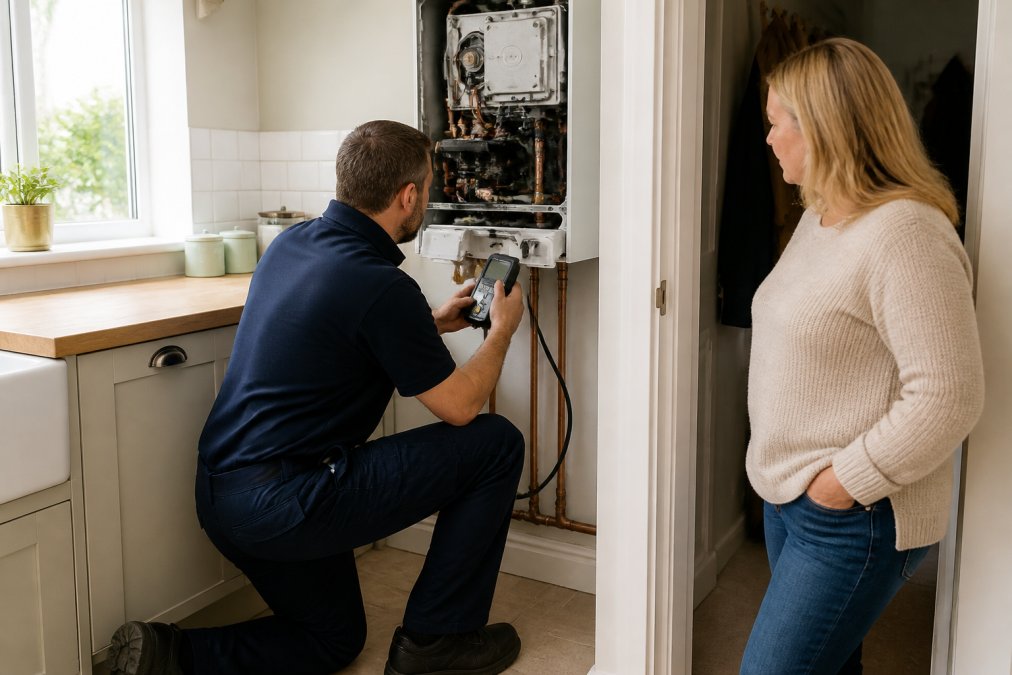
Boiler Service Checklist: What Engineers Check
The boiler service checklist is the list of tasks an engineer works through during a visit, and a good engineer will walk you through it.
A standard service covers:
- Visual inspection of the boiler, pipework and flue
- Flue gas and combustion analysis to confirm safe burning
- Carbon monoxide safety check on the appliance and surrounding area
- Pressure check and top-up of the central heating system
- Inspection of the heat exchanger for corrosion or debris
- Cleaning of components where access allows
- A written service record signed by the engineer
Ask the engineer to show you the combustion analyser readings before they leave. A reading that has drifted since last year tells you more about your boiler’s health than any verbal summary.
What Affects the Cost of an Annual Boiler Service Plan
Pricing for an annual boiler service plan depends on your boiler type, system size, fuel, access and how you pay. There is no single national figure, and any provider quoting one flat number for every home is simplifying heavily.
Boiler Type and System Size
A combi boiler serving a two-bedroom flat is a different job from a system boiler feeding a five-bedroom house with a pressurised cylinder. Larger systems take longer to inspect and involve more components, and older boilers with limited heat exchanger access add labour time.
Fuel Type: Gas, Oil and Electric
The fuel feeding your boiler changes both the equipment used and the time needed:
- Gas, the most common setup in Sussex homes, and the cheapest to service because parts and analysers are widely available.
- Oil, needs additional checks on the tank, filter, nozzle and burner, plus a combustion test with oil-specific equipment. Expect a longer visit.
- Electric, no flue or combustion analysis, but the inspection focuses on the immersion, controls and safety cut-outs, which is a different skill set.
Access, Location and System Condition
Two homes with identical boilers can attract different prices purely because of access. A boiler in a kitchen cupboard with clear space is quick to work on; one boxed into a tight airing cupboard, or with an awkward flue terminal, adds time and sometimes a second pair of hands.
Payment Structure: Monthly vs One-Off
The choice between a monthly direct debit plan and a single visit comes down to how you prefer to budget.
| Payment Method | How It Works | Best For | Watch Out For |
|---|---|---|---|
| Monthly plan | Fixed monthly direct debit, service included | Households wanting predictable costs | Ongoing commitment, even if you move |
| One-off service | Pay per visit, no contract | People who service ad hoc | No priority booking in winter |
| Service plus cover | Monthly payment, service and repairs included | Older boilers, landlords | Exclusions on wear-and-tear parts |
Why Regional Pricing Varies
Most guides give a single national average and stop there. In practice, pricing shifts with the local market. Areas with older housing stock and hard water, common across parts of Sussex, including Crawley and the surrounding towns, see more scale-related and sludge-related work, which nudges servicing time upwards. Dense urban areas also have more engineers competing for the same jobs, keeping prices keener than in rural postcodes where travel time is built into the quote.
Ask any provider whether the price covers a full combustion analysis and a written service record. Those two items separate a genuine annual service from a visual once-over.
How to Compare Quotes Fairly
Before you commit to any plan, check the following:
- Is the engineer Gas Safe registered, and is the registration number on the quote?
- Does the price include the combustion analysis or is that an add-on?
- Is a written service record provided after the visit?
- Are there call-out charges for a missed appointment?
- If cover is bundled, what parts and labour are excluded?
- Can you cancel the plan, and what notice is required?
Our boiler servicing team covers homes across Sussex, including Crawley, and will confirm exactly what a visit includes before you book.
Boiler Service vs Boiler Cover: What’s the Difference?
Boiler service vs boiler cover catches most people out. A boiler service is a scheduled safety and efficiency inspection. Boiler cover, sometimes called boiler breakdown cover, is an insurance-style product that pays for repairs and parts when something fails.
Buying breakdown cover and assuming it includes the annual service is the single most common mistake we see. Many policies treat servicing as an add-on. Check the wording, or you may go two winters without a safety inspection.
How Often Should a Boiler Be Serviced?
Once a year, without exception. Manufacturers require an annual service to keep the warranty valid, and Gas Safe guidance points the same way. The service interval is not flexible: twelve months between visits is the standard for domestic boilers.
There are cases where you should book sooner:
See our boiler repair and servicing →
- After any boiler fault or lockout, even if it reset itself
- If you notice soot, a yellow rather than blue flame, or a smell of gas
- When you move into a property with no service history
- Before the heating season starts, ideally late summer or early autumn
Landlord Gas Safety Requirements and Service Records
Landlords carry a legal duty that homeowners do not. Under the Gas Safety (Installation and Use) Regulations 1998, you must have every gas appliance in a rented property checked annually by a Gas Safe registered engineer and give tenants a copy of the record. The rules are set out in full by the Health and Safety Executive’s landlord gas safety guidance.
A practical asset for landlords managing several properties:
- Diary the certificate expiry date, not the visit date
- Keep the previous two years of records on file
- Give new tenants a copy before they move in
- Display or hand over the record within 28 days of the check
- Book servicing and the certificate in the same visit to save a call-out fee
A boiler service and a gas safety certificate are two different documents. Landlords need both, and booking them together saves a second visit.
Warranty Implications: DIY vs Professional Servicing
Servicing your own boiler is not worth considering, and the reason is not just safety. Almost every manufacturer warranty requires the appliance to be serviced annually by a Gas Safe registered engineer, with the service record kept as proof. Skip that, and a claim for a failed heat exchanger in year four can be refused outright.
How Manufacturers Actually Verify Servicing
The mechanism is simpler than most homeowners expect. When you make a warranty claim, the manufacturer or its approved engineer will typically ask for the service history before agreeing to any parts or labour. That history is the written service record, the signed document the engineer leaves after each visit. If the record is missing, or there is a gap of more than twelve months between entries, the claim can be declined.
What the Warranty Terms Usually Require
While the exact wording varies between manufacturers, the common requirements are consistent:
- An annual service carried out by a Gas Safe registered engineer
- A written record of each service, kept for the life of the warranty
- Servicing carried out within twelve months of the previous visit
- Any repairs or part replacements carried out by a competent, registered engineer
Why DIY Servicing Is Not a Shortcut
Working on a gas appliance without being Gas Safe registered is a criminal offence, not just a warranty issue. The registration scheme is administered by Gas Safe Register, and you can check an engineer’s registration before letting anyone near your boiler.
Where DIY Does Have a Place
Where DIY does have a place is the small stuff around the service: bleeding radiators, checking the pressure gauge, and keeping the area around the boiler clear. Those habits support the annual check without touching the gas side, and make the engineer’s visit faster.
If you cannot produce a service record for the last twelve months, assume the warranty is at risk. Book a service before any fault develops, because a claim made after a gap in servicing is far harder to win.
What to Keep After Each Visit
A simple file, paper or digital, is enough:
- The signed service record from each annual visit
- The Gas Safe registration number of the engineer who attended
- Any parts replaced, with the date
- The original warranty document and its expiry date
- The installation date and commissioning record
Our landlord and letting agent services cover multiple properties on one schedule, which avoids the mess of tracking different renewal dates across a portfolio.
Conclusion: Choosing the Right Boiler Service Plan
The right annual boiler service plan matches your boiler, your budget and your legal position, not the lowest headline number. If you own your home and your boiler is under warranty, a straightforward annual service is usually enough. If you rent out property, you need the service and the gas safety certificate on a schedule you will not forget.
Frequently Asked Questions
What should an annual boiler service include?
A full service covers a visual inspection of the boiler and flue, a combustion analysis to check flue gas readings, a pressure check, inspection of the heat exchanger and key components, and a carbon monoxide safety check. The engineer should also test controls and safety devices, then provide a written service record. If your plan includes a boiler service checklist, ask for it upfront so you know exactly what is covered before booking.
How does a boiler service plan differ from boiler cover?
A boiler service plan covers routine annual maintenance only. Boiler cover, sometimes called boiler breakdown cover, includes repairs and parts if your boiler fails, often with an emergency call-out. Some plans combine both. If your boiler is older or has broken down before, cover may be worth it. For a newer, reliable combi boiler, a service-only plan is often enough to protect efficiency and your manufacturer warranty.
Do I need a service plan if my boiler is still under warranty?
Yes. Most manufacturer warranties require an annual service by a Gas Safe registered engineer to stay valid. Skipping it can void your warranty, meaning you pay for repairs that would otherwise be covered. A service plan keeps a dated service record, which is what manufacturers ask for if you make a claim. It also catches small faults early, before they become expensive breakdowns.
What are the benefits of choosing a local heating engineer for your service plan?
A local engineer can reach you faster for emergency repairs, knows the boiler models common in your area, and builds a long-term record of your central heating system. You also avoid call centre queues and get consistent pricing. Check the engineer is Gas Safe registered and ask what the plan includes, such as annual maintenance, a pressure check, and a carbon monoxide safety inspection.