









Table of Contents
- Emergency Plumber vs General Contractor for Repairs: Quick Comparison
- How to Identify a Plumbing Emergency
- Emergency Plumber vs General Contractor: Scope, Skills and Legal Limits
- Gas Safe Registered Plumber Requirements in the UK
- Emergency Plumbing Call-Out Response Times Explained
- Costs, Callout Fees and Landlord Responsibilities
- DIY Mitigation, Insurance Documentation and What to Do While You Wait
- Conclusion
- Frequently Asked Questions
Last Updated: September 12, 2026
Emergency Plumber vs General Contractor for Repairs: Quick Comparison
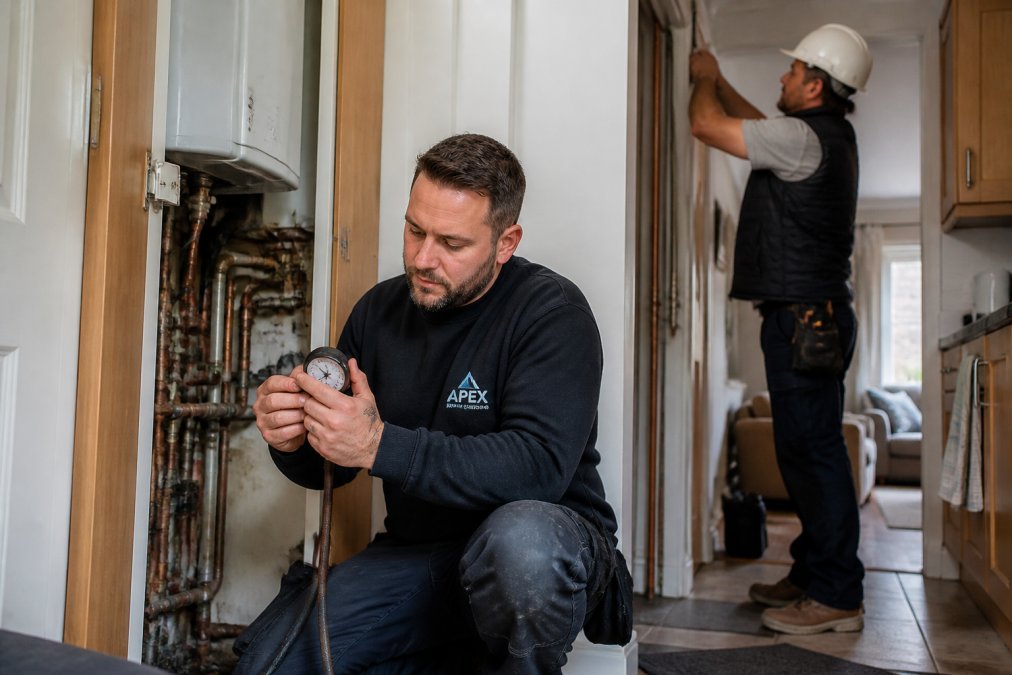
When a pipe bursts at 2am, knowing whether to call an emergency plumber vs general contractor can save you thousands in water damage. This guide from Apex Gas & Heating Ltd breaks down exactly where each trade’s legal limits sit, what a Gas Safe registered plumber is required to hold, and how to document everything for an insurance claim.
The distinction matters more than most homeowners realise. A general contractor can manage a kitchen refit from start to finish, but they cannot legally touch a gas appliance or sign off a boiler installation. Get that boundary wrong and you risk voiding your home insurance, failing a landlord compliance check, or worse, a carbon monoxide incident.
Below, we’ll show you exactly which situations demand a specialist, which can wait for a generalist, and the temporary steps you can take in the meantime.
How to Identify a Plumbing Emergency
A plumbing emergency is any fault that risks immediate water damage, loss of essential services, or a safety hazard such as a gas leak. Anything that can wait until normal working hours without worsening is a routine repair.
Common triggers include a burst pipe, a leaking radiator that won’t stop, a boiler breakdown in cold weather, and blocked drains backing up into the property. If water is actively escaping or you have no running water at all, treat it as urgent.
What Counts as a Plumbing Emergency
Four situations justify an out-of-hours callout: uncontrolled water, no heating or hot water in winter, sewage or foul water entering the home, and any smell of gas. The last one is not a plumbing job at all, it is a gas emergency.
Emergency vs Routine Repairs: Where the Line Sits
A dripping tap, a slow-filling toilet, or a single cold radiator are routine. A leaking radiator valve spraying water across a carpet is not. The test is simple: is damage happening right now, or will it hold until morning?
| Situation | Emergency? | Who to Call |
|---|---|---|
| Burst pipe, water escaping | Yes | Emergency plumber |
| No heating in winter | Yes | Emergency heating engineer |
| Smell of gas | Yes | Gas emergency line, then Gas Safe engineer |
| Dripping tap | No | Plumber, routine hours |
| Single cold radiator | No | Plumber or heating engineer |
| Blocked drain, no backup | No | Drainage specialist |
Emergency Plumber vs General Contractor: Scope, Skills and Legal Limits
The emergency plumber vs general contractor split comes down to one word: scope. An emergency plumber holds the trade qualifications, gas certifications, and insurance to work on water and heating systems directly. A general contractor coordinates multiple trades across a project but rarely performs regulated work themselves.
In the UK, any work on gas appliances must be carried out by a Gas Safe registered engineer. That is a legal requirement, not a preference. A general contractor cannot legally commission a boiler, replace a gas hob, or issue a Gas Safety Certificate, no matter how experienced they are at project management.
Where a general contractor does add value is on larger jobs. If a leak has damaged plaster, flooring, and cabinetry, a contractor can coordinate the plumber, plasterer, joiner, and decorator under one schedule. For a single leaking pipe, that coordination is unnecessary overhead.
Gas Safe Register official guidance on who can legally work on gas appliances
Where Each Trade Wins
Emergency plumber wins when: the fault is active, the work touches gas or water systems, you need a compliance certificate, or the job must be done out of hours.
General contractor wins when: the repair is part of a wider renovation, multiple trades are needed, or you want a single point of contact for a project spanning weeks.
Never let an unregistered tradesperson touch a gas appliance, even for a “quick fix”. It is a criminal offence, it voids most home insurance policies, and it is the leading cause of preventable carbon monoxide incidents in homes.
Gas Safe Registered Plumber Requirements in the UK
A Gas Safe registered plumber is an engineer who has proven their competence on specific gas work types and appears on the official Gas Safe Register. Registration is a legal requirement for anyone working on gas appliances in the UK.
The register lists exactly which gas work each engineer is qualified to carry out, from domestic boilers to commercial catering equipment. Landlords and homeowners can check an engineer’s ID card and verify their registration before any work begins.
For landlords, an annual Gas Safety Certificate, often called a CP12, must be issued by a Gas Safe registered engineer. This is a legal obligation, not a recommendation.
Health and Safety Executive guidance on landlord gas safety duties
Emergency Plumbing Call-Out Response Times Explained
Response times vary widely by provider, time of day, and whether you are inside a dense urban area or a rural postcode. A 24/7 availability promise means the phone is answered at any hour, but it does not guarantee an engineer at your door within a fixed window.
It helps to understand how a firm actually triages a call, because that determines when you will see someone. Most emergency plumbing outfits sort incoming jobs into three rough bands:
- Priority one, active risk. Uncontrolled water, sewage backing up, or a suspected gas escape. These are dispatched first, often with the nearest available engineer diverted from another job.
- Priority two, loss of essential service. No heating or hot water in cold weather, or a total loss of water supply. Usually attended the same day, but behind priority one.
- Priority three, contained faults. A slow leak that has been isolated, or a fault affecting one fixture. Often booked into the next available slot rather than treated as a true emergency.
Ask two questions before booking: what is your average response time tonight, and is there a separate out-of-hours callout fee? A reputable firm will answer both directly. It is also reasonable to ask whether the engineer dispatched holds the relevant gas or heating qualifications for your fault, since a general drainage or water engineer may not be able to touch a boiler.
What Affects How Quickly an Engineer Arrives
Several practical factors move the estimate up or down:
- Distance and traffic. A firm based in Crawley will reach a postcode in Crawley far faster than one covering the whole of Sussex from a single base.
- Time of day. Late evening and early morning calls compete with fewer available engineers, so windows stretch.
- Parts on board. A van carrying common spares can finish the job on the first visit; a firm that has to order a part will return later.
- Access. A clear route to the stopcock, boiler, or meter shortens the visit considerably.
Your Consumer Rights on Response and Quality
When you book a tradesperson, you are entering a contract for services, and the Consumer Rights Act 2015 requires that the work be carried out with reasonable care and skill, within a reasonable time where no deadline was agreed, and at a reasonable price where none was fixed in advance. If a firm promises a specific response window and fails to meet it, that promise forms part of the contract.
If a dispute arises, the first step is usually the firm’s own complaints procedure. If that fails, you can escalate to a recognised alternative dispute resolution scheme or to Citizens Advice for guidance on next steps. Keeping a written record of what was promised on the phone, the time, the fee basis, and the qualifications of the engineer, makes any later complaint far easier to pursue.
When you call, have your postcode, boiler make and model, and a photo of the fault ready. Engineers triage faster with that information, and you will get a more accurate arrival estimate.
Waiting Safely Before the Engineer Arrives
Use the time productively. Isolate the water at the stopcock if water is escaping, switch off the boiler at the isolator if you smell gas, and open windows. Do not attempt to dismantle pipework or gas fittings yourself. If the fault is a gas escape, call the National Gas Emergency Service on 0800 111 999 first, that line operates around the clock and is separate from any plumbing firm.
Costs, Callout Fees and Landlord Responsibilities
Pricing for emergency plumbing typically splits into a callout fee plus an hourly rate, with out-of-hours work costing more than standard hours. Some firms quote a fixed price for common jobs, others bill strictly by time on site. Understanding the structure matters more than any single figure, because two firms quoting the same headline rate can end up costing very different amounts.
How the Bill Is Usually Built
Most emergency plumbing invoices combine several elements:
- Callout or attendance fee. A fixed charge for sending an engineer, sometimes absorbed into the labour if the job proceeds.
- Labour rate. Charged per hour or part-hour, often with a minimum charge of the first hour.
- Out-of-hours uplift. Evenings, weekends, and public holidays usually carry a higher rate than weekday daytime.
- Parts and materials. Boiler components, valves, and fittings are billed on top, sometimes with a small markup.
- VAT. Most domestic plumbing work is standard-rated, so the figure you are quoted may or may not include it.
Always ask whether the callout fee is absorbed into the labour charge or added on top, and whether the quoted rate includes VAT. Those two questions change the final bill significantly. Ask also whether the firm charges for a diagnostic visit separately from the repair, since some do.
Landlord Obligations vs Tenant Rights
Landlords are legally responsible for gas safety checks, boiler maintenance, and repairs to the property’s heating and water systems. Under the Landlord and Tenant Act 1985, a landlord must keep installations for space heating, water heating, and sanitation in proper working order. Tenants must report faults promptly and allow access for repairs.
For gas safety specifically, the landlord must arrange an annual Gas Safety Certificate, often called a CP12, issued by a Gas Safe registered engineer, and provide a copy to the tenant before they move in and within 28 days of each subsequent check. New tenants must receive the certificate before occupation.
If a landlord fails to fix a serious fault, a tenant can escalate to the local council’s environmental health team. Councils have powers to serve improvement notices and, in serious cases, to carry out works and recover the cost. For hazards such as damp, excess cold, or a risk of carbon monoxide, the Housing Health and Safety Rating System gives the council a formal route to act.
What to Do If a Landlord Delays
A common pattern is a tenant reporting a fault, the landlord acknowledging it, and then nothing happening for weeks. Practical steps that tend to move things along:
- Put the report in writing, with dates and photographs, so there is a clear record.
- Give the landlord a reasonable deadline to arrange a repair.
- If nothing happens, contact the council’s environmental health team and provide your written record.
- For gas safety breaches, the Health and Safety Executive can be involved where the landlord has failed in their duties.
For current rates, check Apex Gas & Heating Ltd’s pricing page rather than relying on a phone estimate.
GOV.UK guidance on landlord responsibilities and tenant rights
Health and Safety Executive guidance on landlord gas safety duties
DIY Mitigation, Insurance Documentation and What to Do While You Wait
While you wait for an engineer, you can limit damage without touching anything regulated. Locate your water shut-off valve and close it if water is escaping. Turn off the boiler at the isolator if you smell gas, then open windows and leave the property.
Document everything for insurance: photograph the fault, the affected area, and any damaged belongings before you clean up. Insurers want timestamped evidence, not a tidy scene.
What most guides miss is that temporary mitigation strengthens your claim. Showing you acted reasonably to limit damage is exactly what loss adjusters look for.
Photograph the fault, the water damage, and your meter reading before the engineer arrives. Insurers routinely reject claims where pre-repair evidence is missing.
Conclusion
The gap between an emergency plumber and a general contractor is not about who is better, it is about who is legally allowed to do the work. For any active fault, gas appliance, or compliance certificate, you need a specialist, full stop.
Apex Gas & Heating Ltd provides 24/7 emergency call-out across Sussex and Surrey, with approved Glowworm and Worcester Installers, full public liability insurance, and transparent pricing. Whether you are a homeowner in Crawley facing a winter boiler breakdown or a landlord in Redhill needing a Gas Safety Certificate at short notice, the team responds fast and documents everything for your records. Get a quote and have a qualified engineer on the way.
Frequently Asked Questions
How much should an emergency plumber charge?
Pricing depends on the time of day, the complexity of the fault and whether parts are needed. Apex Gas & Heating Ltd publishes its rates on its pricing page, so you can see the callout and hourly structure before booking. Always ask for a fixed quote or clear hourly rate upfront, confirm whether VAT is included, and check that the engineer carries full public liability insurance. Reputable firms will put the terms in writing before starting work, which protects you from surprise charges.
Do I need a Gas Safe registered engineer for my plumbing repair?
If the repair touches anything gas-related, including a boiler breakdown, gas leak or water heater failure, then yes. Gas Safe registered plumber requirements mean only an engineer on the Gas Safe Register may legally work on gas appliances in the UK. General plumbing work such as a leaking radiator or blocked drain does not require Gas Safe registration, but choosing a firm with that accreditation, like Apex Gas & Heating Ltd, gives you one team for both.
When should I hire a general contractor instead of an emergency plumber?
Hire a general contractor when the job is planned building work rather than an active fault: a bathroom refurbishment, moving pipework for an extension, or replacing fixtures across several rooms. For anything urgent, such as flooding, no running water or a burst pipe, an emergency plumber is the correct call because they carry the specialist tools and 24/7 availability. A general contractor will usually subcontract the plumbing anyway, which adds delay and cost.
How can I verify the credentials of a local plumbing professional?
Check the Gas Safe Register online for gas work, look for TrustMark or Checkatrade membership, and ask for the public liability insurance certificate. A vetting guide worth following: confirm the business address, read recent reviews, and ask to see the engineer’s ID card on arrival. Red flags include cash-only payment, no written quote, and pressure to approve extra work on the spot. Apex Gas & Heating Ltd is a Worcester and Glowworm approved installer, which you can verify directly with those manufacturers.
Are emergency call-out fees standard for plumbing services?
Most firms charge a callout fee that covers travel and the first portion of time, with out-of-hours callout rates higher than weekday rates. Fees vary by firm, region and time of day, so compare the published terms rather than assuming a market average. Ask whether the callout fee is deducted from the repair cost, whether parts are extra, and what happens if the engineer cannot fix the issue on the first visit. Get the answer in writing before you agree to the job.