








Table of Contents
- Why Upgrade Your Boiler Controls
- Check Heating Controls Compatibility With Your Boiler
- Smart Heating Controls for Existing Boiler Systems
- Heating Controls Without Rewiring: What’s Possible
- Boiler Controls Installation: Step-by-Step Process
- Common Mistakes to Avoid When Upgrading Controls
- When to Call a Gas Safe Registered Engineer
- Frequently Asked Questions
Last Updated: October 17, 2026
Why Upgrade Your Boiler Controls
When you upgrade boiler controls without replacing the unit itself, you make one of the smartest investments a homeowner can make. Your heating system works harder than almost any appliance in your home, yet many people live with outdated controls that waste energy and offer no convenience.
At Apex Gas & Heating Ltd, we’ve seen firsthand how the right control upgrade transforms a heating system. Older boilers often have basic on/off switches or mechanical thermostats that can’t adapt to changing weather or your daily routine.
The good news: you don’t need a new boiler to fix this. Modern heating controls work with most existing systems, and many can be installed without disturbing your pipework or walls.
Upgrading boiler controls is faster and cheaper than replacing the boiler itself, and delivers measurable improvements in comfort and efficiency.
Check Heating Controls Compatibility With Your Boiler
Before you buy new controls, you need to understand what your current boiler can support. Not all heating controls work with every boiler model, and compatibility depends on several factors. Spending 20 minutes on this step now saves you from buying incompatible equipment later.
Identify Your Current Boiler Model
Start by finding your boiler’s make and model number. This information is usually on a label attached to the boiler itself, typically on the front or side panel. Look for a sticker or metal plate that shows the manufacturer (Worcester Bosch, Baxi, Glow-worm, Vaillant, or another brand) and a model code.
Write down the exact model number. You’ll need this when checking compatibility with new controls. If you can’t find the label, check your boiler’s instruction manual or any paperwork from your last service. If you’re still stuck, a Gas Safe registered engineer can identify it for you in seconds.
Take a photo of your boiler’s model label with your phone. You can then easily reference it when researching controls or speaking to an engineer.
Review Control System Type and Age
Your boiler will have one of three main control types: a simple on/off switch, a mechanical thermostat, or an electronic control unit. Older boilers often use mechanical thermostats that respond to temperature but can’t be programmed.
Check when your boiler was installed. Boilers from the 1990s and early 2000s may have limited compatibility with modern wireless controls. Boilers from roughly 2010 onwards typically accept most modern heating controls without problems.
If your boiler is very old and you’re unsure about compatibility, get advice from a Gas Safe registered engineer before investing in new controls. If your boiler is nearing the end of its life, boiler repair or new boiler installation may be a more practical option than upgrading controls.
Smart Heating Controls for Existing Boiler Systems
Modern controls fall into two main categories: wireless options that don’t require new wiring, and programmable systems that offer more complex scheduling. Your choice depends on your boiler’s age, your home’s layout, and what features matter most to you.
Wireless Thermostat Options
Wireless thermostats are the easiest upgrade path for most homes. They communicate with your boiler using radio signals, which means no new wiring is needed. You install a receiver unit near the boiler and a wireless thermostat in your living area, usually the hallway or main room where you spend time.
The receiver picks up the thermostat’s signal and tells the boiler when to heat or stop heating. Because there’s no physical connection, you can move the thermostat to a different room if needed.
Wireless options range from basic models with simple on/off control to advanced smart thermostats that learn your routine and adjust automatically. Installation typically takes a few hours and doesn’t require disturbing your walls or pipework.
Homeowners who want a quick, non-invasive upgrade without rewiring. Wireless controls are ideal if your boiler is relatively modern and your home layout makes running new cables difficult.
Programmable and Weather-Responsive Controls
Programmable controls let you set different temperatures for different times of day and days of the week. You might programme your heating to come on an hour before you wake up, drop during the day when you’re out, and rise again before you return home.
Weather-responsive controls go further. They monitor outdoor temperature and adjust your heating output automatically. On mild days, the system uses less fuel. On cold days, it works harder. This matching of heating to actual conditions saves energy compared to fixed schedules.
Some systems combine both features: programmable schedules plus automatic weather adjustment. These are particularly effective in British winters, where temperature swings can be dramatic from one day to the next.
Heating Controls Without Rewiring: What’s Possible
One of the biggest concerns homeowners have is whether upgrading controls means tearing up walls or running new cables through the house. The answer is usually no, but it depends on your current setup.
Wireless Installation Benefits
Wireless controls eliminate the need for new wiring between the thermostat and boiler. This is a huge advantage if your thermostat is in a different room from your boiler, or if running cables would mean disrupting plasterwork or floorboards.
The wireless receiver unit sits near the boiler and connects to it using existing connections. The thermostat communicates wirelessly from anywhere in your home. Installation is typically a few hours of work, and your home remains undisturbed.
Most wireless systems are also easy to remove and reinstall if you move house. You take the thermostat and receiver with you, leaving no permanent changes to the property.
When Rewiring May Still Be Required
Some older boilers have control systems that don’t accept wireless signals. In these cases, a new wired connection between the thermostat and boiler may be necessary. This is less common than it used to be, but it does happen with certain vintage systems.
If rewiring is needed, a Gas Safe registered engineer can advise you on the best route. Sometimes cables can run along skirting boards or inside existing conduits, minimising disruption. Other times, surface-mounted trunking is the tidiest solution.
Rewiring typically adds a day to the installation process and may involve some temporary disturbance, but it’s still far less invasive than replacing the boiler itself.
Never attempt to rewire boiler controls yourself. This work must be done by a Gas Safe registered engineer. Incorrect wiring can damage your boiler or create safety hazards.
Boiler Controls Installation: Step-by-Step Process
Once you’ve chosen your new controls and confirmed compatibility, installation follows a logical sequence. Understanding the process helps you know what to expect and when your heating will be back to normal.
Preparation and Safety Checks
Before any work begins, the engineer isolates the boiler from the electricity supply. This is essential for safety and prevents accidental damage to the new controls during installation.
Next, the engineer documents your current system, how it’s wired, what connections exist, and how the boiler responds to signals. This baseline information is crucial for testing the new system later.
The engineer also checks that all components are compatible and present. New controls usually come with a receiver unit, thermostat, batteries, and mounting hardware. Everything is verified before work starts.
Removing Old Controls and Disconnecting Wiring
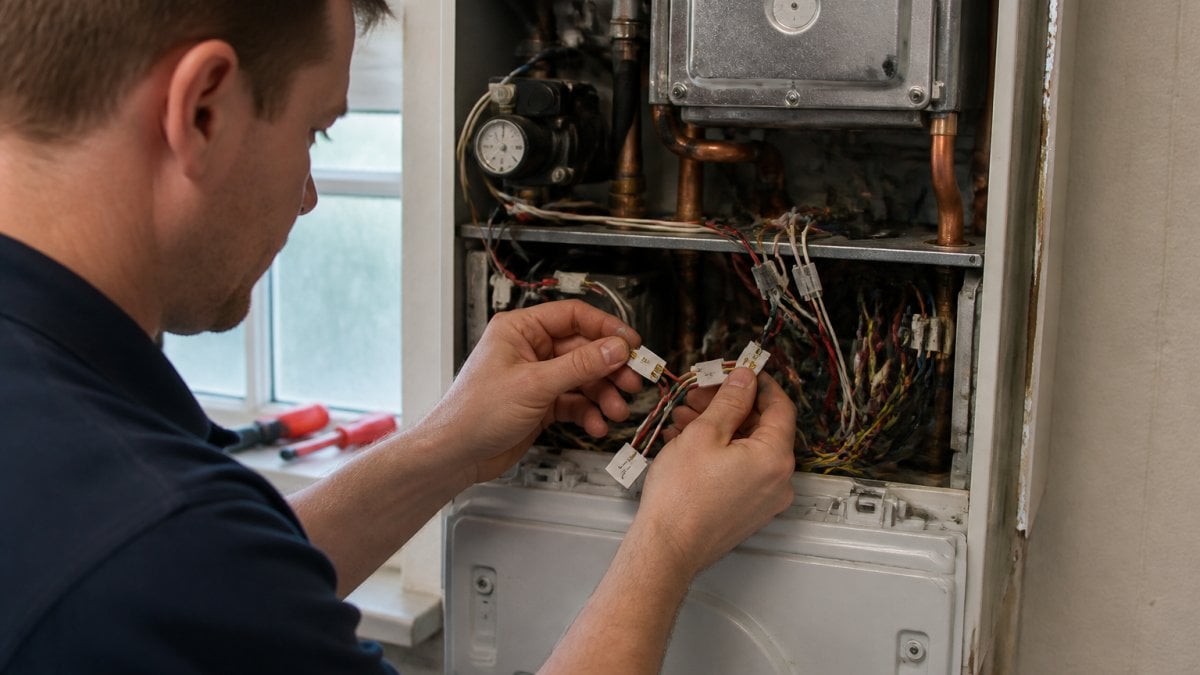
The old thermostat is carefully removed and set aside. If it’s wired to the boiler, the engineer photographs each wire connection before disconnecting them. This record prevents mistakes when reconnecting.
The old receiver or control unit is then disconnected from the boiler. Again, each connection is noted. Some boilers have multiple wiring terminals, and getting these right is critical.
Once everything is disconnected and documented, the old components are safely removed. The engineer checks that the boiler is now isolated and safe to work on.
Installing New Controls and Testing
The new receiver unit is mounted near the boiler, following the manufacturer’s instructions. Wiring connections are made carefully, using the documentation from the old system as a guide. If the new system is wireless, only a power connection is needed.
The new thermostat is mounted in your chosen location, usually the hallway or main living room. For wireless systems, this involves inserting batteries and checking that the signal reaches the receiver.
Once installation is complete, the engineer powers up the system and runs through a full test. The thermostat sends a signal to the receiver, the receiver signals the boiler, and the boiler responds by firing up.
The engineer then explains how to use the new controls, sets up your preferred schedule, and ensures you’re comfortable with all the features.
Common Mistakes to Avoid When Upgrading Controls
Homeowners often make preventable errors when upgrading boiler controls. Being aware of these pitfalls helps you avoid costly problems.
The biggest mistake when you upgrade boiler controls is assuming all wireless options work with all boilers. They don’t. Always check compatibility before purchasing.
Another common error is installing controls without understanding your current system first. You might buy a smart thermostat only to discover your boiler doesn’t accept wireless signals.
Some people try to install controls themselves to save money. This rarely ends well. Always use a Gas Safe registered engineer.
Underestimating the value of a good thermostat location is another pitfall.
Finally, many people buy expensive smart controls but never set them up properly. You get the best results when you actually program schedules that match your routine.
When to Call a Gas Safe Registered Engineer
Some heating control upgrades are straightforward enough that a handy homeowner might attempt them. Most aren’t. Knowing when to call an engineer saves you time and prevents costly mistakes.
If your upgrade involves any electrical work, wiring changes, or connections to the boiler itself, you need an engineer. Gas Safe registered engineers have the training to work safely with boiler systems and understand the regulations that apply.
Even if your new controls are wireless and seem simple, an engineer can ensure proper installation, test the system thoroughly, and provide documentation for your records.
At Apex Gas & Heating Ltd, our Gas Safe registered engineers handle boiler control upgrades as part of our heating service. If you’d like to ensure your boiler is in good working order before upgrading controls, we offer boiler servicing to keep your system running efficiently.
If you’re unsure whether your upgrade needs professional help, the safest approach is to ask. A quick consultation costs nothing and gives you confidence in your decision.
Upgrading your boiler controls is a practical way to improve comfort and reduce energy waste without the cost of a full boiler replacement.
Frequently Asked Questions
Can I upgrade my boiler controls without replacing the boiler?
Yes, in most cases you can upgrade boiler controls independently. Modern heating controls are designed to work with existing boiler units across a range of ages and types. The key is confirming compatibility with your specific boiler model before purchase. Wireless thermostats and programrs often require no rewiring, making them straightforward upgrades. However, some older boiler systems may have limited compatibility options, so checking your boiler’s specifications first is essential to avoid purchasing incompatible equipment.
Do I need a heating engineer to install smart heating controls for my existing boiler?
Many wireless smart heating controls can be installed by homeowners without specialist help, particularly battery-operated thermostats. However, if your upgrade involves disconnecting existing wiring, altering gas or electrical connections, or you’re unsure about compatibility, a Gas Safe registered engineer should handle the work. This ensures the installation is safe, compliant with building regulations, and won’t affect your boiler’s warranty. For complex systems or older boilers, professional installation is always recommended.
Will new heating controls work with my existing programr?
Not always. Compatibility depends on whether your new controls use the same wiring protocol and voltage as your existing programmer. Some modern controls are designed to replace programmers entirely, while others work alongside them. Before upgrading, check your current programmer’s specifications and the new control’s technical requirements. If they’re incompatible, you’ll typically need to replace the programmer as well. A Gas Safe registered engineer can advise on what works with your specific system.
Can I upgrade heating controls without rewiring my boiler system?
Many modern upgrades avoid rewiring altogether. Wireless thermostats and battery-powered controls connect to your boiler without running new cables, making installation quicker and less disruptive. However, if you’re upgrading from an old wired system to one with different voltage or connection requirements, some rewiring may be unavoidable. Assessing your current setup and choosing compatible wireless options where possible will minimise disruption and cost.