







Table of Contents
- Who Can Legally Install a Gas Boiler
- The Gas Safety Requirements That Apply to Every Installation
- Ventilation and Flue Rules You Cannot Skip
- The New Boiler Commissioning Checklist
- Gas Safety Certificate for a New Boiler: What You Should Receive
- Boiler Building Regulations Compliance Certificate and Registration
- Carbon Monoxide Alarms and What to Check Before First Use
- Frequently Asked Questions
Last Updated: October 18, 2026
Who Can Legally Install a Gas Boiler
Gas safety requirements for boiler installations begin with a simple legal fact: only a Gas Safe registered engineer may work on a gas appliance in a home. This guide from Apex Gas & Heating Ltd sets out what the law demands, what paperwork you should receive, and what to check before anyone touches your boiler.
The rules come from the Gas Safety (Installation and Use) Regulations 1998, enforced by the Health and Safety Executive. Working on a gas appliance without registration is a criminal offence, and it is the homeowner who carries the risk. An unregistered installer voids your boiler warranty, may invalidate your home insurance, and leaves you liable for any harm caused.
Checking registration takes two minutes. Ask for the engineer’s Gas Safe ID card, then verify the registration number and the specific work categories on the Gas Safe Register. A card showing “boilers” is what you need; not every registered engineer covers every appliance type.
Never accept “we’re registered” as an answer. Ask to see the card and check the back, where the engineer’s competent work types are listed. An engineer registered only for cookers cannot legally install a boiler.
The Gas Safety Requirements That Apply to Every Installation
Every installation must satisfy four core gas safety requirements: correct sizing and combustion performance, safe flue termination, adequate ventilation, and documented commissioning. These are not optional extras. They are the minimum standard an installer signs off against.
The Gas Safety (Installation and Use) Regulations 1998 require that any person working on a gas fitting is competent, that appliances are installed in accordance with the manufacturer’s instructions, and that no appliance is left in an unsafe condition. In practice, this means your installer must check gas pressure and flow rates, verify combustion readings with a flue gas analyser, confirm the boiler is suitable for the property’s gas supply, and record everything.
Manufacturer instructions carry legal weight here. Fitting a boiler in a way that departs from them breaches the regulations even if the boiler runs. That is why approved installer status matters: Worcester Bosch, Baxi, Glow-worm and Vaillant all require registration and training before an engineer can sign off their appliances.
A common mistake is assuming a like-for-like swap avoids scrutiny. It does not. A replacement boiler still needs full commissioning, and the flue and ventilation must be reassessed because modern condensing boilers have different requirements from the models they replace.
Ventilation and Flue Rules You Cannot Skip
Flue and ventilation failures cause the incidents that gas safety rules exist to prevent. A flue that terminates too close to a window, an opening, or a neighbouring property can let combustion products re-enter the home. The manufacturer’s instructions specify minimum distances, and your installer must measure them rather than estimate.
Room-sealed condensing boilers draw air from outside and generally need no purpose-built ventilation in the room. Open-flued appliances do, and the required free air space depends on the appliance’s rating. Where a boiler is installed in a cupboard or compartment, that space needs specific high and low ventilation openings. Getting this wrong is one of the most frequent defects found at inspection.
Flue routes need thought too. A plume from a condensing boiler discharging across a walkway or into a neighbouring window is a nuisance and a compliance problem. Plume management kits exist for exactly this reason, and a good installer will raise it at survey stage rather than after the flue is cut.
Ask your installer to photograph the flue terminal position and the ventilation openings before the job is signed off. If a dispute arises later, or a future buyer’s surveyor queries it, you have evidence the installation met the required distances on the day.
The New Boiler Commissioning Checklist
Commissioning is the point where gas safety requirements move from design to proof. A properly commissioned boiler has been tested, adjusted, and documented, and you should receive the completed benchmark commissioning checklist as part of the handover.
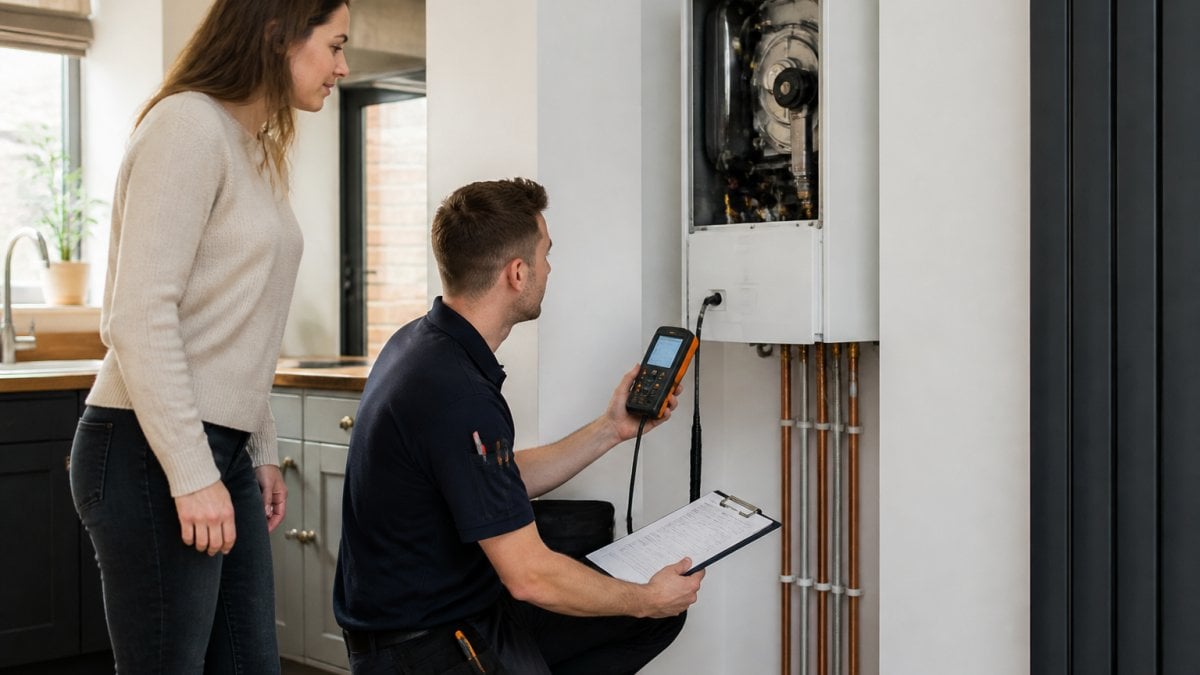
Here is what a complete new boiler commissioning checklist should cover:
- Gas supply pressure and flow rate tested and recorded
- Combustion readings taken with a calibrated flue gas analyser
- Flue integrity and terminal distances confirmed
- Ventilation openings checked and measured where required
- System flushed and inhibitor added
- Controls, thermostat and programmer set up and demonstrated
- Benchmark checklist completed and signed
- Building Regulations compliance notification submitted
- All manuals, certificates and labels handed over
The benchmark checklist is not paperwork for its own sake. Boiler manufacturers use it to validate warranty claims, and an incomplete checklist is grounds for refusing a claim. Keep it with your boiler documents.
We see the same problem repeatedly: homeowners handed a boiler with no commissioning record at all. If that happens, ask for it in writing. Any engineer who cannot produce one has not followed the process.
Gas Safety Certificate for a New Boiler: What You Should Receive
A new boiler installation does not produce a landlord gas safety certificate. It produces a commissioning record and a Building Regulations compliance certificate. The distinction matters because homeowners often expect the wrong document and assume something is missing.
A gas safety certificate for a new boiler is not a standard document. The CP12 record is a landlord obligation, renewed annually for tenanted properties. What you receive after an installation is the benchmark commissioning checklist, the Building Regulations compliance certificate, and the manufacturer’s warranty registration. Landlords should still obtain a CP12 before letting the property, but that is a separate inspection.
If you are a landlord with several properties, keeping these documents organised per address saves considerable trouble at renewal time. Our landlord and letting agent service exists because that record-keeping is where compliance usually slips.
Boiler Building Regulations Compliance Certificate and Registration
The boiler Building Regulations compliance certificate is the document proving your installation was notified to the local authority. Your installer must be registered with a competent person scheme to self-certify the work, and the certificate should arrive shortly after completion.
This certificate confirms the installation meets Part L of the Building Regulations for energy efficiency and Part J for combustion appliances and fuel storage. Without it, selling the property can stall, because solicitors routinely ask for it during conveyancing. If it never arrives, chase the installer; if they have disappeared, a retrospective application to the local authority is possible but slower and usually costs more.
Registration also covers the manufacturer’s warranty. Your installer registers the appliance with the manufacturer, and you should receive confirmation directly. Check that the registration matches your boiler’s serial number and the installation date.
Carbon Monoxide Alarms and What to Check Before First Use
A carbon monoxide alarm is a legal requirement in rooms containing a fixed combustion appliance, under the Smoke and Carbon Monoxide Alarm (England) Regulations 2015 for rented homes, and it is basic good practice in every home. Fit one before the boiler is first fired up, not after.
The alarm must meet British Standard EN 50291. Check the packaging for that marking. An alarm without it has not been tested to the standard that matters. Place it in the same room as the boiler, at head height or above, and away from vents and cookers that could trigger false alarms.
Test every alarm on the day of installation using its test button, and note the replacement date on the unit. Most have a sensor life of around seven to ten years, after which the whole unit is replaced rather than the battery.
If an alarm sounds, do not switch anything on or off. Open windows and doors, get everyone outside, and call the National Gas Emergency Service on 0800 111 999. Do not re-enter until you are told it is safe.
The documents that prove your installation is compliant are the benchmark commissioning checklist, the Building Regulations compliance certificate, and the manufacturer warranty confirmation. If you have all three, the gas safety requirements for your installation have been met and recorded.
Boiler installations involve legal duties that most homeowners never see, and the paperwork is the only evidence they were met. If you are planning a replacement, our new boiler installation service includes full commissioning, Building Regulations notification and warranty registration as standard, carried out by Gas Safe registered engineers who are approved installers for Worcester Bosch, Baxi, Glow-worm and Vaillant. Every job comes with a 2-year workmanship guarantee and full public liability insurance. Get a quote from Apex Gas & Heating Ltd and know exactly what has been done, and what you have to show for it.
Frequently Asked Questions
Who can legally install a gas boiler?
Only a Gas Safe registered engineer can legally install a gas boiler. Registration covers specific work categories, so check the engineer’s ID card to confirm they are registered for boiler installation and not just servicing. Unregistered work is illegal and dangerous, and it can invalidate your home insurance. A Gas Safe registered boiler installer will also notify the local authority and issue the correct certificates after the job.
Does a new boiler installation need a gas safety certificate?
A new installation is not a landlord gas safety check, but you should still receive a gas safety certificate for a new boiler in the form of a commissioning record and Building Regulations compliance certificate. Landlords need a separate CP12 gas safety certificate covering all appliances, renewed every 12 months. Keep both sets of paperwork safe for future sales, lettings or warranty claims.
What safety checks should be carried out when a gas boiler is installed?
The engineer should check gas tightness on all connections, confirm the boiler is correctly rated for the gas supply, test the flue for spillage and correct termination, verify ventilation is adequate, and measure combustion readings with a flue gas analyser. The new boiler commissioning checklist should record these results. Ask to see the completed checklist before the engineer leaves.
What documents should I receive after a boiler installation?
You should receive the manufacturer’s instructions and warranty registration, a completed new boiler commissioning checklist, a Building Regulations compliance certificate, and a gas safety certificate for a new boiler where applicable. The engineer should also record the installation on the Gas Safe register. Keep these documents together, as solicitors and letting agents often ask for them.
Does a new gas boiler need to be registered?
Yes. The installer must notify the local authority building control body, usually through a competent person scheme, and you should receive a boiler Building Regulations compliance certificate within a few weeks. The installation is also recorded on the Gas Safe register. Without this, you may struggle to prove the work was done legally when you sell or let the property.
Can a homeowner install their own gas boiler?
No. Gas work in a home must be carried out by a Gas Safe registered engineer. DIY gas work is illegal, voids most home insurance policies and risks carbon monoxide poisoning. Even hanging the boiler or running pipework yourself is not worth the risk. Book a Gas Safe registered boiler installer and keep the paperwork they provide.
What should I check before using a newly installed boiler?
Before first use, confirm the engineer has completed the new boiler commissioning checklist and left the benchmark record. Check that a carbon monoxide alarm is fitted and working, that the flue outside is clear, and that the pressure reading is within the range in the manual. Run the heating and hot water briefly, then note any unusual noises or smells and call the installer if anything seems wrong.