







Last Updated: October 29, 2026
Quick Summary
To balance radiators, bleed them first, then work cold with a thermometer: fully open every lockshield valve, run the heating, and set the radiator closest to the boiler to a quarter-turn open, opening each further radiator slightly more. Aim for a temperature drop of around 10 to 12 degrees Celsius between flow and return on every radiator.
- Bleeding releases trapped air and must be done before you balance radiators.
- You cannot balance radiators by feel; measure flow and return pipe temperatures.
- Restrict the radiator nearest the boiler most and open distant valves more.
- Work in quarter-turns, record each change, and let the system settle for ten minutes.
- A cold radiator top points to air, while a cold bottom suggests sludge or a stuck valve.
Table of Contents
- Why Some Radiators Heat Faster Than Others
- What You’ll Need Before You Balance Radiators
- Bleeding Radiators vs Balancing: Which Job Comes First
- Step-by-Step: How to Balance Radiators for Even Heating
- Radiator Lockshield Valve Adjustment: Getting the Quarter-Turn Right
- Troubleshooting Cold Spots in Radiators
- Common Mistakes When You Balance Radiators
- Radiator Balancing Terms Explained
- Frequently Asked Questions
Why Some Radiators Heat Faster Than Others
If your front room is toasty while the back bedroom stays lukewarm, the boiler is rarely the culprit. Water takes the path of least resistance, so radiators closest to the boiler get the hottest flow first. The result is a system that heats unevenly, wastes energy, and leaves someone in the house reaching for a jumper. Our troubleshooting guide to common central heating problems helps you rule out a wider system fault.
The fix is usually not a new boiler. It is knowing how to balance radiators for even heating, which means adjusting the flow through each one so every room warms up at roughly the same rate.
Below, we’ll show you exactly how to do that yourself, when to stop, and when to call a Gas Safe registered engineer.
What You’ll Need Before You Balance Radiators
Balancing a central heating system is a job that needs the right kit and a little patience.
Gather these before you start:
- A radiator key for bleeding
- An adjustable spanner or a lockshield valve key
- A digital thermometer or clip-on pipe thermometer
- A cloth and a small container for drips
- A notepad or phone for recording valve turns
- A helper to read temperatures at the far radiators
The digital thermometer matters most. You cannot balance radiators by feel. You need to measure the temperature difference between the flow and return pipes on each radiator.
Bleeding Radiators vs Balancing: Which Job Comes First
Bleeding radiators vs balancing is the question we get asked most, and the answer is simple: bleed first, balance second.
Bleeding releases trapped air so hot water can fill the radiator fully. Balancing adjusts how much water flows through each radiator so heat is shared evenly. Bleeding fixes cold tops. Balancing fixes cold radiators in distant rooms.
If you skip the bleed, you will spend an hour balancing a system that still has air pockets. Follow our guide on the best way to bleed radiators efficiently to clear the air properly first. Do the air first, then the flow.
Step-by-Step: How to Balance Radiators for Even Heating
Here is the process we use on site. Set aside an hour or two for an average home.
| Step | What You Do | Time |
|---|---|---|
| 1 | Cool the system and note valve positions | 10 min |
| 2 | Open every valve and run the heating | 15 min |
| 3 | Set the closest radiator and work outwards | 30-45 min |
| 4 | Measure the temperature drop and repeat | 20-30 min |
Step 1: Let the System Cool and Note the Current Valve Positions
Turn the heating off and let everything cool completely. Hot water can scald, and cold pipes are easier to work on.
Before you touch anything, count how many quarter-turns each lockshield valve is open. Write it down. This gives you a baseline to return to if the result is worse, not better.
Step 2: Open Every Valve and Run the Heating
Open all lockshield valves fully, turn every thermostatic valve to maximum, and run the heating until all radiators are hot.
You should now see the problem clearly. The nearest radiators will be hot and the far ones will be cooler. That imbalance is what you are about to correct.
Step 3: Set the Closest Radiator and Work Outwards
Start with the radiator closest to the boiler. This is the one that heats fastest, so it needs the most restriction.
Close its lockshield valve fully, then open it a quarter-turn. Move to the next radiator and open it slightly more, and so on. The further from the boiler, the more open the valve should be. This is the core of radiator lockshield valve adjustment: restrict the near, free up the far.
Step 4: Measure the Temperature Drop and Repeat
Once set, run the system again and measure the pipe temperature on each radiator. You are aiming for a similar drop across the board, typically around 10 to 12 degrees Celsius between flow and return.
Adjust any radiator that is out of line and re-measure. Repeat until the spread is even.
Radiator Lockshield Valve Adjustment: Getting the Quarter-Turn Right
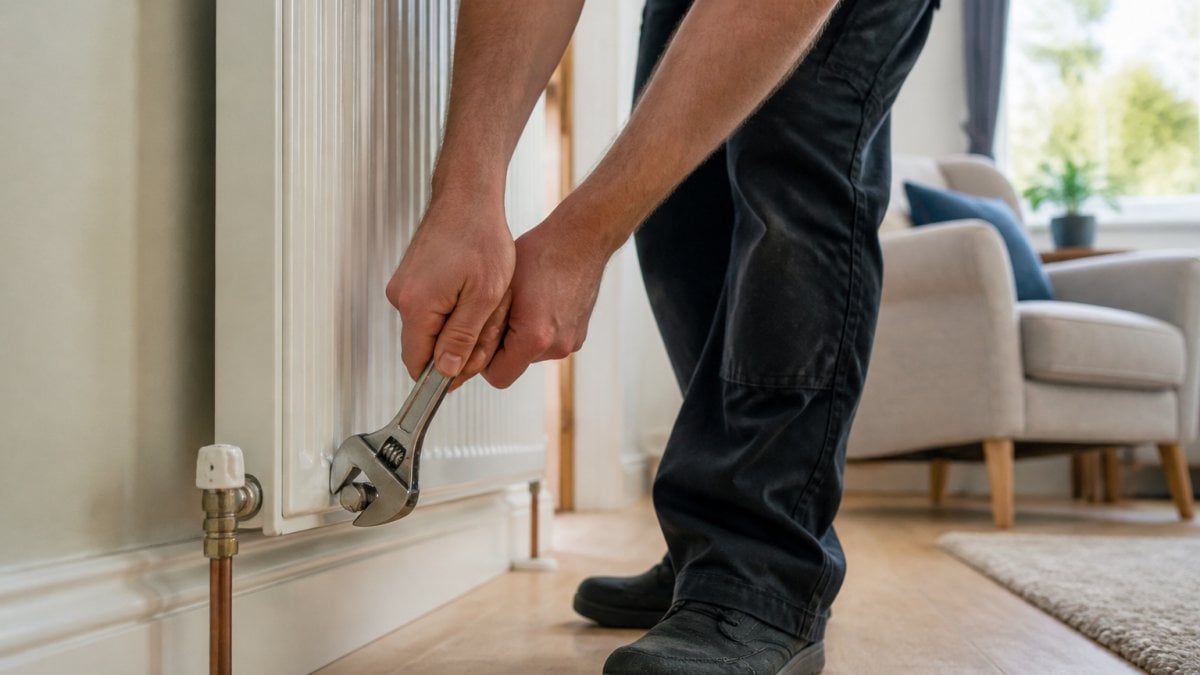
Small movements make a big difference. A quarter-turn on a lockshield valve can change the flow enough to shift heat from one end of the house to the other.
The mistake we see most often is over-opening. Homeowners open every valve fully, hoping for more heat, and end up with the same imbalance. The near radiators still win the race.
Work in quarter-turns, note each change, and give the system ten minutes to settle before you judge the result.
Troubleshooting Cold Spots in Radiators
Troubleshooting cold spots in radiators starts with location. A cold top points to trapped air. A cold bottom points to sludge or a stuck valve. A radiator that is cold all over usually has a closed valve or a blockage.
If balancing alone does not clear the problem, sediment is the likely cause. Find out whether power flushing can fix cold spots on radiators before you book anything.
Common Mistakes When You Balance Radiators
The biggest mistake is adjusting valves on a hot system. Water expands, readings shift, and you end up chasing numbers that keep moving. Always work cold.
Other errors we see:
- Balancing before bleeding, which wastes the whole job
- Opening every valve fully and calling it balanced
- Skipping the thermometer and guessing by touch
- Turning the lockshield too hard and damaging the valve seat
- Forgetting to record the original positions
If you have tried balancing and the system still will not behave, or a valve has been forced and now leaks, stop. A Gas Safe registered engineer can check the wider system safely. You can book a boiler repair service if balancing has not worked or a valve has been damaged.
Radiator Balancing Terms Explained
A short glossary so the steps above make sense:
- Lockshield valve: The valve at the bottom of a radiator, usually under a plastic cap, that sets how much water flows through.
- Flow pipe: The pipe carrying hot water from the boiler to the radiator. It is the hotter of the two.
- Return pipe: The pipe carrying cooler water back to the boiler.
- Temperature drop: The difference between flow and return temperatures on a radiator.
- Balancing: Adjusting lockshield valves so every radiator gets a fair share of hot water.
- Bleeding: Releasing trapped air from a radiator through the bleed valve at the top.
Balancing a central heating system is a job most confident homeowners can manage with a spanner and a thermometer. But if the system is old, the valves are seized, or the same radiators keep going cold, the cause is usually deeper than flow settings. At Apex Gas & Heating Ltd, our Gas Safe registered engineers work on homes across Sussex and Surrey, with fixed-price quotes, a 2-year workmanship guarantee, and a 24/7 emergency call-out service. We are approved installers for Worcester Bosch, Baxi, Glow-worm and Vaillant, so whether you need a heating repair or a full system check, we can help. Get started with Apex Gas & Heating Ltd and get your home heating evenly again.
Frequently Asked Questions
How do I know if my radiators need balancing?
The clearest sign is uneven heat: radiators near the boiler get hot quickly while upstairs or far-end radiators stay lukewarm. You may also notice some rooms never reach the thermostat setting while others overheat. If you’ve bled the radiators and the problem persists, the system is likely unbalanced rather than full of air. A quick check is to feel each radiator at the top and bottom while the heating runs; a large difference between the two ends of the system points to a balancing issue.
What is the difference between bleeding and balancing a radiator?
Bleeding releases trapped air through the bleed valve at the top of a radiator, which fixes cold patches at the top. Balancing adjusts the lockshield valve at the bottom to control how much hot water flows into each radiator, so heat is shared evenly across the whole system. Bleeding is a five-minute job you can repeat whenever radiators gurgle. Balancing takes longer and only needs doing after installation, a radiator change, or when you notice uneven heating. Always bleed first, then balance.
Does balancing radiators save money on heating bills?
It can help. An unbalanced system often means the boiler runs longer to warm the coldest rooms while others overheat, which wastes energy. Balancing lets every radiator heat at a similar rate, so the boiler reaches the thermostat setpoint sooner and cycles less. The saving depends on how far out of balance the system was and how well the rest of the heating is maintained. Pairing balancing with regular boiler servicing and good controls gives the most reliable efficiency gains.
How long does it take to balance a central heating system?
A typical home with 8 to 12 radiators takes around one to two hours once the system has cooled. Most of that time is spent working radiator by radiator, making small lockshield valve adjustments and checking temperatures. Larger systems or homes with several floors take longer. If you find seized valves, a faulty pump or persistent cold spots, stop and book a heating engineer, as these need proper diagnosis rather than more tweaking.
