








Table of Contents
- Why Regular Maintenance Matters for Tankless Water Heaters
- Your Annual Tankless Water Heater Maintenance Schedule
- How to Descale a Tankless Water Heater
- The Tankless Water Heater Flushing Process Explained
- Signs of Tankless Water Heater Failure to Watch For
- Common Maintenance Mistakes to Avoid
- Frequently Asked Questions
Last Updated: October 3, 2026
Why Regular Maintenance Matters for Tankless Water Heaters
A tankless water heater is an on-demand system that heats water as it flows through the unit, rather than storing hot water in a tank. Unlike traditional boilers, these systems need consistent care to perform efficiently and safely.
Regular maintenance keeps your unit running at peak performance. Without it, mineral build-up clogs the heat exchanger. Water pressure drops. Your showers turn lukewarm. Energy bills climb.
Most problems are preventable with a straightforward schedule.
Descaling your tankless water heater annually can extend its lifespan. Hard water areas need more frequent attention, consider twice-yearly flushing if your water is particularly mineral-rich.
Think of tankless water heater maintenance like servicing a car. Small checks catch big problems early. A neglected unit deteriorates fast. One missed flushing cycle leads to another, and suddenly you’re facing a costly repair or replacement.
This guide walks you through a complete tankless water heater maintenance schedule, from monthly checks you can do yourself to professional servicing that keeps your system safe and efficient.
Your Annual Tankless Water Heater Maintenance Schedule
Building a maintenance routine prevents emergency breakdowns. A structured schedule ensures nothing gets missed.
Monthly checks you can do yourself
Start with simple visual inspections. These take minutes and reveal early warning signs.
Check water pressure and temperature consistency. Run hot water from different taps. Does pressure feel normal? Does temperature stay steady? Fluctuations suggest mineral build-up or a failing component.
Look for visible leaks. Inspect the unit, pipes, and connections. Even small drips waste water and indicate underlying problems.
Listen for unusual sounds. Gurgling, popping, or hissing sounds often mean mineral deposits are forming inside the heat exchanger. This is your signal to schedule descaling sooner rather than later.
Test your thermostat. Set it to a specific temperature and verify hot water matches that setting. Drift suggests the unit needs professional attention.
These checks take five minutes monthly but catch problems early. Early detection saves money on repairs and keeps your system reliable.
Quarterly inspections
Every three months, perform slightly deeper checks.
Inspect the inlet filter. Sediment accumulates here first. A clogged filter reduces water flow and forces the unit to work harder. Check it, and replace if necessary.
Check ventilation areas. Make sure vents and exhaust pipes are clear of debris, leaves, or blockages. Poor ventilation reduces efficiency and creates safety risks.
Test the pressure relief valve. This valve prevents dangerous pressure buildup. Locate it and ensure it moves freely. If it’s stuck or leaking, contact a professional immediately.
Review your water hardness. If you notice increased mineral buildup or slower heating, your local water hardness may have changed. Hard water requires more frequent descaling.
Quarterly checks catch problems before they become expensive. They also help you understand your system’s normal behaviour.
A stuck pressure relief valve is a safety hazard. If it won’t move or leaks continuously, stop using the unit and call a professional. Pressure buildup can damage the system or create dangerous conditions.
Annual professional servicing
Once yearly, bring in a qualified engineer. Professional servicing is essential for safety and warranty compliance.
A professional inspection includes:
- Full system pressure and temperature testing
- Heat exchanger inspection and cleaning if needed
- Venting system verification
- Gas connection safety checks
- Electrical component testing
- Documentation for warranty records
Many manufacturers require annual professional servicing to maintain warranty coverage. Apex Gas & Heating Ltd provides comprehensive boiler servicing that covers many of these elements. Our engineers are approved Glowworm and Worcester Installers, ensuring your system receives expert care.
Annual servicing can give you peace of mind that your system is safe and efficient.
How to Descale a Tankless Water Heater
Descaling removes mineral deposits from the heat exchanger. This is the most important maintenance task for tankless water heater maintenance.
What you’ll need
Gather these items before starting:
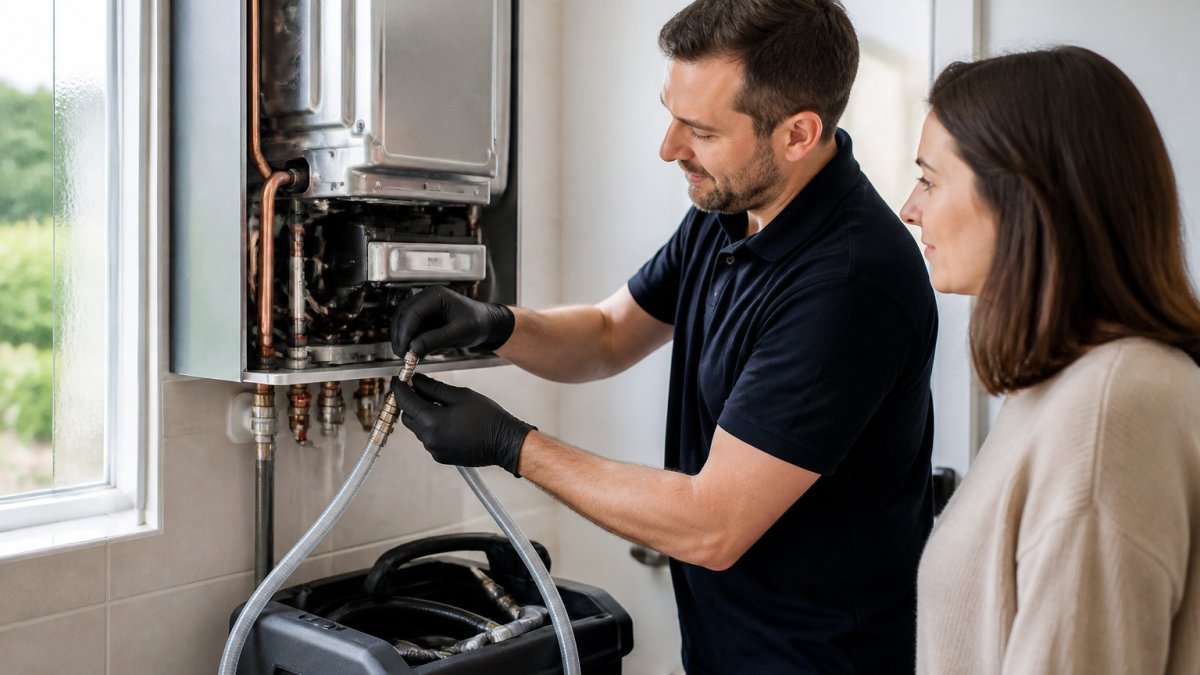
- Descaling solution (food-grade citric acid or a commercial tankless water heater descaler)
- Two large buckets
- Isolation valves (usually come with the unit)
- Hoses that fit your isolation valve connections
- A submersible pump (if using buckets) or a descaling pump kit
- Adjustable spanner
- Towels
Never use vinegar for descaling. Use a proper descaling solution designed for tankless systems.
Step-by-step descaling process
Step 1: Turn off the unit and let it cool (5 minutes)
Safety first. Shut down the system and allow water to cool. This prevents burns and protects internal components.
Step 2: Locate the isolation valves (2 minutes)
Your tankless water heater has two isolation valves, one on the cold water inlet and one on the hot water outlet. These let you close off the unit without shutting down your whole system.
Step 3: Connect your descaling pump (10 minutes)
Attach hoses to the isolation valves. Connect the pump to your descaling solution bucket. The pump circulates solution through the heat exchanger, dissolving mineral buildup.
Step 4: Run the descaling cycle (45-60 minutes)
Turn on the pump and let it run. Most descaling solutions need 30-45 minutes of circulation. Follow your solution’s instructions for timing.
Step 5: Drain and flush (15 minutes)
After descaling, drain the solution completely. Reconnect fresh water and run the system for several minutes to flush out any remaining solution.
Step 6: Reconnect and test (5 minutes)
Close the isolation valves, disconnect the hoses, and turn the unit back on. Test water pressure and temperature to confirm normal operation.
Most homeowners can do this themselves, though some prefer hiring a professional to ensure it’s done correctly.
The Tankless Water Heater Flushing Process Explained
Flushing is similar to descaling but less intensive. It removes loose sediment without using chemical solutions.
Why flushing is essential
Flushing maintains water flow and heat transfer efficiency. Over time, sediment and mineral particles accumulate in pipes and the heat exchanger. Flushing pushes these deposits out before they harden into scale.
Think of flushing as preventive maintenance. Descaling is the deep clean. Flushing is the regular maintenance that keeps descaling intervals longer.
Hard water areas need flushing more often. If your water is soft, flushing once yearly may suffice. Hard water areas benefit from flushing twice yearly.
When to flush your unit
Flush your tankless water heater:
- Twice yearly in hard water areas
- Once yearly in soft water areas
- Immediately if you notice reduced water pressure
- After any repair or service that involves opening the system
- Before winter (to remove sediment that accumulated during summer use)
Flushing takes 20-30 minutes. You can do it yourself using the same isolation valve method as descaling, but without the chemical solution. Just run fresh water through the system at higher pressure.
Signs of Tankless Water Heater Failure to Watch For
Knowing what to look for helps you catch problems early. Some warning signs require immediate attention.
Performance warning signs
Reduced hot water flow or pressure. This is the most common sign of mineral buildup. If your shower pressure drops suddenly, descaling is needed.
Water temperature fluctuates. If hot water temperature swings up and down, the unit struggles to maintain consistent heating. This suggests internal component wear or sensor failure.
Longer time to reach hot water. If it takes noticeably longer for hot water to arrive at your tap, mineral deposits may be restricting flow.
Unusual noises. Gurgling, popping, or hissing sounds indicate mineral deposits or internal corrosion. Address this promptly.
Higher energy bills. A failing unit works harder to heat water, consuming more gas or electricity. If your bills spike without explanation, have the system checked.
Safety and error code indicators
Error codes on the display. Most tankless units show error codes when something’s wrong. Common codes include:
- Ignition failure (won’t light)
- Flame failure (flame goes out during operation)
- Overheat protection (unit shuts down due to excessive temperature)
- Low water pressure (insufficient flow to trigger heating)
Consult your manual for specific codes. Many require professional service.
Strong gas smell. A strong gas smell indicates a potential gas leak. Turn off the unit, ventilate your home, and call a professional immediately.
No hot water at all. If the unit won’t heat water despite being powered on, several components could be failing. This needs professional diagnosis.
Visible corrosion or rust. Rust on the exterior or connections suggests moisture problems or internal corrosion. Have it inspected by a qualified engineer.
Any sign of gas leak, electrical damage, or uncontrolled temperature requires immediate professional attention. Do not attempt repairs yourself. Contact Apex Gas & Heating Ltd for emergency boiler repair service, we offer 24/7 call-outs for urgent issues.
Common Maintenance Mistakes to Avoid
Understanding what NOT to do prevents costly damage.
Neglecting annual servicing. Many homeowners skip professional checks to save money. This backfires. Annual servicing catches problems early and maintains warranty coverage. It costs far less than emergency repairs.
Using vinegar for descaling. Vinegar is weak and leaves residue inside the heat exchanger. Always use a proper descaling solution designed for tankless systems.
Ignoring error codes. Error codes exist for a reason. Ignoring them allows problems to worsen. Address codes promptly, either through troubleshooting or professional service.
Delaying repairs. A small leak or pressure drop seems minor. Left unaddressed, it becomes a major failure. Fix problems quickly.
Failing to check isolation valves. These valves let you service the unit safely. If they’re stuck or corroded, you can’t perform maintenance. Test them quarterly.
Skipping monthly visual checks. Five minutes of monthly inspection prevents major problems. It’s the easiest maintenance step and the most valuable.
Assuming your water is soft. Hard water requires different maintenance schedules. Test your water hardness. If you’re unsure, ask a professional.
Last Updated: October 3, 2026
Tankless water heater maintenance is straightforward when you follow a consistent schedule. Monthly checks, quarterly inspections, and annual professional servicing keep your system running efficiently and safely.
Hard water areas need more frequent attention. Soft water areas need less. Understand your local water conditions and adjust your schedule accordingly.
A well-maintained tankless system can last 15-20 years. A neglected one may fail sooner.
Apex Gas & Heating Ltd provides professional tankless water heater maintenance and emergency repair services across Sussex and Surrey. Our approved Glowworm and Worcester Installers handle annual servicing, descaling, and repairs with full public liability insurance. We offer transparent pricing and fast 24/7 call-outs for urgent issues.
Don’t wait for your system to fail. Get a quote for annual servicing today and keep your hot water running reliably all year round.
Frequently Asked Questions
How often should a tankless water heater be serviced?
Most tankless water heaters require professional servicing at least once per year. In areas with hard water, you may need servicing every six months. Monthly visual checks and quarterly inspections help catch issues early. Regular servicing prevents mineral build-up, maintains efficiency, and extends the unit’s lifespan significantly. Your manufacturer’s guidance and local water hardness will determine your specific schedule.
What are the signs that my tankless water heater needs maintenance?
Watch for reduced hot water flow, inconsistent water temperature, unusual noises like popping or banging, and visible mineral deposits around connections. Error codes on the display panel indicate problems requiring immediate attention. If your unit takes longer to heat water or you notice a burning smell, professional inspection is essential. These signs often point to mineral accumulation or component wear that maintenance can address before failure occurs.
Can I perform tankless water heater maintenance myself?
You can handle basic monthly checks like inspecting for leaks and listening for unusual sounds. However, descaling and flushing require specific equipment and expertise to avoid damaging internal components. Professional technicians have the proper tools and knowledge to safely perform these tasks without voiding your warranty. For safety-critical work involving gas connections or complex flushing procedures, professional servicing is strongly recommended.
Why is annual flushing important for tankless water heaters?
Flushing removes mineral deposits that accumulate inside the heat exchanger, which reduces efficiency and can lead to system failure. Hard water minerals build up gradually and restrict water flow, forcing the unit to work harder and use more energy. Annual flushing maintains optimal performance, prevents costly repairs, and ensures the system operates safely. Neglecting this maintenance significantly shortens your heater’s lifespan and increases running costs.