









Table of Contents
- What Is a Whole House Water Filtration System?
- How Whole House Water Filtration Protects Your Plumbing and Appliances
- Health Benefits: Contaminant Removal and Water Quality Improvements
- Water Softener vs Whole House Filter: Understanding the Difference
- Whole House Water Filter Maintenance: What You Need to Know
- How to Choose a Whole House Water Filter for Your Home
- Environmental and Cost Benefits of Filtration Systems
- Frequently Asked Questions
Last Updated: September 21, 2026
What Is a Whole House Water Filtration System?
A whole house water filtration system is a point-of-entry installation that filters all water entering your home before it reaches any tap, shower, or appliance, protecting your entire plumbing network from contaminants and sediment at the source.
The system draws water from your mains supply through filter stages, typically activated carbon, sediment filters, or reverse osmosis membranes, before distributing treated water throughout your property, ensuring consistent quality across every outlet.
Most whole house water filtration systems are installed at the point where water enters your home, either in the basement, under the stairs, or outside near the water meter. The micron rating of the filters determines what they can remove: sediment filters typically handle particles down to 5-20 microns, whilst activated carbon reduces chlorine, volatile organic compounds, and odours. More advanced systems using reverse osmosis can address heavy metals, total dissolved solids, and PFAS contamination.
A whole house water filtration system treats all water at the point of entry, providing consistent contaminant removal and protection across your entire home’s plumbing network.
How Whole House Water Filtration Protects Your Plumbing and Appliances
Unfiltered water damages pipes, boilers, and appliances. Scale buildup from hard water reduces flow rate, forces your heating system to work harder, and shortens equipment lifespan.
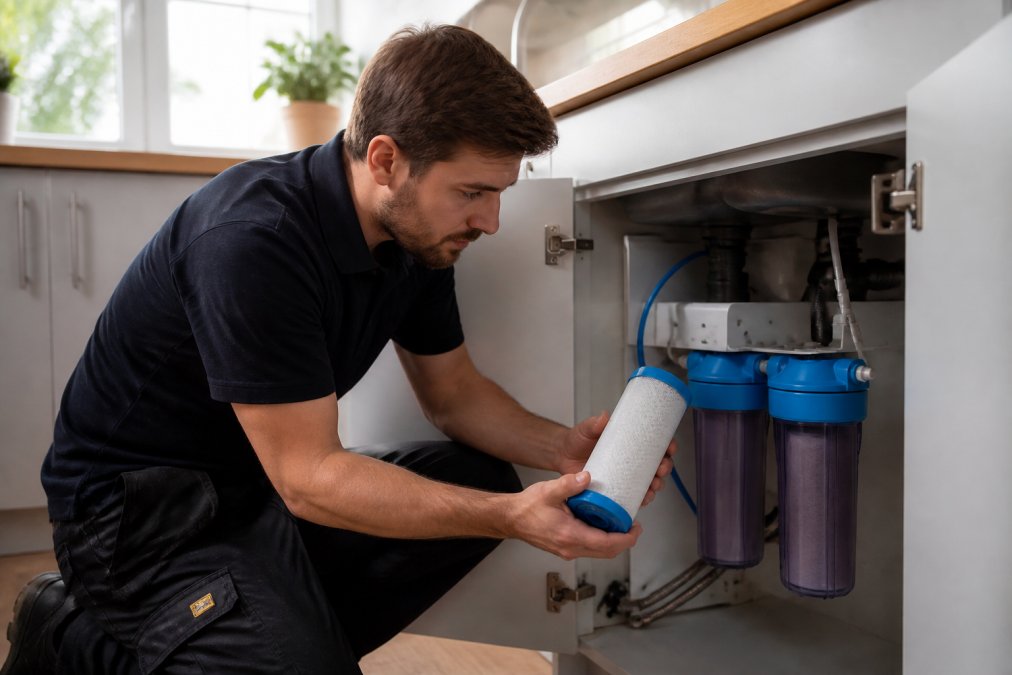
Sediment and mineral deposits restrict water pressure and accelerate corrosion. Limescale on boiler heating elements reduces efficiency and can cause system failure. A whole house water filtration system intercepts these contaminants before they enter your system, protecting pipes and appliances from premature wear. If you’re experiencing boiler efficiency issues or need advice on protecting your heating system, our boiler servicing team can assess whether water quality is affecting your equipment’s performance.
Filtration prevents damage to washing machines and dishwashers by reducing mineral deposits that coat internal components and increase repair costs.
If you notice reduced water pressure or discoloured water from older taps, sediment filtration is often the first step to improving both water quality and plumbing longevity.
Health Benefits: Contaminant Removal and Water Quality Improvements
Filtered water reduces exposure to chlorine and disinfection byproducts (DBPs), particularly trihalomethanes (THMs), which have been linked to long-term health concerns. Activated carbon filtration removes these byproducts before they reach your taps, reducing cumulative exposure across all water use.
Lead, commonly found in older plumbing systems, accumulates in the body and affects neurological development in children and cognitive function in adults. Copper becomes toxic at elevated concentrations. Reverse osmosis and multi-stage systems remove these metals. Test your water through your local supplier’s quality report or professional analysis before choosing a system.
PFAS (per- and polyfluoroalkyl substances), known as “forever chemicals,” persist in the environment and accumulate in human tissue. Detected in water supplies across the region, they’re linked to immune system effects. Whole house filtration using activated carbon or reverse osmosis removes PFAS before it reaches your home, providing protection point-of-use filters cannot match.
Many people report improved skin condition after installing whole house filtration. Chlorine strips natural oils and triggers irritation in people with eczema or psoriasis. Filtered water eliminates this irritant, and households often notice reduced skin dryness and improved hair condition within weeks.
Match your filtration system to your actual water quality. A sediment filter alone won’t remove chemical contaminants; activated carbon won’t remove heavy metals. Check your supplier’s annual water quality report or arrange a professional test to select the right technology.
Request your local water supplier’s annual water quality report (available free online) before choosing a filtration system. This report identifies which contaminants are present in your supply, allowing you to select the right filter type rather than guessing.
Water Softener vs Whole House Filter: Understanding the Difference
A water softener removes calcium and magnesium using ion exchange, addressing scale buildup and improving appliance efficiency. However, it does not remove sediment, chlorine, heavy metals, or PFAS.
A whole house water filtration system removes sediment, chlorine, and other contaminants through mechanical and chemical filtration. It improves taste, odour, and safety but does not soften hard water. Both hard water and chlorine concerns may require both systems.
Choose based on test results. Scale buildup and reduced flow rate require a water softener; contaminant removal and chlorine reduction require a whole house filter. Many properties benefit from both systems.
Homes with tested hard water and chlorine concerns benefit most from combining both systems, a water softener for scale prevention and a whole house filter for contaminant removal.
Whole House Water Filter Maintenance: What You Need to Know
Filter cartridge replacement is the primary maintenance task. Most activated carbon and sediment filters require replacement every 6-12 months. Neglecting maintenance reduces effectiveness and can damage the system through clogged filters.
Maintenance schedules vary by filter type. Sediment filters clog faster in high-sediment areas; activated carbon filters last longer but lose effectiveness when saturated; reverse osmosis systems require multi-stage replacement at different intervals.
Regular filter changes maintain system capacity and water pressure. A clogged filter forces water to bypass filtration entirely. Replacement cartridges are an affordable expense compared to appliance damage or plumbing repairs. Some systems include pressure gauges or filter-change indicators. If yours lacks these, mark replacement dates on a calendar. Professional installation includes guidance on maintenance schedules specific to your system.
How to Choose a Whole House Water Filter for Your Home
Step 1: Obtain and Interpret Your Water Quality Data
Request your local water supplier’s annual water quality report (free), which details all tested contaminants. This report lists turbidity, chlorine residual, hardness, pH, and detected heavy metals. If turbidity exceeds 0.5 NTU, prioritise sediment filtration; if chlorine residual exceeds 0.5 mg/L, use activated carbon; if hardness exceeds 200 mg/L, consider both softening and filtration.
For private boreholes or more detailed analysis, arrange a professional water test. These provide comprehensive results including heavy metals, PFAS, and bacteria. This investment is worthwhile if you’ve experienced water quality issues like discolouration, metallic taste, or appliance scaling.
Step 2: Match Filter Type to Your Test Results
Select the appropriate filtration technology:
- Sediment filters (5-20 micron): Choose if your report shows elevated turbidity or visible particles. These are typically the first stage and protect downstream filters and appliances.
- Activated carbon filters: Select if chlorine residual exceeds 0.5 mg/L or you notice chlorine taste or odour. These remove VOCs and some pesticides.
- Reverse osmosis systems: Necessary if your report identifies heavy metals, PFAS, or TDS above 500 mg/L. Most comprehensive but produces wastewater and requires more maintenance.
- Multi-stage systems: For multiple concerns (sediment, chlorine, hardness), a multi-stage system provides comprehensive protection across all issues.
Step 3: Assess Your Plumbing Type and Installation Space
Whole house systems connect at your point of entry, typically where the mains supply enters your home. Identify this location: it’s usually in your basement, under the stairs, in a utility room, or outside near your water meter. Measure the available space and note your plumbing material (copper, PEX, or older lead pipes). PEX plumbing is more flexible and easier to work with during installation; copper requires soldering connections, which may take longer. If you have older lead pipework, this is another reason to prioritise filtration, as lead leaches into water over time.
Check your incoming water pressure (typically 2-3 bar for mains supply). Whole house systems require adequate pressure to function effectively; if your pressure is below 2 bar, you may need a pressure-boosting pump, which adds to installation cost. Our plumbing services team can measure this during a site survey and advise on the best installation approach for your property.
Step 4: Calculate Flow Rate Requirements
Flow rate determines whether your system maintains adequate water pressure during peak usage.
Step 5: Budget for Total Cost of Ownership
For homes in areas with tested chlorine concerns and moderate sediment (common in many regions), a dual-stage sediment and activated carbon system provides the best balance of protection, cost, and maintenance simplicity.
Environmental and Cost Benefits of Filtration Systems
Installing a whole house water filtration system reduces reliance on bottled water, eliminating plastic waste from your household. A family purchasing bottled water regularly generates significant plastic packaging waste annually. Home filtration provides unlimited tap water without environmental impact from single-use bottles or the energy cost of bottled water production and transport.
| Filter Type | Best For | Maintenance Frequency | Key Benefit |
|---|---|---|---|
| Sediment Filter | Visible particles, cloudiness | Every 6-9 months | Protects pipes and appliances |
| Activated Carbon | Chlorine, taste, odour | Every 9-12 months | Improves water quality |
| Reverse Osmosis | Heavy metals, PFAS, total dissolved solids | Every 6-12 months (multi-stage) | Comprehensive contaminant removal |
| Multi-Stage System | Combined sediment, chemical, mineral concerns | Varies by stage (6-12 months) | Broadest protection across all issues |
Frequently Asked Questions
What contaminants does a whole house water filtration system remove?
A whole house water filtration system removes sediment, chlorine, volatile organic compounds, heavy metals, and PFAS depending on the filtration type. Activated carbon filters excel at chlorine and odour reduction, whilst sediment filters trap particles. Reverse osmosis systems remove up to 99% of total dissolved solids and provide the most comprehensive contaminant removal for improved water quality throughout your home.
Do I need a water softener if I have a whole house filter?
Not necessarily. A whole house water filter and water softener serve different purposes. Filters remove contaminants and improve water quality, whilst softeners address hard water by reducing mineral content like calcium and magnesium that cause scale buildup. If your water is hard, you may benefit from both systems working together, or consider a filter with sediment and carbon stages combined with a separate softening stage.
How often do I need to replace filter cartridges in a whole house system?
Filter cartridge replacement depends on your water quality and system type. Sediment filters typically need changing every 6-12 months, whilst activated carbon filters last 12-18 months. The micron rating and your household’s water usage affect replacement frequency. Regular maintenance schedules prevent reduced flow rate and ensure optimal contaminant removal. Check your system’s specifications for exact intervals.
Will a whole house water filter remove limescale and hard water?
Standard whole house filters remove sediment and some chemicals but do not soften hard water. However, some multi-stage systems include water softening capabilities to address scale buildup on appliances and plumbing. If limescale is your primary concern, a dedicated water softener or a hybrid filtration system combining both filtration and softening technologies will be more effective at preventing appliance efficiency loss.