








Table of Contents
- What Makes a Combi Boiler Suitable for Large Families
- Combi Boiler vs System Boiler for a Large Family
- Combi Boiler Flow Rate for Multiple Bathrooms
- Can a Combi Boiler Run Two Showers at Once
- Key Advantages of Combi Boilers for Larger Households
- Potential Drawbacks to Consider
- Is a Combi Boiler the Right Choice for Your Family
- Frequently Asked Questions
Last Updated: October 20, 2026
What Makes a Combi Boiler Suitable for Large Families
Whether a combi boiler is worth it for large families depends on your household’s hot water demand, bathroom layout, and heating needs. At Apex Gas & Heating Ltd, we help homeowners evaluate whether a combi boiler delivers the right balance of convenience and performance for their situation. A combi boiler is a condensing boiler that provides heating and hot water on demand without requiring a separate hot water cylinder or storage tank.
The appeal is straightforward: combi boilers are compact, energy-efficient, and eliminate the need for bulky storage cylinders. For smaller households or those with modest hot water demands, they’re often an excellent choice. However, large families with multiple bathrooms and overlapping hot water usage patterns face genuine trade-offs that deserve careful consideration before committing to installation.
Understanding your family’s actual usage pattern is the first step. Peak morning showers, weekend bathing, and evening routines often create simultaneous demand that tests a boiler’s capabilities. The difference between choosing the right heating system and choosing the wrong one can mean the difference between comfortable showers and disappointing water pressure when two bathrooms are in use.
Before evaluating specific boiler models, map out your household’s typical hot water usage. Note which times of day multiple showers run simultaneously, whether you use baths regularly, and how many people shower during peak hours. This real-world snapshot reveals whether a combi boiler can genuinely meet your needs.
Combi Boiler vs System Boiler for a Large Family
A system boiler differs fundamentally from a combi in how it stores and delivers hot water, making it worth comparing for larger households. A system boiler includes a separate hot water cylinder that stores heated water, whereas a combi heats water on demand without storage. For a large family, this distinction matters significantly.
System boilers excel when multiple people need hot water at the same time. The cylinder acts as a buffer, meaning several family members can draw hot water simultaneously without the boiler struggling to heat fresh water fast enough.
Combi boilers, by contrast, heat water as it passes through the unit. This on-demand approach works well for light to moderate usage but can result in reduced flow rates or temperature fluctuations when demand spikes. The trade-off is that system boilers require more space for the cylinder and typically cost more to install.
| Feature | Combi Boiler | System Boiler |
|---|---|---|
| Hot water storage | None (on-demand) | Separate cylinder |
| Space requirements | Compact | Larger footprint |
| Simultaneous hot water use | Limited | Better for multiple users |
| Installation complexity | Simpler | More involved |
| Typical cost range | Lower initial outlay | Higher initial investment |
| Best for | Small to medium homes | Larger families, multiple bathrooms |
For large families, system boilers often provide more reliable performance during peak usage times. However, they require more installation work and ongoing maintenance of the cylinder. The choice ultimately depends on your specific household dynamics and available space.
If your family frequently uses multiple showers or baths simultaneously, a system boiler typically outperforms a combi. If hot water usage is staggered or moderate, a combi can work effectively.
Combi Boiler Flow Rate for Multiple Bathrooms
Flow rate determines how much hot water a boiler can deliver per minute, making it the critical specification for households with multiple bathrooms. A combi boiler worth it for large families must have sufficient flow rate to maintain acceptable water pressure when demand increases.
Most modern combi boilers deliver between 10 and 19 litres per minute of hot water. For a single shower, 8-10 litres per minute is generally adequate.
Your water mains pressure and pipe diameter directly affect the boiler’s actual output. Even a high-flow combi cannot exceed the water supply limitations of your property. Before selecting a boiler, have a Gas Safe registered engineer assess your incoming water pressure and pipe specifications.
Larger families with three or more bathrooms often find that a combi boiler’s flow rate becomes a genuine limitation. If two bathrooms are used regularly during peak times, you’re operating at the boiler’s maximum capacity with little margin for error.
When Apex Gas & Heating Ltd installs a new boiler, we assess your household’s actual water demand and recommend a boiler model with appropriate flow rate specifications. This prevents the frustration of discovering post-installation that your chosen boiler cannot meet your family’s needs.
Can a Combi Boiler Run Two Showers at Once
Yes, a combi boiler can run two showers simultaneously, but performance depends on the boiler’s flow rate and your home’s water supply specifications. This is where many families discover whether a combi is genuinely suitable for their household.
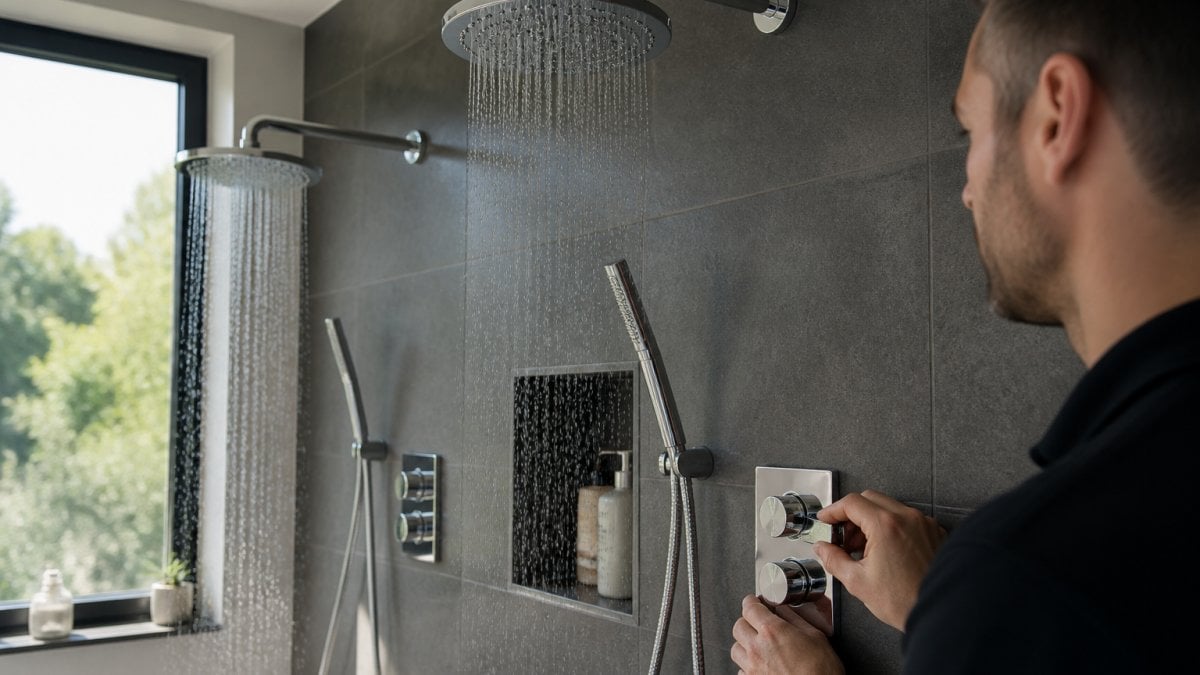
Running two showers at once requires approximately 16-19 litres per minute of hot water. Most modern combi boilers are designed to handle this demand, but the real-world outcome depends on several factors.
Temperature consistency is another consideration. When a combi boiler reaches maximum flow, it may struggle to maintain the target temperature across all outlets. One shower might deliver hot water at 38°C while the other drops to 35°C.
The practical reality for large families is that while a combi can technically run two showers, the experience may feel compromised. Pressure might feel weak, temperature may fluctuate, or both showers might need to operate at slightly reduced flow to maintain comfort.
System boilers avoid this problem by storing hot water in a cylinder, allowing multiple simultaneous draws without the boiler struggling to heat fresh water fast enough.
If your household includes multiple teenagers or a family routine where two showers run simultaneously most mornings, a combi boiler may not deliver the performance you expect. Test this scenario honestly before committing to a combi installation.
Key Advantages of Combi Boilers for Larger Households
Despite the limitations discussed above, combi boilers offer genuine advantages that make them worth considering for some larger families. Understanding these benefits helps clarify whether a combi aligns with your priorities.
Space efficiency is the most obvious advantage. Combi boilers are compact wall-mounted units that eliminate the need for a hot water cylinder, immersion heater, and associated pipework.
Energy efficiency is another significant advantage. Combi boilers heat water only when needed, eliminating the standby losses associated with maintaining a stored cylinder of hot water. Modern condensing combi boilers achieve efficiency ratings above 90 per cent.
Lower installation complexity means faster setup and potentially lower initial labour costs. Installing a combi requires fewer pipework modifications than installing a system boiler with a new cylinder. This translates to less disruption during installation and potentially lower upfront costs.
No cold water storage requirement simplifies plumbing design. Traditional systems require a cold water storage tank in the loft, which combi systems eliminate. This removes a potential maintenance concern and frees up loft space.
For families with moderate hot water demands and space constraints, these advantages can outweigh the limitations. The key is honest assessment of your actual usage patterns rather than assuming a combi will work simply because it’s popular or compact.
Potential Drawbacks to Consider
Before deciding whether a combi boiler is worth it for large families, understand the genuine limitations that affect user experience.
Reduced flow during peak demand is the most common complaint from large families. When multiple showers, taps, or appliances draw hot water simultaneously, pressure and temperature can both suffer.
No hot water during boiler faults creates a particular inconvenience. If your combi boiler develops a problem, you lose both heating and hot water simultaneously.
Higher flow rate requirements mean your water mains must be adequate. If your property has low incoming water pressure or narrow pipes, a combi boiler cannot exceed these physical limitations. Upgrading your water connection is possible but expensive and disruptive.
Temperature fluctuations occur when demand spikes. The boiler’s modulation system works to maintain target temperature, but rapid changes in flow can cause brief temperature variations. Users may experience “cold spells” when other hot water outlets open suddenly.
Limited simultaneous usage means families must coordinate hot water use rather than using it freely. This requires lifestyle adjustment, particularly for households with teenagers or multiple bathrooms in regular use.
Honest evaluation of these drawbacks helps determine whether a combi boiler genuinely suits your family’s needs or whether a system boiler would deliver better real-world performance.
The core question isn’t whether a combi boiler can work for large families, it’s whether you’re willing to accept its inherent limitations in exchange for its space and efficiency advantages.
Is a Combi Boiler the Right Choice for Your Family
Deciding whether a combi boiler is worth it for large families requires evaluating your specific circumstances against the genuine trade-offs involved. This isn’t a one-size-fits-all decision.
Choose a combi boiler if:
- Your family has moderate hot water demands with staggered usage patterns
- Space is limited and a compact boiler is genuinely valuable
- Energy efficiency and lower running costs are priorities
- You rarely use multiple showers or baths simultaneously
- Your household is willing to coordinate hot water use
Choose a system boiler if:
- Multiple family members shower simultaneously most days
- You have three or more bathrooms in regular use
- Consistent water pressure and temperature are non-negotiable
- You value the backup hot water supply if the boiler fails
- You have adequate space for a cylinder
The honest assessment is that large families with multiple simultaneous hot water users often find system boilers deliver better real-world performance. However, families with moderate demands, space constraints, or strong efficiency priorities can make combi boilers work effectively.
When you’re ready to make this decision, a Gas Safe registered engineer can assess your property’s water supply, evaluate your household’s actual usage patterns, and recommend the boiler type that genuinely matches your needs. At Apex Gas & Heating Ltd, our team provides detailed consultations that help homeowners understand exactly what performance to expect from different boiler types before committing to installation.
The right choice isn’t the most popular boiler or the most compact unit, it’s the one that delivers reliable performance for your family’s actual lifestyle. Taking time to evaluate your needs honestly prevents costly mistakes and ensures your heating system works with your household rather than against it.
If your family is experiencing inconsistent hot water pressure, temperature fluctuations, or you’re simply uncertain whether your current boiler meets your needs, our Gas Safe registered engineers can diagnose the issue and recommend solutions. Whether you need boiler repair, servicing, or a complete system upgrade, Apex Gas & Heating Ltd provides transparent advice and reliable workmanship. Get a quote for a consultation and discover which heating solution genuinely suits your home.
Frequently Asked Questions
Is a combi boiler suitable for a large family?
A combi boiler can work well for large families, but suitability depends on your household’s simultaneous hot water demand. Modern combi boilers deliver hot water on demand without a separate tank, which suits families needing flexibility. However, if multiple family members shower or use hot water simultaneously, flow rate becomes critical. A high-output combi boiler (typically 28-35 kW) handles most large-family scenarios effectively, though peak-demand periods may require careful planning.
What size combi boiler does a large house need?
A large family home typically requires a combi boiler rated between 28 and 35 kW. The exact size depends on the number of bathrooms, simultaneous hot water usage, and heating demand. A 4-bedroom house with 2-3 bathrooms usually needs at least 30 kW to maintain adequate flow rate during peak use. Your heating engineer can assess your specific requirements and recommend the appropriate output to ensure consistent performance across your home.
How many bathrooms can a combi boiler support?
A high-output combi boiler can support 2-3 bathrooms comfortably in a large family home. The limiting factor is flow rate, how much hot water the boiler delivers per minute, rather than the number of bathrooms. A boiler with good flow rate (typically 13-16 litres per minute) supplies adequate hot water for simultaneous use in multiple bathrooms. However, running three showers at full flow simultaneously may reduce water temperature, so managing peak-demand periods is important.
What are the disadvantages of a combi boiler in a large household?
The main drawback is flow rate limitation during peak demand. If several family members use hot water simultaneously, pressure and temperature may drop. Combi boilers also lack a hot water storage tank, so they cannot store heated water for later use. Installation can be more complex if your current pipework isn’t optimised for a combi system. For these reasons, some large families find a system boiler with a separate hot water cylinder better suited to their needs, though this depends on your specific usage patterns.
Leave a Reply