Table of Contents
- Quick Comparison: Top Energy Efficient Boilers for 3-Bedroom Homes
- 1. Worcester Bosch Greenstar 4000
- 2. Vaillant ecoTEC Plus
- 3. Viessmann Vitodens 100-W
- 4. Ideal Logic Max
- 5. Alpha NX
- Boiler Size for a 3-Bedroom House: What You Need to Know
- Combi Boiler vs System Boiler: Which Suits Your Home?
- Boiler Servicing and Maintenance for Long-Term Performance
- Making Your Choice
- Frequently Asked Questions
Last Updated: 12 October 2026
Quick Comparison: Top Energy Efficient Boilers for 3-Bedroom Homes
Choosing the right energy efficient boiler for a 3-bedroom house isn’t just about keeping your home warm, it’s about balancing performance, efficiency, and long-term value. At Apex Gas & Heating Ltd, we help homeowners across Sussex and Surrey select boilers that deliver both comfort and lower running costs.
The boilers listed below represent popular options for properties your size. Each has distinct strengths, and the right choice depends on your current heating setup, hot water demands, and budget. Below, we’ll walk you through five models, explain what makes them suitable for 3-bedroom homes, and show you how to match your needs to the best option.
Quick Picks:
- Best Overall: Worcester Bosch Greenstar 4000, proven efficiency and reliability for most homes
- Best Value: Vaillant ecoTEC Plus, strong performance at competitive cost
- Best for Combi Conversion: Ideal Logic Max, straightforward installation and good warranty
- Best Modern Efficiency: Viessmann Vitodens 100-W, advanced controls and long-term savings
- Best Budget Option: Alpha NX, capable performance without premium pricing
1. Worcester Bosch Greenstar 4000
The Worcester Bosch Greenstar 4000 is a commonly specified combi boiler for 3-bedroom homes. It combines proven reliability with solid efficiency ratings, making it a sensible choice for homeowners who want a boiler that will perform consistently without unexpected complications.
This model handles the heating and hot water demands of a typical 3-bedroom property well. It delivers reliable performance in winter and responds quickly when you turn on the taps.
The main consideration is that it sits in the mid-range on efficiency. If your priority is minimising energy bills over the next decade, newer models with more advanced controls might deliver better long-term savings. For straightforward, dependable heating, though, this boiler rarely disappoints.
Make sure your engineer checks your existing pipework before fitting, older systems sometimes need flushing to prevent sludge buildup, which can reduce the boiler’s lifespan.
Pros:
- Widely available and well-supported by local engineers
- Compact design fits most kitchen spaces
- Solid warranty terms
- Good track record over many years
Cons:
- Not the most efficient option available
- Older control technology compared to newer models
- May not be the best choice if you have very high hot water demand
2. Vaillant ecoTEC Plus
The Vaillant ecoTEC Plus brings better efficiency to the table than the Worcester Bosch, which translates to lower gas bills over time. For a 3-bedroom home, this model offers the right balance between performance and running costs.
Vaillant has built a strong reputation for reliability, and this range maintains that standard. The boiler heats your home steadily and delivers hot water quickly.
Where this model stands out is efficiency. The design captures more heat from the combustion process, so less energy escapes through the flue. Over a 10-year lifespan, that efficiency gain adds up noticeably on your heating bills.
Vaillant boilers typically need servicing annually to maintain warranty cover and peak efficiency.
Pros:
- Strong efficiency ratings reduce running costs
- Reliable performance and good build quality
- Responsive customer support and warranty service
- Compact model suitable for most installations
Cons:
- Slightly higher upfront cost than budget options
- Parts can be pricier than some competitors
- Requires annual servicing to maintain warranty
3. Viessmann Vitodens 100-W
The Viessmann Vitodens 100-W represents the modern end of the boiler market. It includes more sophisticated controls and sensing technology, which means your heating system responds more intelligently to actual demand rather than running at fixed settings.
For a 3-bedroom home, this intelligence matters. The boiler learns your household’s patterns and adjusts heating cycles accordingly. In practice, this means warmer mornings and evenings when you need them, and lower gas consumption during off-peak hours.
This model costs more upfront, but the advanced controls can deliver meaningful savings, especially if your household has varied occupancy patterns. If you value modern convenience alongside efficiency, this boiler justifies the investment.
Pros:
- Advanced controls and smart integration
- Excellent efficiency ratings
- Responsive heating performance
- Good warranty and support network
- Long-term energy savings offset higher initial cost
Cons:
- Highest upfront cost of the range
- Requires compatible smart controls to realise full benefits
- More complex setup means installation should be done carefully
4. Ideal Logic Max
The Ideal Logic Max is a practical choice for homeowners who want solid performance without paying premium prices. It handles the heating and hot water needs of a 3-bedroom home reliably, and the installation process is straightforward for qualified engineers.
This boiler doesn’t include the advanced controls of the Viessmann, but it performs its core job well. You get consistent heating, quick hot water response, and a reasonable warranty.
The value proposition is clear: you’re paying for a boiler that works, not for features you may not use. For many homeowners, that’s exactly what they want.
Homeowners replacing an older boiler who want reliable performance and straightforward operation without premium pricing.
Pros:
- Good value for money
- Simple, proven design
- Reliable performance
- Competitive warranty terms
- Easy for engineers to service and repair
Cons:
- Less efficient than Vaillant or Viessmann models
- No smart controls or advanced features
- Higher running costs over time compared to more efficient options
5. Alpha NX
The Alpha NX is the budget-conscious option on this list. It delivers the essentials: reliable heating and hot water for a 3-bedroom home at the lowest entry price. If your budget is tight, this boiler won’t leave you without heat.
Performance is adequate. You’ll get warm radiators and hot water, though response times are slower than premium models, and efficiency is lower. The warranty is standard, and parts are available, though you may find service costs higher relative to more mainstream brands.
This boiler makes sense if you need a replacement quickly and budget is the deciding factor. It’s not the choice for long-term efficiency or advanced features, but it will keep your home warm.
Pros:
- Lowest upfront cost
- Adequate performance for basic heating needs
- Standard warranty coverage
- Functional design without unnecessary complexity
Cons:
- Lowest efficiency rating of the five options
- Slowest hot water response
- Higher running costs over time
- Less widespread engineer support in some areas
Boiler Size for a 3-Bedroom House: What You Need to Know
A 3-bedroom house typically needs a boiler output of between 24 and 28 kilowatts to deliver adequate heating and hot water. This range suits most properties of that size, though the exact requirement depends on your home’s insulation, age, and layout.
An undersized boiler will struggle to heat all rooms evenly and deliver hot water quickly, especially in winter or if multiple taps run simultaneously. An oversized boiler wastes fuel by running at partial capacity most of the time, reducing efficiency and increasing bills.
Your engineer will calculate the correct size by assessing your radiator output, number of bathrooms, and hot water cylinder volume if you have one. This assessment should happen before any boiler is ordered.
Choosing a boiler by guessing the size risks poor performance and wasted money. Always have a qualified engineer perform a heat load calculation before purchase.
The energy efficient boilers listed above are all available in outputs suitable for 3-bedroom homes. When you contact an engineer for a quote, make sure they specify the exact kilowatt output they’re recommending and explain why it suits your property.
Combi Boiler vs System Boiler: Which Suits Your Home?
All five boilers listed above are combi boilers, which heat water on demand and supply both radiators and hot taps from a single unit.
A combi boiler has no separate hot water tank. Water is heated as it flows through the unit, so you get instant hot water at any tap. Installation is simpler, and you save space by not needing a cylinder.
A system boiler, by contrast, heats water into a separate cylinder, which stores it ready for use.
For a typical 3-bedroom home with standard hot water demand, a combi boiler delivers better efficiency and lower running costs. You only choose a system boiler if your household has specific needs that demand it.
Combi boilers are the default choice for 3-bedroom homes: instant hot water, no storage tank, and lower running costs. System boilers suit only homes with high simultaneous hot water demand or weak mains pressure.
When you’re comparing energy efficient boilers for your 3-bedroom house, all the models listed above are combis. If your property currently has a system boiler and you’re happy with the hot water performance, your engineer can advise whether upgrading to a combi makes sense or whether staying with a system boiler is better.
Boiler Servicing and Maintenance for Long-Term Performance
Whichever energy efficient boiler you choose, annual servicing keeps it running at peak efficiency and maintains your warranty.
During a service, your engineer checks the combustion process, cleans the heat exchanger, inspects safety controls, and tests for carbon monoxide leaks. These checks catch problems before they become expensive repairs.
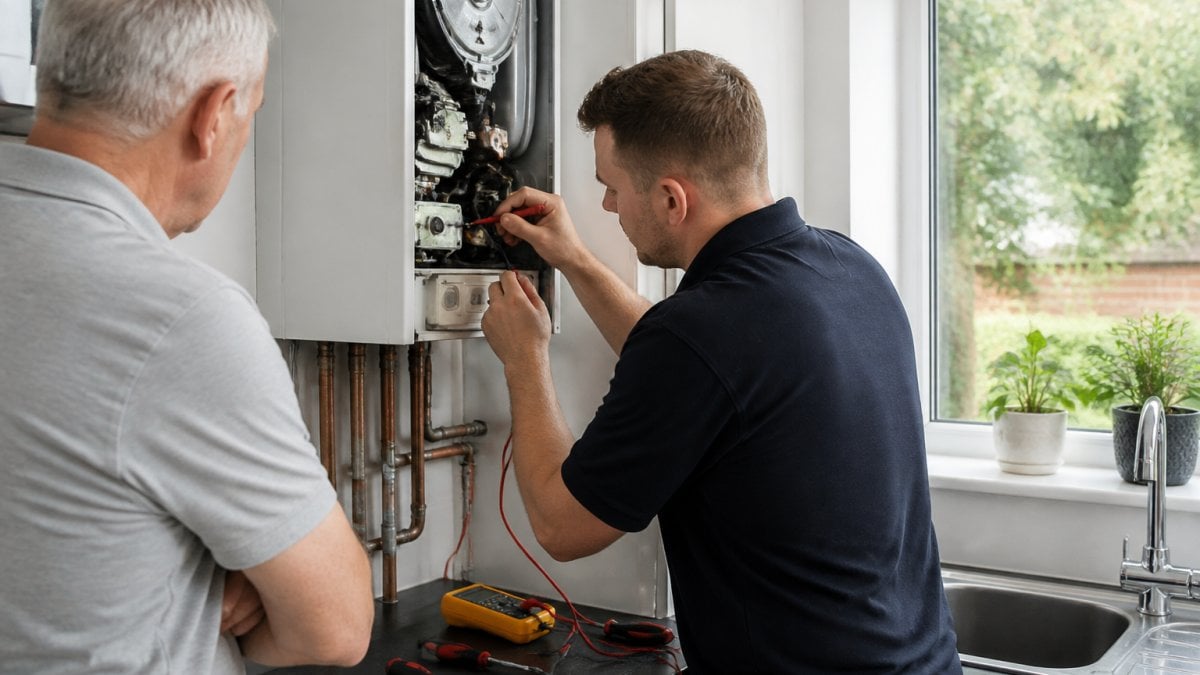
At Apex Gas & Heating Ltd, we recommend booking your service in September or October. We carry out thorough inspections on all major brands, including Worcester Bosch and Glow-worm models, and we’re available across Sussex and Surrey for both routine servicing and emergency repairs.
Maintenance costs are modest compared to the cost of a full replacement. An annual service and occasional repairs can be far cheaper than dealing with a boiler breakdown when you can least afford it.
Making Your Choice
The best energy efficient boiler for your 3-bedroom home depends on three factors: your budget, how long you plan to stay in the property, and whether you value modern controls.
If budget is tight, the Alpha NX gets the job done. If you want the best balance of efficiency and reliability, the Vaillant ecoTEC Plus or Worcester Bosch Greenstar 4000 are solid choices.
All five options will keep a 3-bedroom home warm and deliver hot water reliably.
| Boiler Model | Best For | Key Advantage | Main Consideration |
|---|---|---|---|
| Worcester Bosch Greenstar 4000 | Balanced choice | Proven reliability | Mid-range efficiency |
| Vaillant ecoTEC Plus | Best value efficiency | Lower running costs | Requires annual servicing |
| Viessmann Vitodens 100-W | Long-term savings | Advanced controls | Highest upfront cost |
| Ideal Logic Max | Budget-conscious | Affordable entry price | Lower efficiency |
| Alpha NX | Tight budget | Lowest cost | Highest running costs |
Once you’ve decided which energy efficient boiler suits your home, the next step is getting a professional survey and installation quote.
At Apex Gas & Heating Ltd, we’re approved Worcester and Glow-worm installers with 24/7 emergency support across Sussex and Surrey. We provide transparent pricing, full public liability insurance, and reliable workmanship on every new boiler installation. Whether you need a boiler fitted, your existing system serviced, or emergency boiler repair support, our team responds fast and gets the job done right.
Get a quote from Apex Gas & Heating Ltd today and find out which energy efficient boiler is right for your 3-bedroom home. Our team will walk you through your options and help ensure your new heating system delivers warmth, comfort, and lower energy bills for years to come.
Frequently Asked Questions
What size boiler do I need for a 3-bedroom house?
A 3-bedroom home typically needs a boiler with an output of 24-30 kW. This depends on the number of bathrooms, insulation quality, and whether you need simultaneous hot water and heating. A combi boiler is often sufficient for smaller 3-bedroom properties, whilst larger homes may benefit from a system boiler with a separate hot water tank. Your installer can calculate the exact size based on your specific property requirements.
Is a combi boiler suitable for a 3-bedroom house?
Yes, combi boilers work well for most 3-bedroom homes, especially those with one or two bathrooms. They provide instant hot water without needing a separate tank, saving space and improving efficiency. However, if your household uses multiple taps simultaneously or you have more than two bathrooms, a system boiler may be more practical. Consider your water usage patterns and available space before deciding.
How can I improve my boiler’s efficiency?
Regular boiler servicing and maintenance are essential for efficiency. Have your boiler serviced annually to ensure all components work optimally and to identify potential problems early. Installing a programmable thermostat, bleeding radiators, and keeping your heating system properly balanced also improve performance. Insulating pipes and ensuring your home is well-insulated reduces the workload on your boiler, lowering energy consumption.
What boiler efficiency rating should I look for?
Look for boilers with an SEDBUK (Seasonal Efficiency of a Domestic Boiler in the UK) rating of at least 90%, with A-rated models being most efficient. Modern energy efficient boilers typically achieve 92-98% efficiency. Higher efficiency ratings mean lower fuel bills and reduced carbon emissions. All new boilers sold in the UK must meet minimum efficiency standards, but choosing a higher-rated model provides greater long-term savings.