








Table of Contents
- How HVAC Filters Help with Allergies
- MERV Rating Explained for Homeowners
- Types of Filters That Reduce Allergens
- Signs of a Clogged Air Filter
- How Often to Change HVAC Filters
- Choosing the Right Filter Size for Your System
- Maintaining Your System for Better Air Quality
- Frequently Asked Questions
Last Updated: September 22, 2026
How HVAC Filters Help with Allergies
When allergens circulate through your home, they settle on surfaces, trigger symptoms, and make indoor living miserable. HVAC filter allergies are a common cause of discomfort. A quality HVAC filter traps these particles before they spread. The right filter choice makes a genuine difference to air quality and your health.
Your heating and cooling system pulls air through filters constantly. Each time air cycles, the filter captures dust, pollen, pet dander, and mould spores. Over time, this prevents allergens from building up in your home. But not all filters work equally; some catch far more particles than others.
Choosing the right HVAC filter for allergies starts with understanding what you’re filtering for. Seasonal pollen counts spike in spring and autumn. Pet owners face year-round dander. Mould thrives in damp conditions. Your filter needs to handle your specific allergen load.
A well-maintained heating system with the right filter is one of the simplest ways to improve indoor air quality.
Replace your filter on schedule, even if it looks clean. Filters clogged with allergens work harder, strain your system, and let particles slip through. Set a calendar reminder so you never miss a replacement.
MERV Rating Explained for Homeowners
What MERV Ratings Mean
MERV stands for Minimum Efficiency Reporting Value. It’s a rating system that measures how effectively a filter captures particles between 0.3 and 10 microns in size. According to ASHRAE Standard 52.2, this is the standard for filter efficiency.
The scale runs from 1 to 16. A higher MERV number means the filter catches more particles. MERV 1 filters trap only large dust; MERV 16 filters capture nearly everything, including bacteria and some viruses.
Think of MERV like a net. A loose net (low MERV) lets small fish through. A tight net (high MERV) catches nearly everything, but it also slows water flow. Your HVAC system has to work harder to push air through a dense filter.
Best MERV Ratings for Allergy Sufferers
To address HVAC filter allergies effectively, aim for MERV 8 to MERV 13 in most homes. Industry benchmarks suggest these ratings offer a good balance between filtration and system strain.
MERV 8 catches common household dust, pollen, and pet dander. This is a solid starting point if you have mild allergies or just want better air quality than a basic filter provides.
MERV 11 to MERV 13 filters trap smaller particles, including fine dust, mould spores, and some bacteria. These suit homes with multiple pets, smokers, or people with moderate to severe allergies.
MERV 16 filters are hospital-grade and rarely needed at home. They restrict airflow significantly, which can strain your system and reduce heating or cooling efficiency. Use them only if your doctor specifically recommends them for a serious respiratory condition.
Check your system’s documentation or ask your installer what MERV rating your unit can handle. Pushing too high a MERV rating through an older system can damage it. A MERV 11 filter that your system actually uses beats a MERV 16 that chokes your airflow.
Using a filter higher than your system is rated for can cause the motor to overwork, reduce efficiency, and shorten the life of your heating system. Always verify compatibility before upgrading.
Types of Filters That Reduce Allergens
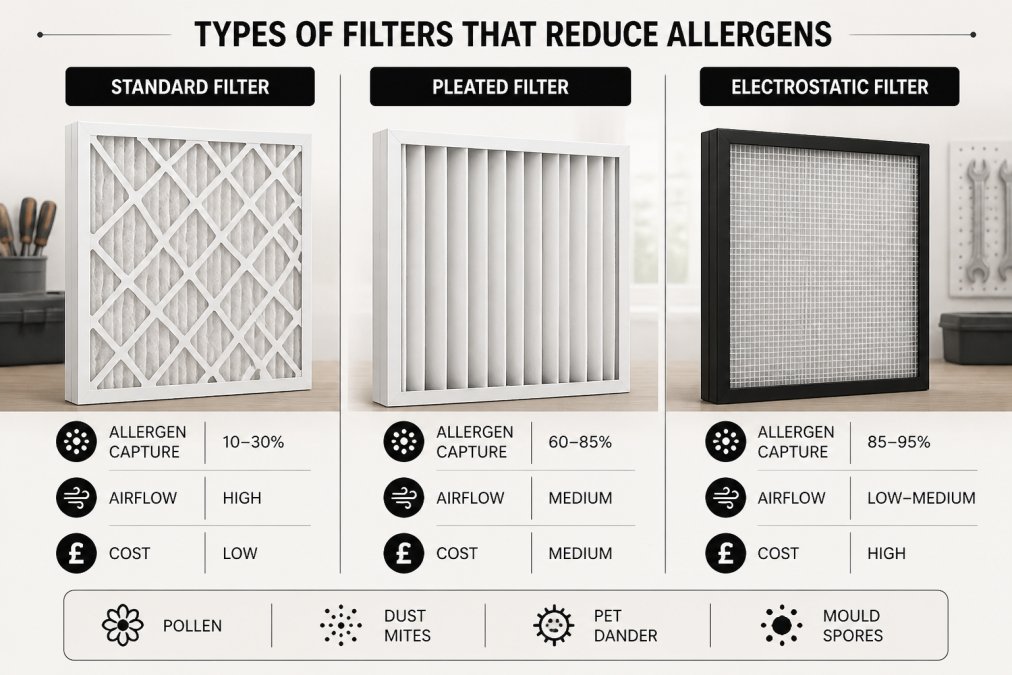
Electrostatic Filters
Electrostatic filters use an electrical charge to attract and trap particles. They work like a magnet for dust and pollen.
These filters are reusable; you wash them instead of replacing them.
The catch: electrostatic filters need regular cleaning to work. A clogged electrostatic filter loses its charge and becomes nearly useless.
For allergy sufferers, electrostatic filters work best in homes with light to moderate allergen loads. They handle pet dander and seasonal pollen well.
Pleated Filters
Pleated filters have a folded, accordion-like design that increases surface area. More surface means more particle capture.
These filters are disposable. You replace them every 1 to 3 months depending on use. They require no maintenance beyond installation.
Pleated filters typically range from MERV 8 to MERV 13, making them ideal for allergy sufferers. They catch pollen, dust, pet dander, and mould spores effectively.
The main drawback: they’re single-use. But for most homeowners, the convenience and allergen-trapping power make pleated filters a good choice.
Signs of a Clogged Air Filter
A clogged filter reduces airflow and forces your heating system to work harder. Watch for these warning signs:
- Reduced heating or cooling power: your rooms don’t warm or cool as quickly.
- Higher energy bills: your system runs longer to reach the target temperature.
- Dust around vents: particles bypass the clogged filter and enter your home.
- System noise: the motor strains and sounds louder than normal.
- Visible dirt on the filter: you can see dust and debris caked on the surface.
If your filter looks dark or feels stiff, it’s time to replace it. Don’t wait for symptoms to appear; swap it out on schedule.
How Often to Change HVAC Filters
Factors That Affect Replacement Frequency
Standard pleated filters typically need replacement every 1 to 3 months. But several factors change this timeline:
Pets in the home: fur and dander accelerate filter clogging. Homes with dogs or cats may need filter changes every 4 to 6 weeks.
Allergies or respiratory conditions: if someone in your home has asthma or severe allergies, change filters more often. A fresher filter means better air quality.
Air quality: homes in areas with high pollen counts or pollution may need more frequent changes.
System usage: if you run your heating or cooling constantly, the filter clogs faster than in homes that use the system seasonally.
Filter type: electrostatic filters last longer between cleanings if you wash them regularly. Pleated filters have a fixed lifespan.
A practical approach: check your filter every month. If it looks dirty, replace it. If it still looks clean, wait.
Set a monthly filter check into your calendar. It takes 30 seconds and prevents the air quality problems that come with clogged filters.
Choosing the Right Filter Size for Your System
Your HVAC system uses a specific filter size. Common sizes include 16×25×1, 20×25×1, and 16×25×4 inches. Using the wrong size defeats the purpose; air bypasses the filter and allergens enter your home.
Find your filter size by:
- Checking the side of your current filter; the size is printed on the frame.
- Looking at your system’s documentation or manual.
- Asking your installer or a technician.
Once you know your size, buy filters that match exactly. Don’t try to force a slightly smaller or larger filter into place; the gaps will leak unfiltered air.
Maintaining Your System for Better Air Quality
Clean filters are just one part of the equation. A well-maintained heating system performs better and protects your health.
Annual servicing keeps your system efficient and catches problems early. A technician checks airflow, cleans components, and ensures everything runs safely. Regular servicing also extends the life of your equipment.
Ductwork inspection reveals leaks and blockages that reduce airflow. Leaky ducts let unfiltered air into your home, undoing the work of your filter.
Thermostat settings matter too. Running your system continuously cycles more air through the filter, which clogs it faster, but also improves air quality. Running it only when needed saves energy but may let allergens accumulate.
For homeowners in Crawley, Three Bridges, and across the region, professional servicing ensures your system works at peak efficiency. Apex Gas & Heating Ltd provides comprehensive boiler servicing that keeps your home warm.
Allergies make home life uncomfortable, but the right HVAC filter traps the particles that trigger symptoms. A MERV 11 or MERV 13 pleated filter suits most allergy sufferers; it balances allergen capture with system efficiency. Replace it every 1 to 3 months, check it monthly, and pair it with annual servicing to keep your system running smoothly.
If your heating system isn’t delivering the comfort it should, or if you’re unsure whether your current filter is the right choice, our team at Apex Gas & Heating Ltd can help. We provide expert advice on boiler servicing and can recommend the best filtration approach for your home. Get a quote today and breathe easier this winter.
Frequently Asked Questions
What MERV rating is best for allergies?
For allergy sufferers, look for MERV 11 to MERV 13 filters. These capture allergens like pollen, pet dander, and dust mites effectively without restricting airflow too much in standard residential systems. MERV 13 offers superior filtration but may require your heating system to work harder, so check your system’s specifications before upgrading.
How often should I change my HVAC filter if I have allergies?
If you have allergies, change your filter every 30 days rather than the standard 90 days. More frequent changes prevent allergen build-up and maintain consistent air quality. If you have pets or live in a dusty area, monthly replacement is especially important for keeping allergens under control.
Can the right HVAC filter help reduce dust and pet dander?
Yes. High-efficiency filters with MERV 11 or higher ratings capture dust, pet dander, and other airborne particles effectively. Pleated and electrostatic filters are particularly good at trapping these allergens. Combined with regular replacement, the right filter significantly reduces what circulates through your home.
Do high-efficiency filters restrict airflow in my heating system?
Higher MERV filters do create slightly more resistance than standard filters, but MERV 11-13 filters work well with most residential systems. If you notice reduced heating performance after upgrading, your system may need professional inspection. Our heating engineers can assess whether your boiler can handle a higher-efficiency filter without strain.