









Table of Contents
- What Is Central Heating Sludge and How Does It Form?
- 7 Warning Signs of Sludge Buildup in Central Heating
- How Sludge Affects Boiler Efficiency and Energy Bills
- Power Flushing Central Heating: What It Involves
- Central Heating System Inhibitor: Why It Matters
- DIY Checks vs Professional Diagnostics
- Frequently Asked Questions
Last Updated: September 11, 2026
What Is Central Heating Sludge and How Does It Form?
Central heating sludge is the thick, black, mud-like substance that builds up inside radiators, pipework and heat exchangers when water reacts with the metal in your system.
The tell-tale signs of sludge buildup in central heating creep in over months and years, which is why so many homeowners mistake a sludged system for a boiler that simply needs replacing.
How Iron Oxide and Corrosion Create Black Sludge
Every central heating system contains water, oxygen and mixed metals, a corrosion engine. As water circulates, it eats away at the inside of your radiators and pipework, producing iron oxide, also known as magnetite.
That iron oxide settles at the lowest points of the system. Add limescale from hard water and general debris, and the result is black sludge that sticks to internal surfaces and narrows the pathways water travels through.
7 Warning Signs of Sludge Buildup in Central Heating
The clearest signs of sludge buildup in central heating are cold spots at the bottom of radiators, kettling or banging noises, slow heat-up times and rising energy consumption. If you notice two or more of the following, sludge is the likely culprit.
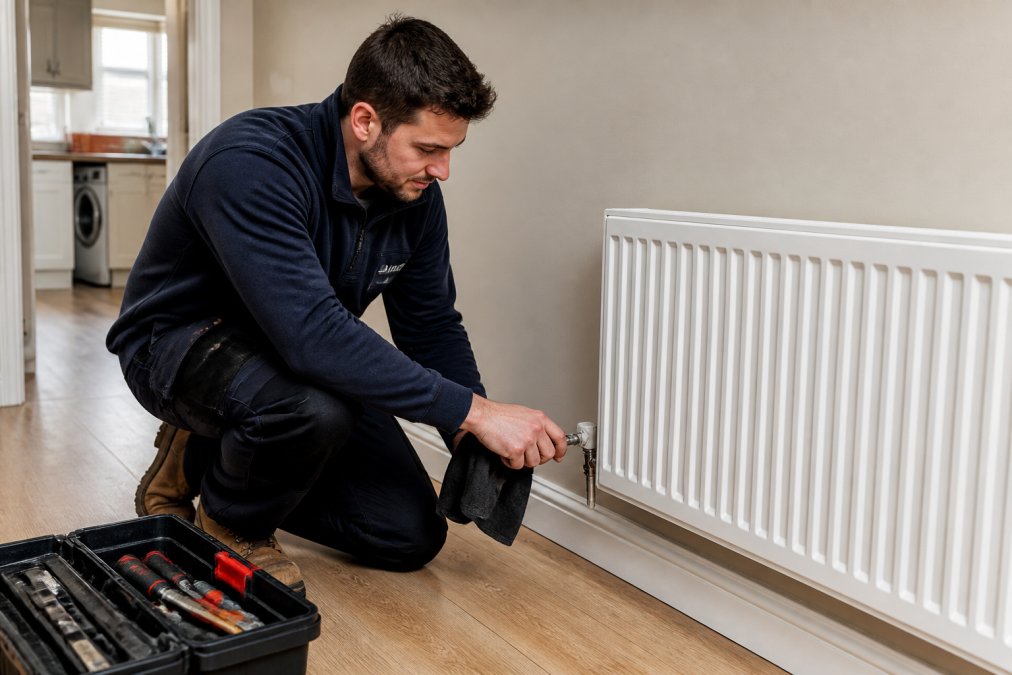
- Cold spots at the bottom of radiators while the top stays hot
- Kettling – a rumbling, boiling-kettle sound from the boiler
- Banging or clunking noises in pipework and radiators
- Radiators that need bleeding constantly, with little improvement
- Slower heat-up times than in previous winters
- Higher energy bills with no change in how you use the heating
- Black water when you bleed a radiator or drain the system
Why a Radiator Cold at the Bottom Points to Sludge
A radiator cold at the bottom is the classic sludge signature. Hot water rises, so the top heats fine, but sludge settles along the bottom channel and blocks circulation there.
Air locks behave differently: cold at the top usually means trapped air that bleeding will fix, while cold at the bottom almost always means physical debris that bleeding will not clear.
If you keep bleeding a radiator that is cold at the bottom, you are wasting your time and letting air into the system. The sludge stays put, and repeated bleeding can actually add fresh oxygen that accelerates corrosion.
Kettling, Banging Noises and Pump Failure
Kettling is the sound of water overheating in a restricted heat exchanger. Sludge and scale insulate the metal, so heat cannot transfer efficiently, the water around the blockage boils, and you hear that distinctive rumble.
Left alone, this does more than make noise. Restricted circulation forces the pump to work harder, often leading to pump failure, and strains the diverter and radiator valves. A blocked heat exchanger is one of the more expensive outcomes of ignoring early warning signs.
How Sludge Affects Boiler Efficiency and Energy Bills
Sludge reduces boiler efficiency because it acts as an insulator. A clean system transfers heat from the burner into the water quickly; a sludged system must burn longer and harder to reach the same temperature, and that extra work shows up on your energy consumption.
Iron oxide and scale have poor thermal conductivity compared with clean metal, so a coated heat exchanger cannot do its job properly.
Many homeowners find a system they were ready to replace only needed a proper flush. Weighing a flush against a new boiler is worth discussing with a heating engineer before you commit, and if replacement does turn out to be the answer, a new boiler installation is a straightforward next step.
Power Flushing Central Heating: What It Involves
Power flushing central heating is a controlled clean using a high-flow pump, low pressure and specialist chemicals to break down and remove sludge from the whole system, the most thorough way to clear established buildup without dismantling every radiator.
A typical power flush involves:
- Connecting a flushing pump to the system, often at the pump head or a radiator tail
- Adding cleansing chemicals to loosen iron oxide and scale
- Reversing flow through each radiator in turn to dislodge debris
- Flushing the loosened material out to waste
- Adding a chemical inhibitor before refilling
A magnetic filter is a smart addition alongside a flush: it captures circulating magnetite before it settles again, far cheaper than repeating the process every few years.
Ask for a before-and-after temperature check on each radiator. A good flush should show a measurable improvement across every radiator, not just the ones nearest the pump. If nobody offers to record temperatures, ask why.
Central Heating System Inhibitor: Why It Matters
A central heating system inhibitor is a chemical dosed into the water to slow the corrosion that produces magnetite. It is the difference between a system that stays clean after a flush and one that silts up again within a couple of years. Skipping it is the single most common reason sludge returns.
How Inhibitors Actually Work, and Why They Stop
Most inhibitors blend film-forming amines, phosphonates and sometimes silicate or molybdate compounds. They adsorb onto internal metal surfaces, forming a molecular barrier that keeps dissolved oxygen and water away from the steel, and some buffer pH to keep it slightly alkaline, slowing the reaction that turns iron into iron oxide.
The catch is that this is consumable, not a permanent coating. Inhibitor molecules are gradually used up reacting with fresh oxygen, dissolved metals and the surfaces they protect. Every drain and refill, radiator bleed or mains top-up introduces fresh oxygen and dilutes what is left.
A common pattern is a system correctly dosed at installation and never checked again. Three or four years later the concentration has dropped below the protective level, corrosion restarts quietly, and the first symptom is a cold radiator bottom the following winter.
Concentration, Testing and the Annual Check
Inhibitor only works within a concentration window. Too little does nothing; too much can cause foaming, interfere with the pump or leave deposits. Manufacturers publish a target concentration, usually in parts per million, and the only way to know where you stand is to test.
See our boiler repair and servicing →
A heating engineer will draw a sample from a radiator or drain point and use a test kit to check inhibitor level and pH. It is a five-minute job during an annual service and the most cost-effective thing you can do to protect the system.
For landlords this matters more than for owner-occupiers. A rental may go years between services, and a sludged system tends to fail in December, when tenants are least tolerant and emergency call-out rates are highest. Recording the inhibitor reading at every annual service gives you a paper trail and genuine early warning.
System-Specific Differences: Combi vs Traditional
Sludge does not behave the same way in every system, and the symptoms you notice depend heavily on what you have.
Combi boilers have a plate heat exchanger with very narrow waterways, so magnetite that would sit harmlessly in a large traditional radiator can block it far sooner. Symptoms differ too: rather than cold radiator bottoms, you may notice lukewarm hot water, rapid cycling, or a flow or temperature fault code. Because the plate heat exchanger is small and expensive, combi systems benefit most from a magnetic filter on the return.
Traditional open-vented systems have a feed-and-expansion tank, often in the loft, open to the air so oxygen dissolves into the water continuously and debris enters easily. Sludge collects in the lowest radiators and pipework below floor level. Check the header tank at every service, if it is full of black sludge, the system is actively corroding.
Sealed systems are pressurised and closed, so oxygen ingress is much lower, but not immune. Slow pressure loss needing regular top-ups is a warning sign: every top-up introduces oxygenated water and dilutes the inhibitor. Adding water more than once or twice a year is worth investigating.
Gravity-fed and older microbore systems are the most vulnerable. Microbore pipework has a small internal diameter, so even modest sludge causes a disproportionate loss of flow, and symptoms can appear at radiators far from the boiler.
Do not assume a flush alone will fix a sludged system. If the inhibitor is not replenished and the underlying oxygen ingress is not addressed, a leaking feed-and-expansion tank, a pressurised system losing pressure, or an open vent pulling in air, the sludge will return. Cleaning without protecting is a temporary fix.
DIY Checks vs Professional Diagnostics
Most guides stop at “call a heating engineer”, which is unhelpful if you are trying to work out whether you have trapped air or a system that has been silting up for a decade. The checks below let you narrow it down yourself before you spend anything.
The Magnet Test: What It Actually Tells You
Hold a strong fridge magnet against the bottom channel of a radiator, then the top. On a clean steel radiator the pull feels roughly the same. If the magnet grabs noticeably harder along the bottom, magnetite, the iron oxide making up the bulk of central heating sludge, is sitting against the internal wall.
Two caveats: the test only works on steel radiators, as aluminium and stainless steel panels respond differently, and a strong pull tells you sludge is present, not how much, a radiator can be heavily sludged in the middle yet only mildly magnetic at the edges.
The Temperature Gradient Test
With the heating running and every radiator turned on, let the system stabilise for around twenty minutes, then run your hand down each radiator from top to bottom.
- Hot at top, cold at bottom, sludge settling in the lower channel. This is the classic signature.
- Cold at top, hot at bottom, trapped air. Bleed it and recheck.
- Hot at the flow end, cool at the return end, restricted circulation, often sludge or a partially closed valve.
- One radiator cold while the rest are hot, a localised blockage or a balancing issue, not necessarily a system-wide problem.
A cheap infrared thermometer gives numbers rather than a hand-feel guess. A drop of more than about 10°C between the flow and return pipes at the boiler is a reasonable prompt to look closer, though the exact figure depends on your boiler and flow temperature.
What a Thermal Imaging Camera Adds
A thermal camera turns those hand checks into a picture. On a sludged radiator you typically see a sharp horizontal band, warm across the top, cool across the bottom, rather than an even gradient. On pipework, cold streaks along a run that should be uniformly warm point to a restriction.
Thermal cameras are now cheap enough that some homeowners buy one, but interpretation is the useful part. A cold patch can mean sludge, a closed valve, a stuck thermostatic radiator valve pin, or simply a radiator needing balancing. The camera shows you where to look, not why.
Where DIY Stops Being Useful
There are four things a homeowner cannot realistically check:
- Inhibitor concentration, needs a test kit and a sample drawn from the system; the result shows whether corrosion is still active.
- System pressure and flow rate, a sealed system losing pressure slowly, or a pump struggling to move water, points to blockages a magnet will never find.
- Heat exchanger condition, on a combi, the plate heat exchanger can block with magnetite long before radiators show symptoms, and inspecting it means opening the appliance.
- Distribution of the problem, one sludged radiator versus a system-wide issue changes the fix entirely, and that requires tracing flow through the whole circuit.
A magnet and an infrared thermometer will tell you whether sludge is likely and roughly where it sits. They will not tell you how far it has spread, whether your inhibitor is still working, or whether the heat exchanger is already compromised. Those answers decide whether you need a flush, a filter, or a new appliance, and guessing wrong is expensive.
If you are in Crawley, Horsham, East Grinstead or anywhere across Sussex and Surrey and your checks point to sludge, it is worth having the system assessed properly before committing to a flush or a replacement, whether that means a boiler repair or a full system clean.
Frequently Asked Questions
How do I know if my radiator is full of sludge?
Feel the radiator while the heating runs. If it is hot at the top but cold at the bottom, sludge has settled inside and is blocking water circulation. You may also hear banging or gurgling noises, notice cold spots across the panel, or find that bleeding the radiator releases dark, dirty water instead of clear. A heating engineer can confirm with a quick system check.
Can sludge in central heating cause a boiler to fail?
Yes. Sludge travels through the system and collects in the heat exchanger, restricting water flow. This makes the boiler work harder, causes kettling, and can lead to pump failure or a cracked heat exchanger over time. Regular servicing and a central heating system inhibitor help prevent this, but once sludge is established, a power flush is usually needed.
How much should it cost to flush a central heating system?
The cost depends on the number of radiators, the system size, and how severe the contamination is. Contact Apex Gas & Heating Ltd for a quote based on your system, and we will confirm pricing before any work begins.
What is the difference between central heating sludge and limescale?
Sludge is a mix of iron oxide, rust, and debris that forms when water reacts with metal inside the system. Limescale is calcium carbonate left behind by hard water, mostly in areas with high mineral content. Sludge tends to settle in radiators, while limescale builds up in the heat exchanger. Both reduce boiler efficiency, but they need different treatments.