








Table of Contents
- Why Central Heating Efficiency Matters in Older Properties
- Assess Your Current Heating System and Heat Loss
- Draught-Proof Windows and Doors to Reduce Heat Loss
- Benefits of Power Flushing Central Heating Systems
- How to Bleed Radiators Effectively for Better Performance
- Smart Thermostat Installation Benefits and Setup
- Loft and Floor Insulation to Retain Heat
- When to Upgrade Your Boiler for Maximum Efficiency
Last Updated: August 30, 2026
Why Central Heating Efficiency Matters in Older Properties
Homes built before the 1980s lose heat far more readily than modern properties. Poor insulation, draughty windows, ageing boilers, and inefficient radiator systems combine to create significant heat loss. For homeowners in older properties across Sussex, this translates directly into higher energy bills and rooms that never quite feel warm enough.
Central heating efficiency in older homes isn’t merely about comfort, it’s about controlling costs and reducing your carbon footprint. A Victorian terraced house or Edwardian semi might lose 25-30% of its heat through the roof alone, with additional losses through walls, floors, and windows.
The good news is that improving central heating efficiency doesn’t always require expensive full renovations. Strategic upgrades and maintenance steps can deliver measurable results. At Apex Gas & Heating Ltd, we’ve helped countless homeowners across Sussex and Surrey identify where their heating systems are underperforming and implement cost-effective solutions.
This guide covers eight practical steps to improve central heating efficiency in older homes. Whether you’re dealing with a period cottage in Crawley or a Victorian villa elsewhere, you’ll find actionable advice on everything from draught-proofing and insulation to boiler upgrades and smart controls.
Assess Your Current Heating System and Heat Loss
Understanding where your home loses heat is the essential first step. Roofs and lofts account for roughly 25-30% of heat loss in uninsulated homes. Walls (particularly solid brick without cavity insulation) lose another 30-35%. Windows and doors contribute 15-20%, while floors account for 10-15%.
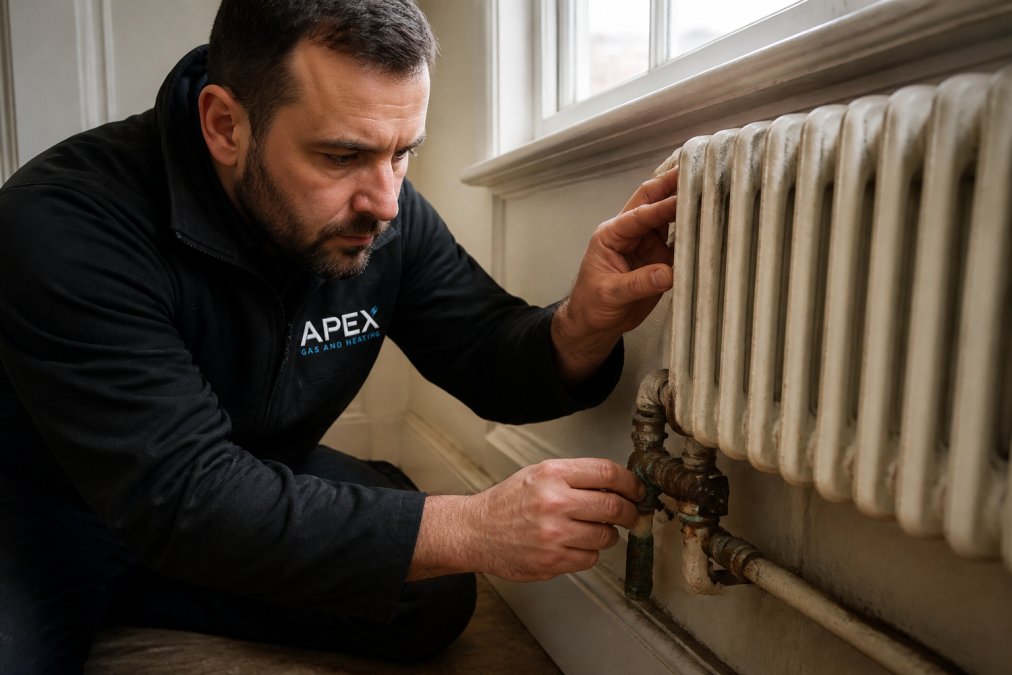
Inspect your boiler and note its age, model, and fuel type. Boilers older than 15 years typically operate at 60-75% efficiency. Modern condensing boilers achieve 90%+ efficiency. Check your radiators for signs of sludge or corrosion. If radiators feel cold at the bottom or only warm at the top, internal debris is restricting water flow.
An energy performance certificate (EPC) provides a baseline assessment of your home’s energy efficiency. Review the recommendations, as they often highlight the most cost-effective improvements for your specific property.
Draught-Proof Windows and Doors to Reduce Heat Loss
Draught-proofing is one of the quickest wins for improving central heating efficiency. Older windows and doors often have loose seals and gaps that allow warm air to escape.
Check the seal around external doors by holding a lit candle near the edges on a windy day. If the flame flickers, air is leaking. Draught excluders, foam strips, brush seals, or rubber gaskets cost very little and install easily. Self-adhesive foam strips work for many gaps; for larger spaces, consider brush-seal strips or silicone caulk.
Windows in older properties often have single glazing or loose-fitting sashes. Double-glazed replacement windows are expensive, but draught-proofing strips around the frame reduce air leakage significantly. Heavy thermal curtains or lined roller blinds help trap heat at night. Secondary glazing (a thin additional pane fitted inside existing frames) offers thermal benefits at a fraction of the cost of full replacement.
Pay particular attention to sash windows, which are common in period homes. Brush seals designed specifically for sashes work well. Similarly, check letterboxes, keyholes, and any other openings that penetrate the external envelope.
Draught-proofing can offer significant savings through reduced heating bills, and you’ll notice rooms feel warmer immediately.
Benefits of Power Flushing Central Heating Systems
Power flushing removes sludge, rust, and debris that accumulate inside radiators and pipework over decades. This buildup restricts water flow, forces your boiler to work harder, and reduces radiator output.
Sludge forms when metal components corrode inside the heating circuit. In systems over 20 years old, this is almost inevitable. You’ll notice sludge buildup if radiators are cold at the bottom, if some radiators heat slowly, or if your boiler cycles on and off frequently.
Power flushing involves connecting specialist equipment to your heating system and pumping high-velocity water through the circuit to dislodge and flush out debris. The process typically takes 4-8 hours depending on system size. After flushing, an inhibitor chemical is added to prevent future corrosion.
Homeowners report that radiators heat more evenly, rooms reach target temperature faster, and boiler noise stops. Your boiler efficiency improves because it’s no longer working against restricted flow. In some cases, power flushing extends boiler life by several years.
If you’re planning a boiler replacement, power flushing beforehand is essential. A new boiler installed into a sludge-filled system will underperform and may develop faults quickly. Apex Gas & Heating Ltd recommends power flushing as a precursor to any boiler upgrade.
How to Bleed Radiators Effectively for Better Performance
Air trapped inside radiators prevents hot water from filling them completely, leaving sections cold. Learning how to bleed radiators effectively is a simple maintenance task that improves heat output.
You’ll need a radiator bleed key (a small square or flat tool) and a container to catch water drips. Turn off your heating and let the system cool slightly. Locate the bleed valve, typically a small nipple at the top corner of each radiator. Place your container underneath. Insert the bleed key and turn it anticlockwise slowly, you’ll hear a hiss as air escapes. Once water drips out steadily with no more air hissing, turn the key clockwise to close it.
Bleed radiators in order from those furthest from the boiler toward it. This ensures air is pushed progressively toward the system outlet.
After bleeding, check your system pressure using the gauge on the boiler. If pressure has dropped significantly, top up the system using the filling loop (a flexible pipe with isolation valves under or near the boiler). Consult your boiler manual for the correct pressure range, typically 1-1.5 bar when cold.
Bleed radiators annually, ideally before winter. If air keeps returning to the same radiators, it may indicate a leak or a problem with the system’s air vent, worth having an engineer investigate.
Smart Thermostat Installation Benefits and Setup
A smart thermostat gives you precise control over when and how much your heating runs, eliminating wasteful cycles and adapting to your actual occupancy patterns.
See our boiler repair and servicing →
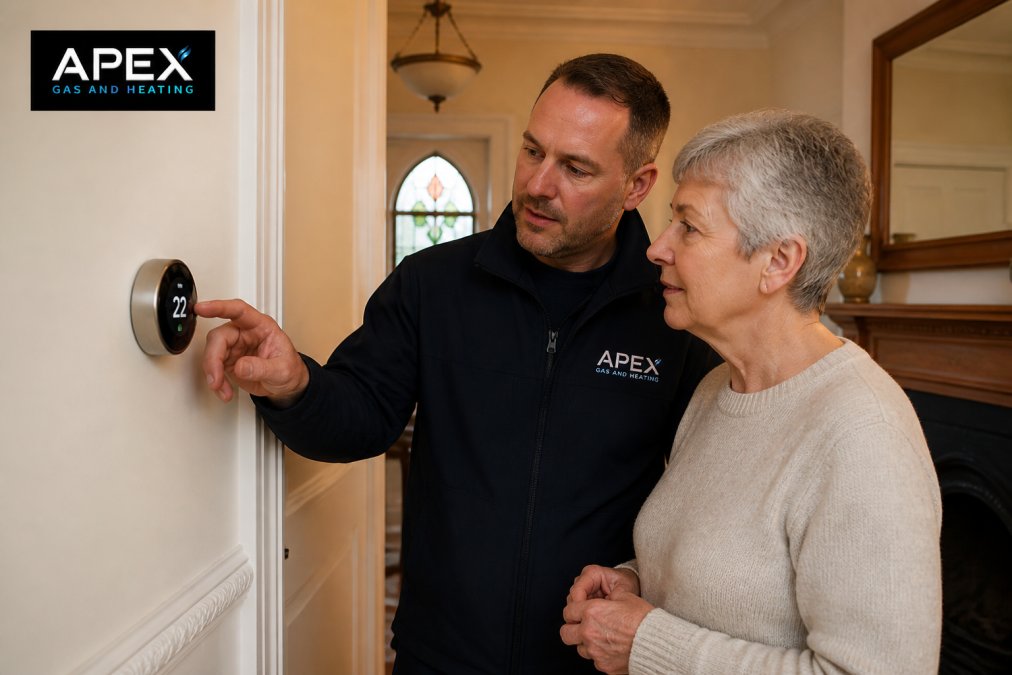
Traditional thermostats are often positioned in hallways or living rooms, meaning they respond to local temperature rather than your home’s actual heating needs. Smart thermostats learn your schedule, allow remote adjustment via smartphone, and some models include room sensors that balance temperature across your property.
Installation is straightforward for most properties. The thermostat replaces your existing wall-mounted unit, connecting to the same wiring. Most smart models work with standard heating systems, though you should verify compatibility with your specific boiler before purchasing.
Benefits include scheduling heating to run only when you’re home, reducing temperature by 1-2°C when away or asleep (each degree saves roughly 3% on heating bills), geofencing that turns heating on as you approach home, and historical data showing when and how much you heat.
Setup typically takes 10-15 minutes. Download the app, connect to your home WiFi, input your schedule, and let the system learn your preferences over 1-2 weeks.
Loft and Floor Insulation to Retain Heat
Loft insulation is the single most effective upgrade for reducing heat loss in older homes. An uninsulated loft loses enormous amounts of warmth, particularly in period properties where the roof structure is exposed.
Check your loft depth. If insulation is less than 100mm thick, or if there’s no insulation at all, you’re losing heat rapidly. Modern standards recommend 270mm of mineral wool or equivalent. Adding insulation is straightforward: lay mineral wool batts or rolls between the joists, ensuring complete coverage with no gaps.
Ensure loft insulation doesn’t block ventilation. Older properties sometimes have inadequate roof ventilation, which can lead to condensation and damp. If your loft feels damp or shows signs of mould, improve ventilation before adding insulation. Soffit vents, ridge vents, or gable vents allow air to circulate while insulation prevents heat loss.
Floor insulation is less commonly addressed but equally important in older homes. Ground floors in properties built before cavity wall construction often sit directly on earth with minimal protection. If your ground floor feels noticeably colder than upper floors, poor floor insulation is likely responsible.
Solid concrete floors can be insulated from above by laying rigid foam board under new flooring. Suspended timber floors can be insulated by adding mineral wool between the joists from below or by lifting floorboards and inserting batts from above.
For many homeowners, loft insulation is the priority, it’s the quickest, cheapest improvement with the most dramatic effect on central heating efficiency in older homes.
When to Upgrade Your Boiler for Maximum Efficiency
If your boiler is over 15 years old, replacement often delivers better returns than continued repairs. Modern condensing boilers operate at 90%+ efficiency, compared to 60-75% for older conventional models. This efficiency gap means a new boiler can reduce heating bills by 20-30% compared to an ageing unit.
Signs that replacement is worth considering include: boiler is over 15 years old, repair costs are significant, boiler fails to maintain consistent temperature, kettling or banging noises, pilot light won’t stay lit, or annual servicing reveals significant corrosion or wear.
Before committing to replacement, have a qualified engineer assess your system. They can confirm whether your boiler is the efficiency bottleneck or whether other factors (insulation, draught-proofing, radiator performance) are the real culprits.
When you do upgrade, choose a modern condensing boiler. These extract heat from exhaust gases, recovering energy that conventional boilers waste. Condensing boilers require a condensate drain (a small pipe that removes acidic water produced during the condensation process), but installation is straightforward in most properties.
Boiler choice depends on your fuel type and property size. Gas boilers remain the most common and cost-effective option for properties with mains gas. Oil boilers are necessary for rural properties without gas supply. Heat pumps (air source or ground source) are increasingly popular but require more space and higher upfront investment.
When you’re ready to explore boiler replacement, Apex Gas & Heating Ltd can assess your current system and recommend the most efficient option for your property. Our team are approved Glowworm and Worcester installers, meaning you’ll receive expert fitting and manufacturer support.
Summary Table: Central Heating Efficiency Improvements
| Improvement | Typical Cost | Payback Period | Difficulty |
|---|---|---|---|
| Draught-proofing | See website for pricing | 1-2 years | DIY-friendly |
| Power flushing | See website for pricing | Immediate | Professional only |
| Bleeding radiators | See website for pricing | N/A | DIY-friendly |
| Smart thermostat | See website for pricing | 1-2 years | DIY or professional |
| Loft insulation | See website for pricing | 3-5 years | DIY or professional |
| Boiler replacement | See website for pricing | 7-10 years | Professional only |
Improving central heating efficiency in older homes requires a combination of maintenance, targeted upgrades, and strategic replacements. Start with quick wins like draught-proofing and radiator bleeding, then move toward larger investments in insulation and boiler replacement. Each step reduces heat loss, lowers your energy bills, and makes your home more comfortable.
The most effective approach depends on your property’s specific condition, age, and construction. A Victorian terrace with solid walls and single glazing faces different challenges than an Edwardian semi with cavity walls and original sash windows. An energy audit or professional assessment helps identify which improvements will deliver the best returns for your situation.
Apex Gas & Heating Ltd provides boiler servicing, replacement, and system assessments across Sussex and Surrey. If you’re uncertain whether your heating system is performing efficiently, or if you’re ready to upgrade to a modern condensing boiler, get a quote from our approved installers. We’ll assess your current setup and recommend the most cost-effective path to improved central heating efficiency in your older home.
Frequently Asked Questions
What are the main causes of poor central heating efficiency in older homes?
Older homes lose heat through uninsulated lofts, single-glazed windows, draughty doors, corroded boilers, and sludge accumulation in pipework. Many period properties also have high ceilings and solid walls without cavity insulation, which increases thermal loss significantly. A professional heating assessment can identify which issues affect your property most.
What are the benefits of power flushing central heating systems?
Power flushing removes sludge, rust, and debris from your heating system, improving water circulation and boiler efficiency. It reduces cold radiators, can help lower energy bills, extends boiler lifespan, and prevents breakdowns during winter. Older systems particularly benefit, as sludge accumulates over decades and restricts heat distribution throughout your home.
How often should I bleed my radiators to maintain central heating efficiency?
Bleed radiators annually before winter or whenever you notice cold patches at the top. Air trapped in radiators prevents hot water circulation, reducing heating output. Bleeding takes minutes and is a simple DIY task: turn the bleed key at the radiator's top valve until water flows, then close it. Regular bleeding keeps your system running efficiently.
Can smart thermostats really reduce heating costs in period properties?
Yes. Smart thermostats learn your routine, adjust temperatures automatically, and allow remote control via smartphone. Many users see energy savings by avoiding overheating and scheduling heating to run only when needed. For older homes with poor insulation, smart controls prevent wasted heat and work alongside other efficiency measures like draught-proofing and insulation.