






Last Updated: October 29, 2026
Quick Summary
A gas hob leaking usually shows up as a rotten-egg smell near the hob, a steady hiss from the burners or connections, or burners that click but will not light. Treat any suspected leak as urgent: stop using the hob, open windows, avoid naked flames and switches, leave the property and call 0800 111 999.
- A rotten-egg smell near the hob, floor or meter is the most common warning sign.
- A steady hiss suggests gas escaping under pressure and should be treated as an emergency.
- Never use a lighter, match or naked flame to look for a gas leak.
- Leave the property and call the National Gas Emergency number, 0800 111 999, from outside.
- Book a Gas Safe registered engineer to inspect the hob, connections and hoses.
Table of Contents
- How a Gas Hob Leak Usually Shows Itself
- Signs of a Gas Leak to Check For Around the Hob
- What to Do If You Smell Gas
- Gas Leak Emergency Steps for UK Homes
- Why Your Gas Hob Is Not Lighting Properly
- What Not to Do When Checking for a Leak
- Booking a Gas Safe Inspection of Your Hob
- Frequently Asked Questions
How a Gas Hob Leak Usually Shows Itself
Most gas hob leak incidents are slow, quiet and easy to miss. The first sign is often a faint smell rather than anything you can see. Natural gas has no smell of its own, so a warning odour is added to it, which many people describe as rotten eggs.
A gas hob leak tends to come from a few places around the hob: a loose burner connection, a tap that does not seal fully when turned off, or a flexible hose that has cracked or worn with age. Any of these can let gas escape into your kitchen.
Knowing the signs early gives you time to act. This guide explains what to look for, what to do straight away and when to call a Gas Safe registered engineer.
Signs of a Gas Leak to Check For Around the Hob
Start by using your senses in a quiet kitchen, with the hob turned off. Gas escaping from a hob often gives off clear clues, and knowing what each one means helps you judge how urgently to act.
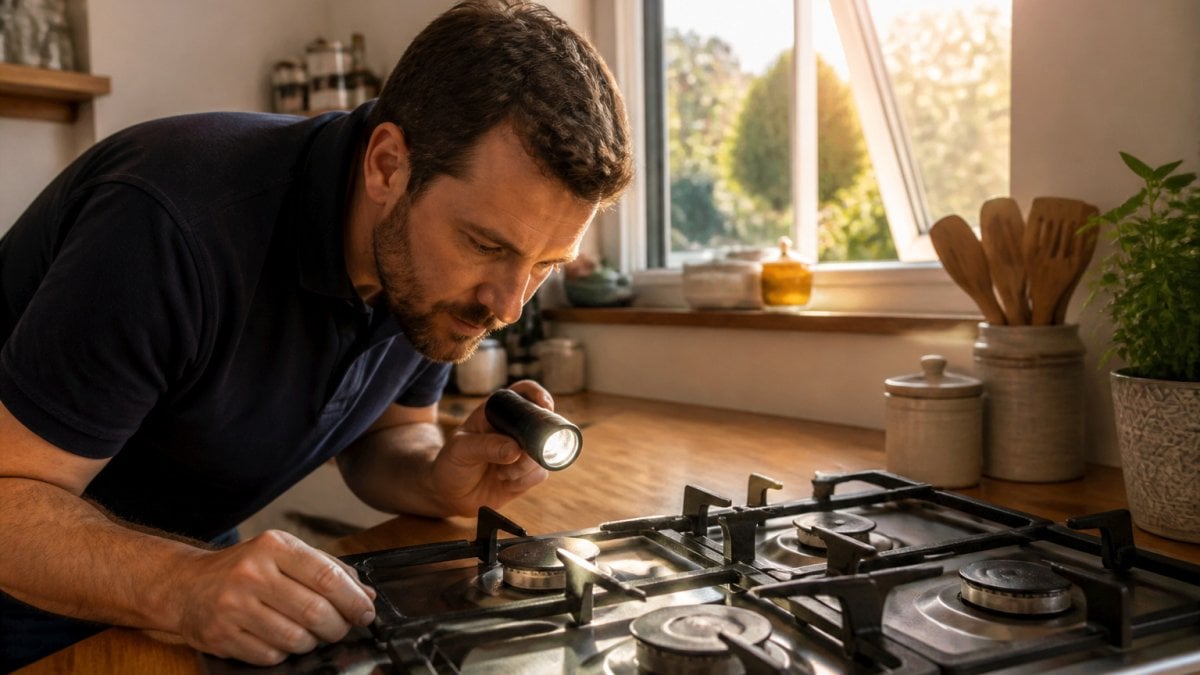
- A rotten-egg or sulphur-like smell, strongest near the hob, the floor or the meter cupboard
- A faint hissing, whistling or rushing sound from the burners, pipework or connections
- Burners that will not light, click repeatedly without igniting, or flames that look weak, yellow or uneven
- Dark or sooty marks on pans, the hob surface or nearby walls
- Headaches, dizziness, nausea or a feeling of breathlessness while in the kitchen
What Each Sign Tells You
A smell is the most common warning. The odour is added to natural gas precisely because the gas itself is odourless, so any smell near an appliance that is switched off deserves attention. Pay particular attention if the odour is strongest close to the hob, at floor level (gas is lighter than air but can pool in low spots in still conditions) or near the meter.
Hissing is less common but more serious. A steady hiss suggests gas escaping under pressure from a joint, hose or valve, and it should be treated as an emergency rather than something to investigate at leisure.
Hob-specific symptoms matter too. If a burner clicks but will not ignite, if the flame keeps extinguishing shortly after lighting, or if one ring behaves differently from the others, the burner valve, injector or ignition electrode may need attention. Do not try to fix these yourself, a Gas Safe registered engineer can test the components safely.
Sooty marks are a sign of incomplete combustion rather than a leak in the pipework, but they still mean the appliance needs prompt attention. Yellow or lazy flames instead of crisp blue ones point the same way.
Symptoms Beyond Smell and Sound
Physical symptoms can appear before a smell is obvious, particularly in a small kitchen or a flat with limited ventilation. Headaches, dizziness, nausea, tiredness and a feeling of breathlessness are all worth taking seriously if they ease when you leave the room and return when you go back in.
If you or anyone in the household feels unwell alongside a gas smell, leave the property, get fresh air and call the National Gas Emergency number from outside. Seek medical advice if symptoms persist.
Ignition Odour Versus a Persistent Leak
A brief smell when you light a burner is often normal. Small amounts of gas can escape during ignition and clear within a few seconds once the flame catches.
A persistent leak is different. If the smell lingers after the burners are off, returns when nothing is in use, or is noticeable on entering the kitchen after time away, treat it as a leak. Repeated or ongoing odours should always be checked by an engineer, do not talk yourself out of calling because the smell fades.
Never use a naked flame, lighter or match to check for a leak, and never run the hob to see whether the smell gets stronger. Both can turn a small leak into a fire or explosion risk.
The table below sets out each warning sign, what it usually means and how urgently to act.
| Sign | What it may mean | Urgency |
|---|---|---|
| Rotten-egg or sulphur-like smell | Gas escaping, strongest near hob, floor or meter | Act immediately |
| Steady hissing or whistling | Gas escaping under pressure from a joint, hose or valve | Emergency |
| Burner clicks but will not light | Burner valve, injector or ignition electrode fault | Book an engineer |
| Weak, yellow or uneven flames | Incomplete combustion or valve fault | Book an engineer |
| Dark or sooty marks on pans or walls | Incomplete combustion | Prompt attention |
| Headaches, dizziness or nausea in the kitchen | Possible gas exposure | Leave and get fresh air |
What to Do If You Smell Gas
If you smell gas, act quickly and calmly. Do not wait to see if it goes away.
Follow these steps:
- Open doors and windows to let fresh air in
- Turn off the gas at the meter if you can reach it safely
- Do not use naked flames, lighters or matches
- Do not smoke or switch electrical devices on or off
- Leave the property and call the National Gas Emergency number, 0800 111 999
Once you are outside, stay out until the emergency service confirms it is safe to return.
Gas Leak Emergency Steps for UK Homes
In an emergency, speed and clear actions matter most. Use the steps below as a simple checklist.
- Get everyone out of the property, including pets
- Avoid any action that could create a spark or flame
- Call the National Gas Emergency number, 0800 111 999, from outside
- Keep clear of the property until the engineer says it is safe
- Arrange a Gas Safe engineer to inspect the hob and connections
Never try to find a leak with a flame. Never try to repair a gas fitting yourself.
Why Your Gas Hob Is Not Lighting Properly
A hob that will not light is not always a leak, but it can be a warning sign. Common causes include a blocked burner port, a damaged ignition electrode or a fault in the gas valve.
Simple cleaning can sometimes help. Wipe away spilt food and make sure burner caps sit correctly. If the burner still will not light, stop using it and book an engineer.
Gas pressure problems can also cause poor flames. An engineer can test the supply and identify the cause safely. If the fault points to a wider issue with your appliances, a boiler repair visit from our team can cover the connections as well.
What Not to Do When Checking for a Leak
Many people make a suspected leak worse by trying to test for it in the wrong way. The risks below are the ones engineers most often hear about after the event.
- Do not use a naked flame. A lighter, match or candle is the single most dangerous way to look for gas. A flame near an escaping cloud can ignite it instantly.
- Do not run the hob to see if the smell gets stronger. Operating the appliance adds more gas to the room and can trigger the ignition source you are trying to avoid.
- Do not switch lights, fans, extractors or sockets on or off. A spark at a switch can ignite gas. Leave electrics exactly as they are until you are outside.
- Do not smoke, vape or use a phone indoors once you suspect a leak. Move outside before making any call.
- Do not dismantle the hob, pipework, hose or valve. Gas fittings should be worked on by a Gas Safe registered engineer.
- Do not ignore a smell because it fades quickly. Intermittent odours are common with a slow leak and are just as worth reporting.
- Do not assume a soapy-water test settles it. A proper inspection by a registered engineer uses suitable leak-detection equipment, and a DIY test can miss a slow leak.
Where Safe Checking Ends
There is a clear line between what you can safely do and what needs an engineer. Safe actions are limited to using your senses, turning the gas off at the meter if you can reach it without effort, opening doors and windows, and leaving the property.
Anything that involves touching a gas fitting, testing a joint, removing a burner cap beyond a simple clean, or resetting a valve belongs to a Gas Safe registered engineer.
If in doubt, treat it as a leak: stop using the hob, avoid anything that could spark, get everyone outside and call 0800 111 999 from a safe location.
Booking a Gas Safe Inspection of Your Hob
If you are unsure about your hob, book a Gas Safe inspection. A registered engineer can check the burners, connections, hoses and valves and explain what they find.
Apex Gas & Heating Ltd provides a 24/7 emergency call-out service for urgent concerns across Sussex and Surrey, and works on homes only.
For a formal check of your gas appliances, see our gas safety CP12 service.
Ask the engineer to explain any faults and what needs fixing.
Frequently Asked Questions
What are the first signs of a gas leak?
The most common first sign is a rotten-egg smell, because natural gas is odourless and an odourant called mercaptan is added so leaks can be noticed. You may also hear a hissing sound near a pipe, appliance or connection. Some people notice a headache, dizziness or nausea, which can indicate exposure. If you notice any of these, avoid flames and switches, open windows, leave the property and call the National Gas Emergency Service on 0800 111 999 from a safe place.
Can a gas hob leak without a smell?
Yes, a leak can be very small or intermittent, and the odourant may be less noticeable in some situations, so a lack of smell does not prove the hob is safe. Hissing, a gas smell that comes and goes, or unexpected sickness or headaches are reasons to take action. Do not rely on smell alone. Arrange an inspection by a Gas Safe registered engineer if you have any doubt.
Should I turn off the gas if I suspect a leak?
If you smell gas, the safest first step is to turn off the gas supply at the meter or the emergency control valve if you can reach it safely, without using any flame or electrical switch. Then open windows, leave the property and call the National Gas Emergency Service on 0800 111 999 from outside. Do not turn lights or appliances on or off while you are in the property.
Who should I call if I think my gas hob is leaking?
If you smell gas or suspect a leak, call the National Gas Emergency Service on 0800 111 999 straight away. Once the area is safe, a Gas Safe registered engineer can inspect the hob, burners, valves and connections and repair or replace faulty parts. Apex Gas & Heating Ltd offers boiler repair and gas safety services across Sussex and Surrey, and you can request a quote through our website.