








Table of Contents
- What a Boiler Lockout Means and Why It Happens
- Safety Checks Before You Reset a Boiler
- How to Locate the Reset Button on Your Boiler
- Step-by-Step: How to Reset a Boiler After Lockout
- Boiler Error Codes Explained: What the Display Is Telling You
- Common Causes of Low Boiler Pressure and Lockouts
- When to Call a Gas Safe Registered Engineer
- Frequently Asked Questions
Last Updated: September 16, 2026
What a Boiler Lockout Means and Why It Happens
A boiler lockout is a safety shutdown: the control board has detected a fault it cannot safely clear and has cut the gas supply to the burner. Unlike a normal switch-off, it is deliberate, and the boiler stays off until someone resets it manually.
The most common triggers are ignition failure, flame failure, low system pressure, a frozen condensate pipe, or a power cut that interrupted the startup sequence. In each case the boiler is protecting you, not failing on you.
At Apex Gas & Heating Ltd, we attend lockouts across Sussex and Surrey every week.
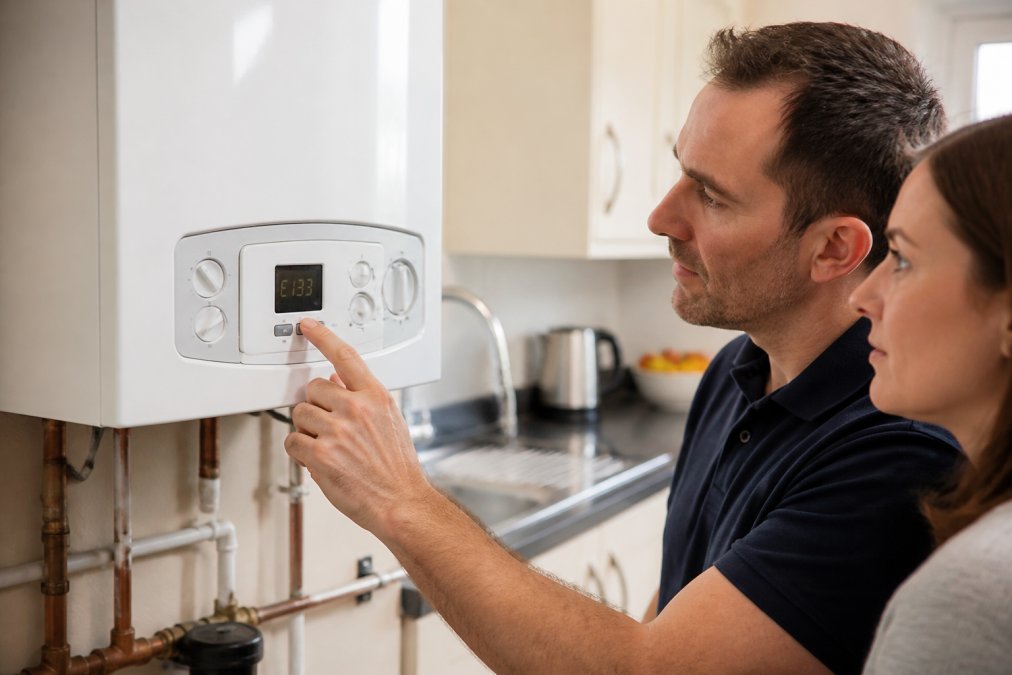
A lockout is a safety mechanism, not a breakdown. The boiler has shut itself down because something in the startup sequence did not check out.
Safety Checks Before You Reset a Boiler
Before you touch anything, confirm three things: no smell of gas, no signs of leaking water, and a clear area around the boiler. If you smell gas, do not reset the boiler. Turn off the gas at the meter, open windows, leave the property, and call the National Gas Emergency Service on 0800 111 999.
The Gas Safe Register’s guidance for homeowners is clear that gas work must only be carried out by a registered engineer. Pressing a reset button is a user control, not gas work, so it sits outside that restriction. Anything beyond it does not.
Checking Gas Supply and Power
Two failure points cause more false alarms than any other: an interrupted gas supply and a power cut.
- Check other gas appliances. If the hob lights, gas is reaching the property.
- Check the boiler’s power. Look for a lit display or standby light.
- Check the programmer or thermostat is calling for heat.
- Check the pressure gauge reads between 1 and 1.5 bar when the system is cold.
If the display is dead, the issue is electrical and resetting will do nothing. If the gauge reads below 1 bar, pressure has dropped and you must top up the filling loop before resetting.
How to Locate the Reset Button on Your Boiler
The reset button is almost always on the front control panel, either as a dedicated button marked with a flame symbol or circular arrow, or as a combined button that also serves as the pressure or mode selector. On most modern wall-mounted boilers it sits to the right of the display, below the pressure gauge, or behind a flip-down flap.
If you cannot find it, the boiler manual is the fastest answer: every manufacturer publishes a digital copy, and searching your model number plus “manual” will bring it up.
Visual Identification Guide for Common Boiler Brands
Where the reset control sits varies by manufacturer.
| Brand | Reset Control Location | Typical Marking |
|---|---|---|
| Worcester Bosch | Right of the display, below the pressure gauge | Flame symbol or “Reset” |
| Glow-worm | Left side of the control panel | Circular arrow |
| Baxi | Centre panel, beside the mode selector | Flame with a line through it |
| Vaillant | Far right of the fascia | Flame symbol |
| Ideal | Below the display, separate button | “Reset” text |
If your boiler is not listed, look for any button carrying a flame or a circular arrow, that is the reset control on most models.
Step-by-Step: How to Reset a Boiler After Lockout
Here is the sequence that works on almost every domestic boiler.
- Note the fault code. Before you reset anything, write down what the display shows. This is the single most useful piece of information for an engineer, and it disappears once the boiler restarts.
- Turn the thermostat down. Set the room thermostat to its lowest setting so the boiler does not immediately fire at full demand.
- Locate the reset button using the guide above or your manual.
- Press and hold for three seconds. Most boilers require a sustained press, not a tap. Some models need up to five seconds.
- Release and wait. The boiler will run a purge cycle, usually 30 to 60 seconds, before attempting ignition.
- Watch the display. A steady flame symbol or a temperature reading means it has fired successfully.
- Turn the thermostat back up and check that radiators begin to warm within 15 minutes.
How Long to Hold the Reset Button
Three seconds is the common figure, but the correct hold time is model-specific, and getting it wrong is a frequent reason a reset appears not to work.
- Worcester Bosch and Vaillant models typically need a firm press of around three seconds until the display flashes or the fault code clears.
- Baxi and Ideal units often respond to a shorter press of one to two seconds, and holding longer can push the boiler into a service mode rather than a reset.
- Glow-worm controls generally require the button to be held until the display changes, which can take up to five seconds.
If nothing happens after a five-second press, release and wait ten seconds before trying once more. A button that feels loose or fails to register points to a control panel fault rather than a lockout, and no amount of pressing will clear it.
What Happens During the Purge Cycle
After a successful reset the boiler does not fire immediately. It runs a pre-purge, drawing air through the combustion chamber to clear residual gas before ignition, which is why you hear the fan run for 30 to 60 seconds with no flame. Do not press reset again during this window: interrupting a purge cycle is the fastest way to trigger a second lockout.
Once the purge completes you should hear the ignition spark, then the flame establishing, and the display will move from a flashing fault code to a steady temperature reading. If the boiler fires, runs a few minutes and locks out again, the fault is intermittent, note that pattern for the engineer.
If the First Reset Fails
A single failed reset is not unusual, particularly after a power cut or a period of inactivity.
Never hold the reset button down continuously or press it more than three times in succession. On some models this can cause unburnt gas to accumulate in the combustion chamber, which is a genuine safety risk when the boiler next attempts ignition.
If your boiler locks out after a power cut, check the programmer has retained its settings before you reset. A programmer that has defaulted to ‘off’ will let the boiler fire, satisfy nothing, and lock out again within minutes, which looks like a boiler fault but is not.
Boiler Error Codes Explained: What the Display Is Telling You
| Code Type | Common Meaning | Action |
|---|---|---|
| F1 / E1 / EA | Ignition failure or flame failure | Check gas supply, then reset once |
| F22 / E119 | Low system pressure | Top up via filling loop to 1-1.5 bar |
| F28 / E133 | Flame detected when none expected | Do not reset. Call an engineer |
| F75 / E110 | Overheat thermostat tripped | Check pump and radiator valves |
| F29 / E168 | Flame lost during operation | Check condensate pipe for freezing |
Common Causes of Low Boiler Pressure and Lockouts
Low boiler pressure is the most frequent cause of lockout we see, and the most misunderstood.
Seasonal Lockout Causes: Winter Versus Summer
Lockouts cluster at two points in the year, with a different cause each time.
Lockouts After Running Out of Fuel
If your property runs on LPG or oil rather than mains gas, running the tank low is a common lockout trigger.
Lockouts After a Power Cut
Match the lockout to the season and the fuel type before you reach for the reset button. A frozen condensate pipe, an empty LPG tank and a pressure drop all present as the same lockout, but each needs a different first response.
When to Call a Gas Safe Registered Engineer
Photograph the fault code and the pressure gauge reading before you call. Engineers can often identify the likely part needed from those two images alone, which means a first-visit fix instead of a second appointment.
Frequently Asked Questions
How long should I wait before trying to reset a boiler after lockout?
Wait at least 10 to 15 minutes after the lockout occurs before pressing the reset button. This gives the boiler’s safety mechanisms, such as the overheat thermostat, time to cool and reset internally. If you try immediately, the boiler may lock out again straight away. If it fails to restart after two attempts, stop and call a Gas Safe registered engineer.
Why does my boiler keep locking out after a reset?
Repeated lockouts usually point to an underlying fault rather than a one-off glitch. Common causes include low system pressure, a blocked condensate pipe, ignition failure, or a faulty pump. If your boiler locks out more than twice in a row, do not keep pressing reset. Book a boiler repair with a Gas Safe registered engineer to diagnose the root cause properly.
Is it safe to reset a boiler multiple times?
No. Resetting a boiler more than twice in quick succession can mask a serious fault and may damage components. The lockout is a safety mechanism designed to protect you. If the boiler will not stay running after two reset attempts, switch it off and arrange for a qualified engineer to inspect it. This is especially important if you smell gas or see warning lights.
What should I do if the reset button does not work?
If pressing the reset button has no effect, check that the boiler has power and the gas supply is on. Also check the pressure gauge; if it reads below 1 bar, you may need to repressurise the system. If the button still does nothing, the fault likely requires professional attention. Call Apex Gas & Heating Ltd for a fast emergency call-out across Sussex and Surrey.