







Table of Contents
- What Is the Ideal Boiler Pressure and Why It Matters
- Common Causes of Low Boiler Pressure Explained
- How to Check Your Boiler Pressure: Step-by-Step
- Identifying Leaks in Your Central Heating System
- How to Repressurize a Boiler Using Your Filling Loop
- Boiler Leaking Water and Low Pressure: Diagnosis and Action
- When to Call a Gas Safe Engineer Near You
- Seasonal Maintenance Checklist to Prevent Pressure Loss
Common Causes of Low Boiler Pressure: A Practical Guide
Last Updated: July 27, 2026
Understanding the common causes of low boiler pressure is essential for keeping your heating system running efficiently. At Apex Gas & Heating Ltd, we’ve helped hundreds of homeowners across Sussex and Surrey diagnose and fix pressure issues before they turn into costly breakdowns. Low boiler pressure affects everything from heating performance to system safety, yet many people don’t realize what’s happening until their radiators stop warming up entirely.
Your boiler’s pressure gauge tells a story about your heating system’s health. When that needle drops below the normal operating range, it signals one of several underlying problems, some simple enough to fix yourself, others requiring a qualified Gas Safe engineer.
What Is the Ideal Boiler Pressure and Why It Matters
Your boiler operates most efficiently within a specific pressure range, typically between 1 and 1.5 bar when the system is cold. This measurement tells you how much force the water inside your heating circuit is exerting against the boiler’s internal components.
Understanding bar and psi measurements
Pressure is measured in two common units: bar and psi (pounds per square inch). Most UK boilers use bar as the standard measurement. One bar equals approximately 14.5 psi. When we talk about ideal boiler pressure in the UK, we’re typically referring to 1-1.5 bar for a cold system at rest.
How pressure affects your heating system
Pressure drives water circulation through your central heating system. Without adequate pressure, water moves sluggishly through pipes and radiators, delivering less heat to your home. The pressure also maintains system integrity by keeping water in the pipes rather than allowing it to escape through micro-leaks. When pressure drops significantly, your boiler’s pressure relief valve may activate, further reducing pressure and creating a cycle of declining performance.
Check your boiler’s pressure when the system is cold and at rest. Pressure readings taken when the heating is running will be artificially elevated and won’t give you an accurate picture of your actual system pressure.
Common Causes of Low Boiler Pressure Explained
Low boiler pressure rarely appears without a cause. The most frequent culprits are leaks, bleeding radiators, expansion vessel failure, and faulty pressure relief valves.
Leaks in pipework and solder joints
Leaks represent the single most common cause of pressure loss in heating systems. Water escaping from your pipework reduces the total volume in your closed system, and that missing water directly translates to lower pressure readings. External leaks are usually obvious, you’ll see water pooling under pipes or staining on ceilings and walls. Internal leaks are trickier, with water escaping inside walls or under floorboards without visible evidence at first.
Solder joints are particularly vulnerable. Over time, corrosion or manufacturing defects can cause pinhole leaks that drain enough water to drop your pressure by 0.3-0.5 bar within a few days.
Bleeding radiators and pressure loss
When you bleed a radiator to release trapped air, you’re also releasing a small amount of water. Each time you open a bleed valve, roughly 50-100ml of water escapes. After bleeding radiators, you should expect to top up your system pressure using the filling loop.
Expansion vessel failure
Your expansion vessel is a small tank, usually mounted near the boiler, that absorbs excess water as it heats and expands. Inside this vessel is a rubber diaphragm that separates water from pressurized air. When the diaphragm fails, water enters the air chamber, reducing the vessel’s ability to absorb expansion and forcing excess water out through the pressure relief valve.
A failed expansion vessel creates a specific pattern: your pressure drops, you repressurize, the heating runs fine initially, then pressure drops again within hours. Expansion vessel failure is relatively common in systems over 8-10 years old and requires professional replacement.
Faulty pressure relief valve symptoms
The pressure relief valve (PRV) is a safety device designed to open when pressure exceeds a safe threshold, typically around 3 bar. A faulty PRV may open prematurely or fail to close properly after opening, causing water to continuously escape from your system.
You might notice water dripping from a small pipe near your boiler. Alternatively, you may see pressure dropping steadily without any visible leak elsewhere in the system.
Never attempt to repair or adjust a pressure relief valve yourself. This is a safety device that must be handled by a qualified Gas Safe engineer. Improper adjustment can prevent the valve from protecting your system if pressure becomes dangerously high.
How to Check Your Boiler Pressure: Step-by-Step
Checking your boiler pressure takes less than a minute and requires no special tools.
Reading your pressure gauge
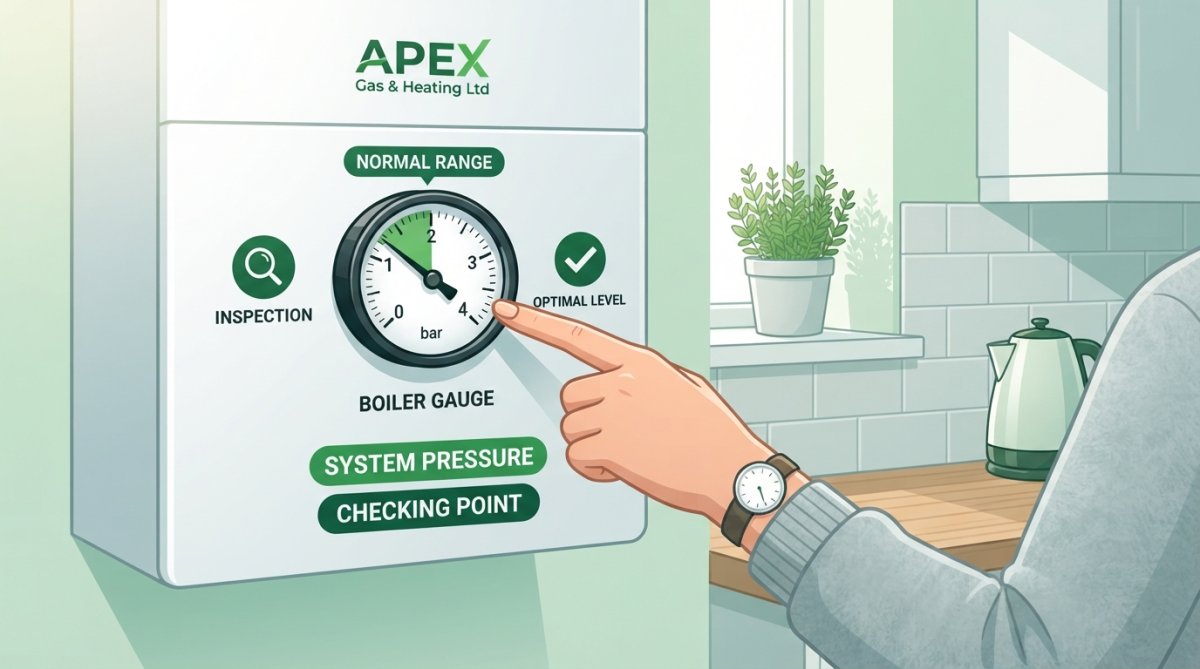
Locate your boiler’s pressure gauge, it’s typically a circular dial mounted on the front or side of the boiler unit. The gauge shows a needle pointing to a number on a scale. The normal operating range is usually marked in green, typically between 1 and 1.5 bar. If the needle is below 1 bar, your system has low pressure.
Check the gauge when your heating system is cold and has been off for at least 30 minutes. Pressure readings taken while the heating is running will be 0.2-0.4 bar higher due to thermal expansion.
Identifying visual signs of pressure problems
Cold radiators in some rooms while others heat normally suggest that low pressure isn’t pushing water to distant radiators effectively. Listen for gurgling or hissing sounds inside pipes, these often signal trapped air, which frequently accompanies pressure loss.
Check under your boiler and along visible pipework for water droplets or damp areas. Look at your expansion vessel for signs of corrosion or weeping. Discoloured patches on ceilings or walls, especially above pipes, indicate internal leaks that are slowly draining your system.
Identifying Leaks in Your Central Heating System
Once you’ve confirmed low pressure, finding the leak is your next priority.
External leaks: what to look for
Start by inspecting all visible pipework. Look under sinks, behind radiators, along the boiler unit, and in any cupboards where pipes run. Check for water pooling, damp patches, or mineral deposits (white or green staining) that indicate slow weeping from a joint.
Pay particular attention to solder joints where copper pipes connect. A tiny pinhole leak may produce only a slow drip, but over days it will noticeably reduce your system pressure. If you find an external leak, mark its location and photograph it for a Gas Safe engineer.
Internal leaks and system integrity checks
Internal leaks are hidden within walls, under floorboards, or in inaccessible pipe runs. If your pressure drops by 0.5 bar or more within a week but you can’t find any external leak, an internal leak is likely present.
Check for damp patches that gradually expand on walls or ceilings. An internal leak behind a wall will eventually show moisture on the surface as water saturates the plasterboard. System integrity is compromised when leaks are present, as water escaping creates a partial vacuum that draws in air, reducing heating efficiency.
How to Repressurize a Boiler Using Your Filling Loop
If your pressure has dropped but you haven’t found a leak, or if you’ve just bled radiators, you’ll need to repressurize your system.
What you’ll need before you start
Locate your filling loop, it’s a flexible hose with isolation valves at each end, usually positioned near the boiler. Ensure the heating system is cold before you begin. Never attempt to repressurize a hot system, as this can damage components and create safety risks.
Step-by-step repressurizing process
- Locate both isolation valves on the filling loop (one connected to the mains water supply, one connected to the boiler circuit).
- Ensure both valves are in the closed position (turned clockwise).
- Open the mains isolation valve (turn counter-clockwise) to allow water into the filling loop.
- Slowly open the boiler isolation valve (turn counter-clockwise) to allow water into your heating system.
- Watch your pressure gauge as water enters. Stop when the gauge reads 1.2-1.3 bar.
- Close both isolation valves (turn clockwise) to seal the loop.
- Turn the boiler back on and check that the pressure remains stable after 10 minutes of operation.
Common mistakes to avoid
The most frequent error is opening the isolation valves too quickly, which can cause a sudden pressure spike that triggers the pressure relief valve. Open valves slowly and deliberately. Another mistake is failing to close the isolation valves after repressurizing, this leaves the filling loop open and allows water to continue entering if a minor pressure drop occurs.
Some homeowners repressurize too high, pushing the gauge above 1.5 bar. Aim for 1.2-1.3 bar as your target.
Repressurizing is a temporary fix if you have an active leak. If your pressure drops again within a week, you have a leak that must be found and repaired. Repeatedly repressurizing without addressing the underlying cause will eventually damage your boiler.
Boiler Leaking Water and Low Pressure: Diagnosis and Action
When your boiler is actively leaking water, low pressure is inevitable.
Why water escaping causes pressure drop
Every litre of water that leaves your system reduces the total volume available to circulate. Your heating circuit is a closed loop containing a fixed amount of water that circulates continuously. When water escapes, that loop has less water to work with, resulting in lower pressure.
When to call a Gas Safe engineer
If you see water pooling directly under your boiler, or if water is dripping from the boiler unit itself, do not attempt repairs. Water inside a boiler indicates either a cracked heat exchanger, a failed internal seal, or a broken pipe connection, all of which are beyond DIY repair.
If your pressure drops and you cannot find any external leak despite a thorough inspection, the leak is likely internal to the boiler. An internal boiler leak often requires boiler replacement, as repair costs typically exceed the cost of a new unit. Contact a Gas Safe engineer immediately if you suspect an internal boiler leak. According to Gas Safe Register guidance on boiler safety, any boiler showing signs of water leakage should be inspected by a registered engineer before further use.
When to Call a Gas Safe Engineer Near You
Knowing when to stop troubleshooting and call a professional prevents wasted time and protects your system from damage.
Signs you need professional help
You should contact a Gas Safe engineer if:
- You’ve identified a leak but cannot access it (concealed pipework, solder joints, internal boiler leaks)
- The pressure relief valve is weeping water
- Your expansion vessel shows signs of failure (corrosion, weeping, or rapid pressure drops after repressurizing)
- You cannot find the source of pressure loss despite thorough inspection
- Your boiler itself is leaking water
- Pressure drops repeatedly despite having no visible leak
DIY vs professional repair: cost-benefit analysis
Repressurizing your boiler yourself takes 5 minutes and costs nothing. Bleeding radiators yourself takes 30 minutes and costs nothing. However, identifying and repairing leaks in concealed pipework, replacing expansion vessels, or fixing pressure relief valves requires specialist skills and equipment.
An engineer call-out typically costs £80-150 for diagnosis alone. If repair is needed, costs vary widely, from £200 for a simple joint repair to £800+ for an expansion vessel replacement. These costs are justified when they prevent boiler failure or water damage to your home.
Apex Gas & Heating Ltd offers transparent pricing and fast response times across Sussex and Surrey. Our 24/7 emergency call-out service means you’re never left without heating in winter, and our Gas Safe certified engineers diagnose and fix pressure issues efficiently.
Seasonal Maintenance Checklist to Prevent Pressure Loss
Regular maintenance catches pressure problems before they become emergencies.
Spring (March-May): After winter heating use, check your pressure gauge. If it’s dropped below 1 bar, investigate for leaks. Bleed radiators in rooms that were coldest during winter. Top up pressure to 1.2-1.3 bar using your filling loop.
Summer (June-August): With heating off, inspect pipework for corrosion or damp patches. Check under sinks, in cupboards, and along any visible pipe runs. Look for mineral deposits or water staining that indicate slow weeps.
Autumn (September-November): Before the heating season starts, have your boiler serviced. A professional service includes pressure system inspection and can catch problems before winter demands peak performance.
Winter (December-February): Monitor your pressure gauge weekly during the coldest months. If pressure drops by more than 0.2 bar per week, you have a leak that needs attention.
Worcester Bosch guidance on boiler maintenance recommends annual professional servicing to maintain warranty coverage and ensure safe operation.
Low boiler pressure disrupts your heating and signals an underlying problem that won’t resolve itself. Whether the cause is a slow leak, a failed expansion vessel, or a faulty relief valve, identifying the issue early prevents costly damage and keeps your home warm through winter. If you’ve checked your pressure, ruled out simple fixes like radiator bleeding, and found that pressure continues to drop, it’s time to call a professional. Apex Gas & Heating Ltd provides Gas Safe certified engineers across Sussex and Surrey who diagnose pressure problems quickly and fix them right the first time. With transparent pricing, full public liability insurance, and 24/7 emergency call-outs, you can trust our team to restore your heating system’s performance. Get a quote today and stop worrying about low boiler pressure.
Frequently Asked Questions
What are the signs of low boiler pressure?
Common signs include weak heating output, radiators not warming evenly, boiler shutting down unexpectedly, and a pressure gauge reading below 1 bar. You may also notice the heating system takes longer to reach temperature or your towel rails feel cold. Check your boiler's pressure gauge regularly, most modern boilers display pressure clearly on the front panel.
How do I repressurise a boiler safely?
Most boilers have a filling loop (a flexible hose with isolation valves) beneath or behind the unit. Turn off the boiler and let it cool slightly. Open both isolation valves slowly to allow water from the mains to enter the system until the pressure gauge reads 1-1.5 bar. Close the valves carefully and restart the boiler. If you're unsure or the pressure won't hold, contact a Gas Safe engineer.
Can a boiler lose pressure without a leak?
Yes. A faulty pressure relief valve, expansion vessel failure, or bleeding radiators can all cause pressure loss without visible water escaping. Seasonal temperature changes can also affect pressure slightly. However, if pressure drops repeatedly after repressurizing, a leak or faulty component is likely present. A Gas Safe engineer can diagnose the exact cause using system integrity tests.
Why does my boiler keep losing pressure after repressurising?
Repeated pressure loss indicates a persistent problem: a slow leak in pipework or solder joints, a failing expansion vessel, or a defective pressure relief valve. Internal leaks are harder to spot than external ones. If pressure drops within days of repressurizing, stop repressurizing yourself and call a heating engineer. Continuing to top up without fixing the underlying cause wastes water and risks boiler damage.
Leave a Reply