








Table of Contents
- What Is Boiler Pressure and Why It Matters
- How to Check Your Boiler Pressure
- Common Causes of Low Boiler Pressure
- How to Use a Boiler Filling Loop to Top Up Pressure
- Boiler Pressure Keeps Dropping After Topping Up: What to Do
- When to Call a Gas Safe Registered Engineer
- Conclusion
- Frequently Asked Questions
Last Updated: September 16, 2026
What Is Boiler Pressure and Why It Matters
Boiler pressure is the water pressure inside your central heating system, and it is the most common reason homeowners in Crawley and across Sussex wake up to no heating. This guide from Apex Gas & Heating Ltd explains how to maintain it.
Pressure loss is a symptom, not a problem. Fixing the symptom without finding the cause means you will be topping up again next month.
How to Check Your Boiler Pressure
Checking boiler pressure takes under a minute and needs no tools. Locate the gauge, read it cold, and compare it against your boiler manual.
Reading the Pressure Gauge
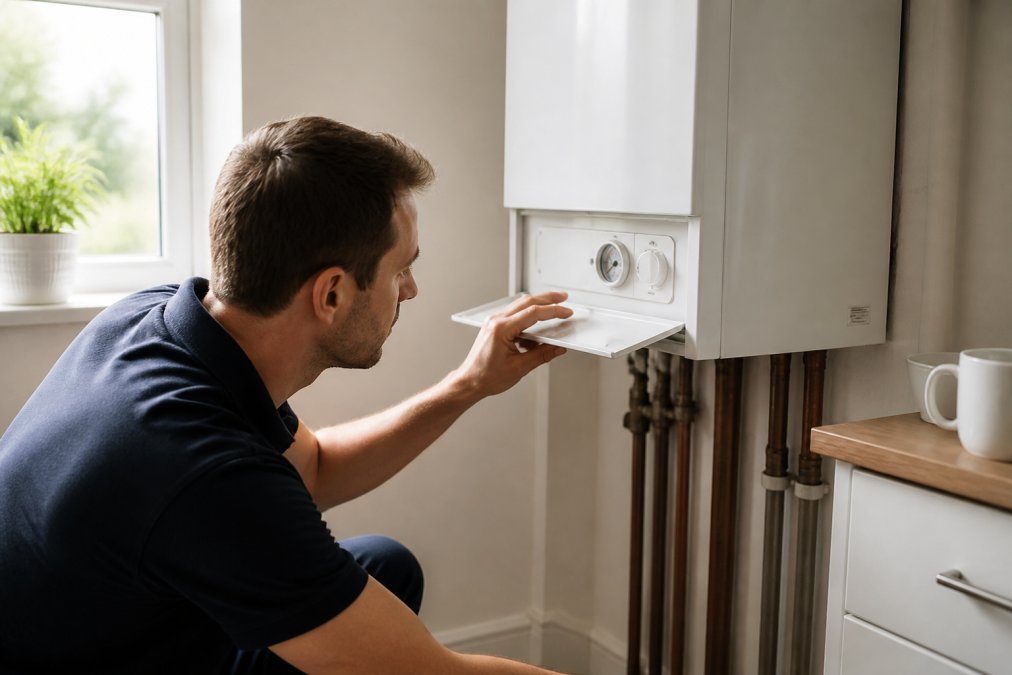
The gauge is usually a small circular dial on the front of the boiler, behind the control panel flap, or under the casing on older models. Many modern Worcester and Glowworm units show it digitally.
Visual Identification Guide: Which Gauge Do You Have?
Use this quick reference to identify your gauge type before you read it:
| Gauge Type | What It Looks Like | Where to Find It | How to Read It |
|---|---|---|---|
| Analogue dial (most common) | Circular face, numbered 0-4 bar, black needle | Front panel, behind flap, or under casing | Read where the needle points when cold |
| Digital display | LCD or LED screen showing numbers | Front control panel | Press the info or pressure button if not always visible |
| Dual-scale dial | Two number rings (bar and psi) | Same as analogue | Read the bar scale only |
| Remote or app gauge | No physical gauge; reading in app | Smartphone app or wall thermostat | Check the manufacturer’s app |
What the Correct Pressure Should Be
Most sealed heating systems want 1.0 to 1.5 bar cold. How to interpret your reading:
| Gauge Reading (Cold) | What It Means | Action |
|---|---|---|
| Below 1.0 bar | Pressure too low, lockout likely | Top up using the filling loop |
| 1.0 to 1.5 bar | Correct operating range | No action needed |
| 1.5 to 2.0 bar | Slightly high but often fine | Monitor for changes |
| Above 2.5 bar | Pressure too high | Check filling loop is closed, call an engineer |
Fault Code Interpretation Table
When pressure drops, many boilers also show a fault code. This table covers the codes most commonly seen alongside low pressure on Worcester, Glowworm, Vaillant and Ideal models. Always confirm against your own manual, as codes vary.
| Code | Common Meaning | Likely Cause | DIY Action |
|---|---|---|---|
| F1 / E1 | Ignition lockout | Low pressure, gas supply issue, or flame sensor fault | Check pressure; if below 1.0 bar, top up. If pressure is fine, call an engineer |
| F22 / E22 | Low water pressure | Pressure below minimum | Top up via filling loop; if it drops again within days, call an engineer |
| F28 / E28 | Flame loss during operation | Air in system, blocked condensate, or pressure fluctuation | Check pressure and bleed radiators; if code returns, call an engineer |
| F75 / E75 | No pressure change detected | Filling loop left open, sensor fault, or blocked pressure sensor pipe | Close filling loop; if code persists, call an engineer |
| F0 / E0 | Flow or return temperature sensor fault | Sensor or wiring issue | Call an engineer |
| F29 / E29 | Flame extinguished too often | Pressure instability or flue issue | Check pressure; if stable, call an engineer |
A fault code is a starting point, not a diagnosis. Use it to decide whether you can safely top up or whether the next step is a phone call.
Common Causes of Low Boiler Pressure
Low boiler pressure almost always traces back to water escaping the system, or to air introduced during routine maintenance. Understanding the common causes saves you from repeatedly topping up a system that is quietly leaking.
Leaks in the Heating System
Water loss is the leading cause. A pinhole leak on a radiator valve, a corroded pipe joint under the floorboards, or a failing pressure relief valve can drain pressure slowly over weeks. Look for damp patches, discoloured ceilings, or greenish crusting around radiator valves.
Bleeding Radiators
Bleeding radiators releases trapped air, so system pressure drops. This is normal, and a quick top-up restores it. Cold spots at the top of a radiator with warmth at the bottom usually mean trapped air, bleed it, then check the gauge and top up if needed.
Seasonal Causes: Why Pressure Drops Differ in Summer and Winter
The cause of pressure loss often changes with the season, and knowing which pattern you are seeing speeds up diagnosis.
Winter (high demand)
- Thermal expansion and contraction. More heating cycles stress joints and seals, so a weak joint that holds in summer may weep in winter.
- Frozen condensate pipe. Not a pressure fault itself, but it can cause a lockout homeowners mistake for low pressure. Check for ice on the external pipe.
- Higher system temperatures. Pressure swings more between hot and cold, so a marginal expansion vessel shows up as repeated low-pressure lockouts.
- Increased radiator bleeding. Trapped air rises as systems heat up, so more homeowners bleed radiators in winter, each bleed dropping pressure.
Summer (low usage)
See our boiler repair and servicing →
- Standing pressure loss. With the heating off for weeks, a slow leak becomes obvious because nothing masks it.
- Corrosion inhibitor degradation. Warm-weather stagnation lets inhibitor levels drop, accelerating internal corrosion and pinhole leaks.
- Expansion vessel charge loss. A vessel that has lost its air charge over winter may only become noticeable when the system is cold for long periods.
- Seal drying. Rubber seals and washers can dry out when not exposed to warm water, leading to small weeping joints when the system restarts in autumn.
Fault Codes That Accompany Low Pressure
The most common low-pressure codes are F22/E22 (low water pressure), F1/E1 (ignition lockout, often pressure-related), and F75/E75 (no pressure change detected). Top up first, then monitor. If the code returns within days, the cause is still present and needs an engineer.
Never keep topping up a system that loses pressure repeatedly without investigating. A constant fresh water supply dilutes the corrosion inhibitor in your system, which accelerates internal rust and can lead to premature boiler failure.
Keep a simple log: date, cold pressure reading, and whether you topped up. After a few weeks you will see whether the loss is seasonal, constant, or linked to heating use, which helps an engineer diagnose faster.
How to Use a Boiler Filling Loop to Top Up Pressure
Using a boiler filling loop is a straightforward job most homeowners can complete safely. The filling loop is a braided flexible hose, usually with two valves, that temporarily connects your mains cold water supply to the heating circuit. Some boilers have an internal filling loop operated by a key or lever; others use an external hose stored near the boiler.
Step-by-Step Guide
Total time: 10 minutes
Difficulty: Beginner
What you’ll need:
- Your boiler manual (to confirm the target pressure)
- A cloth for drips
- Turn the heating off and let the system cool. Pressure must be read cold; topping up a hot system gives a false reading.
- Locate the filling loop and pressure gauge. The gauge needs to be visible while you work.
- Open one valve slowly. On a two-valve loop, open the valve nearest the boiler first. You should hear water flowing.
- Open the second valve slowly. Watch the gauge, pressure can jump from 1.0 to 2.0 bar in seconds.
- Stop at 1.2 to 1.3 bar. Aim slightly below the maximum so there is headroom for expansion.
- Close both valves firmly. Close the valve nearest the heating circuit first, then the mains side.
- Disconnect the hose if it is removable. Leaving a filling loop permanently connected is against water regulations.
- Run the heating and recheck. After an hour, confirm the cold reading still sits in range.
Boiler Pressure Keeps Dropping After Topping Up: What to Do
Pressure that falls again within days points to an active fault rather than normal expansion and contraction, an unresolved leak, a failed pressure relief valve, or a faulty expansion vessel.
Work through this diagnostic sequence:
- Check every visible radiator valve and joint for weeping or crusting.
- Inspect the pressure relief valve discharge pipe outside the property. If it drips constantly, the valve is passing and needs replacing.
- Look at the expansion vessel charge. A vessel that has lost its air charge causes pressure to swing wildly between hot and cold.
- Check for air ingress. If radiators need bleeding every few weeks, air is being drawn in somewhere.
When to Call a Gas Safe Registered Engineer
Call a Gas Safe registered engineer for any work involving the gas supply, the combustion chamber, or components inside the boiler casing. In the UK, it is a legal requirement that anyone working on a gas appliance is on the Gas Safe Register, and you can verify an engineer’s credentials through the official Gas Safe Register.
- Pressure drops repeatedly within days of topping up
- The pressure relief valve is discharging
- You can smell gas or see soot or yellow staining around the boiler
- The boiler shows a fault code you cannot clear
- The boiler is over ten years old and has never been serviced
Note your pressure reading and the date every time you top up. A written record turns a vague “it keeps dropping” into hard evidence an engineer can work from, and it often reveals whether the loss is seasonal or constant.
Conclusion
Pressure loss is one of the most common boiler complaints, and the fix is rarely just topping up. Finding the underlying cause, a weeping valve, a failed expansion vessel or air from bleeding radiators, is what keeps your heating reliable through the coldest months.
Frequently Asked Questions
What is the correct pressure for a gas boiler?
Most gas boilers should be set between 1.0 and 1.5 bar when the system is cold. This is the ideal range for efficient operation. If the pressure reads below 1.0 bar, you may need to top it up using the filling loop. If it reads above 2.0 bar, you should bleed a radiator or call an engineer. Always check your boiler manual for the manufacturer’s specific recommendation, as some models vary slightly.
Why does my boiler pressure keep dropping after topping up?
If your boiler pressure keeps dropping after topping up, there is likely a leak somewhere in the heating system. Common culprits include a faulty pressure relief valve, a leaking radiator valve, or a hidden pipe leak. It could also be trapped air that needs bleeding. If the pressure falls again within days, it is best to call a Gas Safe registered engineer to investigate and fix the underlying issue.
Is it safe to top up my own boiler pressure?
Yes, topping up boiler pressure using the filling loop is generally safe for homeowners and is considered routine maintenance. However, you must never open the boiler casing or attempt repairs on gas components. If you are unsure how to use the filling loop, or if the pressure keeps dropping, contact a Gas Safe registered engineer. They can safely diagnose and repair any faults.
When should I call a Gas Safe registered engineer for pressure issues?
Call a Gas Safe registered engineer if your boiler pressure drops repeatedly after topping up, if you notice water leaks around the boiler, if the pressure relief valve is discharging, or if you smell gas. Also seek professional help if you are unsure how to operate the filling loop or if the boiler shows a fault code. Engineers can safely repair leaks, replace faulty valves, and ensure your system is safe.