







Last Updated: October 24, 2026
Quick Summary
Yes, you must provide carbon monoxide alarms if you let a property with a gas appliance, a solid fuel appliance, or a flue. Fit one in every room containing a fixed combustion appliance, excluding gas cookers, and repair or replace a faulty alarm once a tenant reports it.
- Since October 2022, private landlords in England have had to provide alarms in specific circumstances.
- The penalty for getting it wrong can reach £5,000.
- Keep the alarm at least 30cm from walls and light fittings.
- Test every alarm before a new tenant moves in and give them a copy of the test record.
- Most alarms last around 7 to 10 years, so check the manufacturer’s label.
Table of Contents
- Do Landlords Have to Provide Carbon Monoxide Alarms?
- Landlord Carbon Monoxide Alarm Requirements Under the Law
- Carbon Monoxide Alarm Placement in a Rental Property
- Carbon Monoxide Alarm Testing Before Tenancy
- What to Do If a Rented Property Has No Carbon Monoxide Alarm
- Common Mistakes Landlords Make With Carbon Monoxide Alarms
- Book a Gas Safety Check for Your Rental Property
- Frequently Asked Questions
Do Landlords Have to Provide Carbon Monoxide Alarms?
Yes. If you let a property with a gas appliance, a solid fuel appliance, or a flue, you must fit a working carbon monoxide alarm. This guide from Apex Gas & Heating Ltd explains exactly what the law asks for, where alarms go, and how to stay compliant without overpaying. You can also get your free landlord compliance quote covering certificates, servicing and repairs.
The rules are stricter than many landlords realise. Since October 2022, the Smoke and Carbon Monoxide Alarm (Amendment) Regulations have required private landlords in England to provide alarms in specific circumstances. The penalty for getting it wrong can reach £5,000, so this is not a box-ticking exercise.
Below, we break down the landlord carbon monoxide alarm requirements in plain terms. You will see what applies to your property, how to test alarms before a tenancy, and what to do if something is missing.
Landlord Carbon Monoxide Alarm Requirements Under the Law
The core rule is simple: fit an alarm in any room with a fixed combustion appliance, excluding gas cookers. A carbon monoxide alarm is a device that sounds an alert when the gas reaches a dangerous level in the air.
Here is what the law requires of you:
- Private rented sector: A carbon monoxide alarm must be in every room containing a fixed combustion appliance, such as a boiler, gas fire, or wood burner. Gas cookers are the one exception.
- Solid fuel appliances: If the property has an open fire, wood stove, or coal-effect fire, an alarm is required.
- Repair and replacement: You must repair or replace a faulty alarm once a tenant reports it. You cannot pass this cost or duty to the tenant.
- Social landlords: Similar duties apply, with enforcement through the regulator.
The government guidance on carbon monoxide alarms sets out the detail. In practice, most rented homes with a gas boiler need at least one alarm near the appliance. If that boiler sits in a cupboard or a room a tenant rarely uses, think carefully about placement.
Here are the key legal duties for landlords at a glance.
| Item | Requirement | Note |
|---|---|---|
| Rooms needing an alarm | Every room with a fixed combustion appliance | Gas cookers are the one exception |
| Solid fuel appliances | Alarm required for open fire, wood stove or coal-effect fire | Applies where these are present |
| Faulty alarms | Repair or replace once a tenant reports it | Cost and duty cannot pass to the tenant |
| Social landlords | Similar duties apply | Enforcement through the regulator |
| Penalty for getting it wrong | Can reach £5,000 | Not a box-ticking exercise |
| Rules in force since | October 2022 | Private landlords in England |
Carbon Monoxide Alarm Placement in a Rental Property
Place the alarm where it will wake someone up. That usually means a hallway or landing near bedrooms, plus a unit in any room with a boiler or solid fuel appliance. Carbon monoxide rises and mixes with warm air, so mounting at head height or on the ceiling is standard.
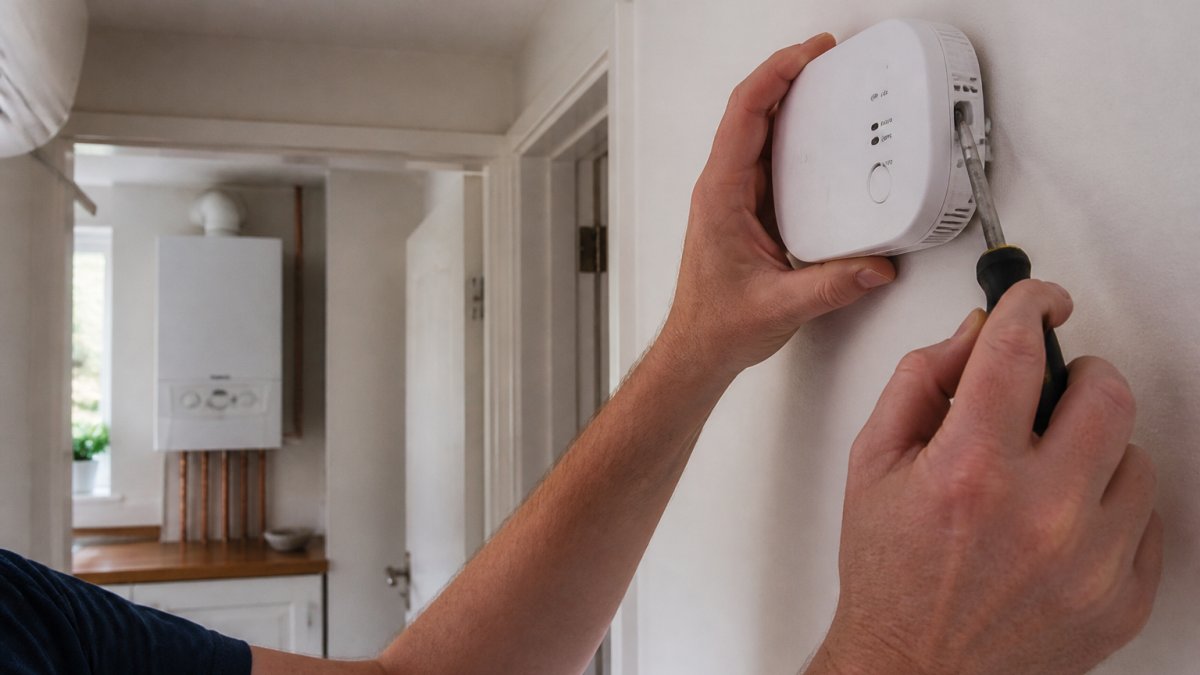
A few placement rules worth following:
- Keep the alarm at least 30cm from walls and light fittings.
- Do not fit it right next to a cooker or a door that lets in draughts.
- Avoid dead air spots, such as the corner of a ceiling.
- Fit one on each floor if the property has multiple levels.
For a detailed walkthrough, our guide on carbon monoxide detector placement in homes covers bedrooms, hallways, and awkward layouts.
Carbon Monoxide Alarm Testing Before Tenancy
Test every alarm before a new tenant moves in, and record the result. A quick press of the test button confirms the unit has power and the sounder works. Note the date, the location of each alarm, and the outcome.
The law also requires you to give tenants a copy of the alarm test record. In practice, we recommend:
- Testing at the start of every tenancy.
- Checking the alarm when you service the boiler.
- Replacing the unit by the expiry date printed on it.
Most alarms last around 7 to 10 years, but check the manufacturer’s label. Our guide on choosing the best carbon monoxide detectors for flats explains lifespan, sensor types, and what suits a rental. When you book a Gas Safety / CP12 inspection, our engineers will check the alarms as part of the visit.
What to Do If a Rented Property Has No Carbon Monoxide Alarm
Act fast. A missing alarm is a legal breach and a real safety risk. The steps depend on whether you are the landlord or the tenant.
If you are the landlord:
- Fit an alarm in every relevant room without delay.
- Keep the receipt and note the installation date.
- Tell your tenant what you have done.
If you are the tenant:
- Report the missing alarm to your landlord in writing.
- Ask for a date when it will be fitted.
- Contact your local council’s environmental health team if nothing happens.
Watch out: carbon monoxide has no smell and no colour. If anyone in the property feels dizzy, sick, or confused, open the windows, turn off the appliance, and call the gas emergency line on 0800 111 999. Our guide on the signs of a carbon monoxide leak explains the symptoms and the checks to run.
Common Mistakes Landlords Make With Carbon Monoxide Alarms
The most common error is fitting an alarm but never testing it. A dead alarm gives a false sense of safety. Here are the other slips we see:
- Assuming a gas cooker needs one. It does not, but a gas boiler or fire does.
- Fitting one alarm for a large property. Multi-floor homes usually need more than one.
- Ignoring the expiry date. Sensors degrade over time.
- Forgetting to replace a reported fault. This is a legal duty, not a goodwill gesture.
- Skipping the record. Without a test record, you cannot show compliance.
What most guides miss is the link between the alarm and the annual gas safety check. A Gas Safe registered engineer will spot a missing or faulty alarm during a CP12 visit. That is one reason to keep the two tasks together.
Book a Gas Safety Check for Your Rental Property
The simplest way to stay on top of carbon monoxide alarm requirements is to book a combined visit. Our Gas Safe registered engineers check the boiler, test the alarms, and issue a digital CP12 on the same day.
As approved installers for Worcester Bosch, Baxi, Glow-worm and Vaillant, we handle boiler servicing, repairs, and new installations across Sussex and Surrey. We offer fixed-price quotes, a 2-year workmanship guarantee, and full public liability insurance. Landlords with multiple properties can book all of them in one go.
You can get your free Gas Safety / CP12 quote and book a visit that fits your schedule. If you are still working through your obligations, our team can also quote for landlord compliance covering certificates, servicing, and repairs.
Frequently Asked Questions
Do landlords have to provide carbon monoxide alarms in every room?
No. The law requires a carbon monoxide alarm in any room containing a fixed combustion appliance, such as a gas boiler, gas fire or gas hob, with some exceptions for appliances used solely for cooking. A common mistake is fitting one in every bedroom, which is not a legal requirement. What matters is that each appliance room is covered and that the alarms are working on the day the tenancy starts.
Who is responsible for replacing a carbon monoxide alarm in a rented property?
The landlord. Carbon monoxide alarms are part of the landlord’s legal duties, so if an alarm is faulty, out of date or missing, replacing it is the landlord’s job, not the tenant’s. Alarms have a limited lifespan, often around five to ten years depending on the model, so landlords should check the expiry date at each tenancy change and replace units before they fail.
Do carbon monoxide alarm rules differ across the UK?
Yes. England, Wales, Scotland and Northern Ireland each set their own rules, and Scotland’s requirements are the most extensive, covering more appliance types. If you own property in more than one nation, check the rules that apply where each property sits rather than assuming one set covers all of them. A Gas Safe registered engineer carrying out a gas safety check can confirm what is needed for a specific property.
Can a landlord be fined for not fitting a carbon monoxide alarm?
Yes. Failing to comply with the alarm rules can lead to enforcement action from the local authority, including financial penalties. Beyond the fine, there is the far bigger risk that a faulty appliance goes unnoticed and someone is harmed. Pairing working alarms with an annual gas safety check is the practical way to manage both the legal and the safety side.
Carbon monoxide alarms are a legal duty, not an optional extra. If you are unsure whether your rental meets the rules, Apex Gas & Heating Ltd can check the alarms, service the boiler, and issue your CP12 in a single visit. Our engineers are Gas Safe registered, and we offer fixed-price quotes with a 2-year workmanship guarantee. Get started with Apex Gas & Heating Ltd and keep your properties safe and compliant.
