







Table of Contents
- Why Does My Boiler Keep Breaking? Main Culprits Explained
- Common Boiler Problems That Lead to Repeated Breakdowns
- How to Prevent Boiler Breakdowns: Maintenance & Smart Checks
- DIY vs. Professional Repair: Safety Thresholds You Must Know
- Boiler Repair Cost UK: What to Expect for Repeated Issues
- Boiler Servicing UK: Your Best Defence Against Breakdowns
- Emergency Boiler Breakdown: What to Do Right Now
- Conclusion: Stop the Cycle of Boiler Breakdowns
Last Updated: July 30, 2026
If you’re asking why does my boiler keep breaking, you’re not alone. At Apex Gas & Heating Ltd, we’ve diagnosed hundreds of repeat boiler failures across Sussex and Surrey, and the patterns are consistent: a single unaddressed issue like low water pressure or a frozen condensate pipe triggers a cascade of breakdowns. Below, we’ll explain the exact reasons your boiler keeps failing, what you can safely fix yourself, and when you need a Gas Safe engineer.
Why Does My Boiler Keep Breaking? Main Culprits Explained
Repeated boiler failures almost always signal an underlying condition that hasn’t been properly addressed. Age plays a role, but a well-maintained 15-year-old boiler can outperform a neglected 5-year-old system. When small issues go unnoticed, a drop in system pressure, a faulty sensor, or a partially blocked pipe, they compound into bigger failures.
The single best predictor of repeat boiler breakdowns is whether the system received an annual service in the previous year. Boilers without annual servicing are 3-4 times more likely to fail unexpectedly.
Age-Based Breakdown Analysis
Boilers older than 12 years are statistically more prone to repeated failures, but age alone doesn’t guarantee problems. The critical threshold is around the 10-year mark, when internal components like the heat exchanger begin to show wear. Corrosion accelerates, seals degrade, and the pump loses efficiency. For boilers over 15 years old, repair costs climb steeply, and many engineers recommend replacement rather than continued repairs.
Seasonal Breakdown Patterns
Winter is when most boiler breakdowns occur. Cold weather places extreme stress on your heating system, water pressure fluctuates due to temperature changes, and condensate pipes freeze solid. Autumn is the critical prevention window, if your boiler hasn’t been serviced by October, you’re entering winter with an untested system. Spring and summer breakdowns are rarer but more telling; if your boiler fails during mild weather, the fault is usually a sensor issue, faulty diverter valve, or pilot light problem, not weather-related stress.
Common Boiler Problems That Lead to Repeated Breakdowns
Boiler Pressure Issues
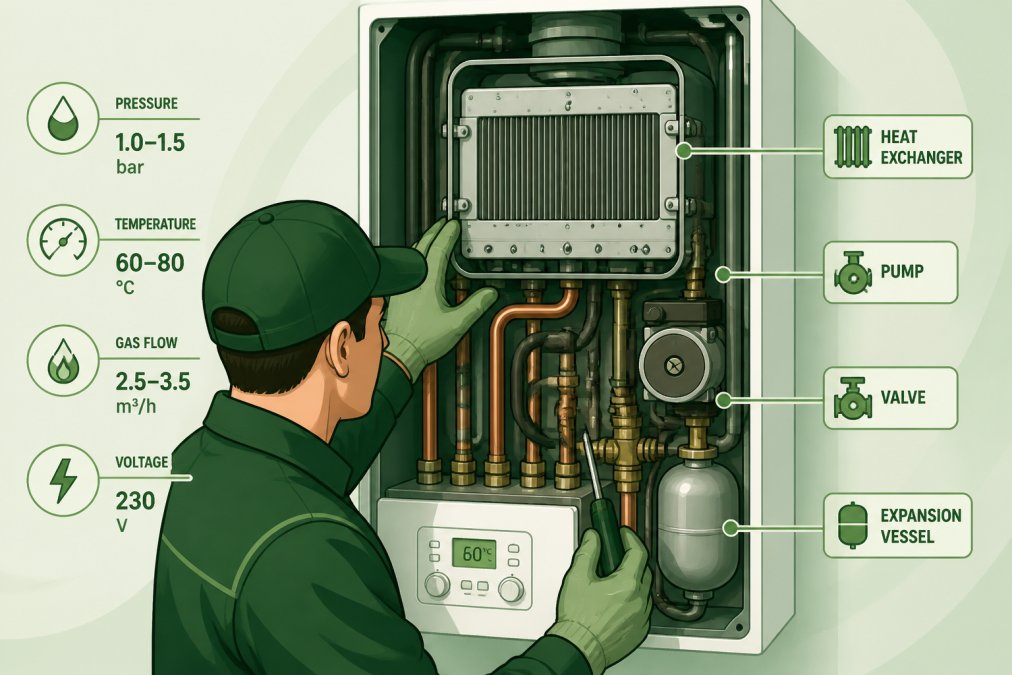
Low boiler pressure is the single most common reason homeowners call for emergency repairs. Your boiler operates at 1-1.5 bar when cold; below 1 bar, it locks out as a safety measure. Pressure loss happens due to a small leak, a faulty pressure relief valve, or a problem with the expansion vessel. If your boiler pressure keeps dropping, the underlying cause needs professional investigation. A one-off top-up is temporary; a permanent solution requires identifying whether you have a leak, faulty component, or system design issue.
Never ignore a boiler that requires pressure top-ups more than once per heating season. Repeated low pressure indicates a leak or faulty component and will eventually lead to boiler lockout at the coldest moment of winter.
Frozen Condensate Pipes in Cold Weather
Modern boilers produce condensate, a thin acidic liquid that drains through a small plastic pipe. In cold weather, this pipe freezes solid, causing the boiler to shut down automatically. Condensate pipe freezing is frustrating because it’s seasonal and recurring. The real solution is insulation or relocation of the pipe to a warmer route. A properly installed condensate pipe should run inside your home as much as possible, or be heavily insulated if it must run outside.
Pilot Light Failure and Lockout
The pilot light is a small continuous flame that ignites the main burner. When it fails, the boiler goes into lockout. Pilot light failure is usually caused by a faulty thermocouple, a blocked pilot jet, or a gas supply problem. If your boiler keeps going into lockout and requiring manual reset, the underlying cause won’t resolve itself. Continuing to reset without addressing the root cause is like ignoring a warning light on your car dashboard.
How to Prevent Boiler Breakdowns: Maintenance & Smart Checks
Prevention is infinitely cheaper than emergency repairs. Most repeat boiler failures are entirely preventable with basic maintenance and early detection.
Annual Servicing and Safety Inspections
An annual boiler service is the single most effective way to prevent repeated breakdowns. During a service, a Gas Safe engineer inspects every component, cleans the heat exchanger, checks for leaks, tests safety controls, and identifies parts that are starting to wear. The service also produces a gas safety certificate, proof that your boiler is safe to use, required by law for rental properties and valuable for insurance claims.
Schedule your annual service for September or October, before winter heating demand peaks. This ensures any problems are caught and fixed before the cold season arrives.
Seasonal Maintenance Schedules
Between annual services, perform simple checks. In autumn, check your boiler’s pressure gauge, it should read 1-1.5 bar when cold. If below 1 bar, top it up using the filling loop. In winter, listen for unusual noises: kettling suggests limescale buildup, and banging indicates air in the system or a failing pump. In spring, check that your boiler’s display shows no fault codes.
Smart Home Integration Troubleshooting
If your boiler is connected to a smart thermostat and has started failing, the problem might be a wiring issue or incompatibility. Check that the thermostat is powered, wiring is secure, and the thermostat is set to "heating" mode. Many smart thermostat problems can be resolved by restarting the device or recalibrating it to your boiler.
DIY vs. Professional Repair: Safety Thresholds You Must Know
If it involves gas, electricity, or opening sealed components, call a Gas Safe engineer.
What You Can Safely Troubleshoot Yourself
You can safely check and top up your boiler’s water pressure using the filling loop. You can listen for unusual noises and note fault codes. You can restart your boiler after lockout by pressing the reset button once. You can check that your thermostat is powered and set correctly. You can pour warm water on a frozen condensate pipe to temporarily restore function. You can perform basic visual inspections for leaks and check that the flue is clear.
What you absolutely cannot do: open the boiler casing, replace internal components, adjust gas pressure, work on gas pipework, or clear internal blockages. These require training, certification, and specialist tools.
When to Call a Gas Safe Engineer Immediately
Call immediately if you smell gas, suspect a gas leak, or see water pooling under the boiler. Call if your boiler produces unusual smells or if it shuts down and won’t restart even after pressing the reset button. Call if it’s going into lockout repeatedly (more than once per month). Call if your boiler is over 10 years old and has broken down more than once in the past 12 months.
If you suspect carbon monoxide poisoning, headaches, nausea, dizziness, or confusion that improves when you leave the house, evacuate immediately, open windows, and call emergency services. Do not attempt to diagnose or repair the boiler yourself.
Boiler Repair Cost UK: What to Expect for Repeated Issues
A single repair costs £300-£600. If you’re paying this multiple times per year, replacement becomes financially sensible. A useful rule: if your boiler is over 10 years old and the repair cost exceeds 50% of the replacement cost, replacement is usually better. A new boiler costs £2,500-£4,000 installed and comes with a warranty (5-10 years) and peace of mind. Modern boilers are 10-15% more efficient than models from 10 years ago, and energy savings can offset a significant portion of installation cost over 15 years.
Boiler Servicing UK: Your Best Defence Against Breakdowns
Regular servicing is the most cost-effective way to prevent repeated breakdowns.
What a Professional Service Includes
A comprehensive service includes visual inspection of all accessible components, cleaning of the heat exchanger and burner, checking of all safety controls and sensors, testing of the thermostat and timer, inspection of the flue and ventilation, and a pressure test. The engineer will also check the pilot light, test the ignition sequence, verify correct temperature and flow rate, top up lost pressure, and clean or replace the filter. Most importantly, they’ll issue a gas safety certificate.
How Regular Servicing Stops Repeated Breakdowns
Servicing catches wear and tear before it becomes a failure. A thermocouple starting to fail might show signs during inspection, allowing replacement before lockout. A pressure relief valve leaking slightly can be identified and fixed, preventing repeated pressure drops. Servicing also cleans components that accumulate debris, restoring performance and preventing overheating. Service records create a historical pattern, helping engineers identify the root cause rather than treating symptoms.
Emergency Boiler Breakdown: What to Do Right Now
Immediate Steps Before Calling an Engineer
Check if the boiler has gone into lockout by looking at the display panel. If there’s a fault code or red light, try pressing the reset button (usually red or black on the front) for 3-5 seconds. Wait 30 seconds to see if the boiler restarts. If it restarts and heating works, monitor it over the next few hours. If it locks out again, there’s a recurring fault needing professional diagnosis.
If the reset button doesn’t work, check your boiler’s pressure gauge. If it’s below 1 bar, use the filling loop to top up pressure to 1.2-1.5 bar. If pressure is normal and reset didn’t work, check: Is the power switch on? Is the thermostat set to "heating" mode and above current room temperature? Is the timer set to allow heating?
Understanding Boiler Lockout and Reset Procedures
Boiler lockout is a safety feature. When the boiler detects a fault, no pilot light, low pressure, sensor failure, or gas supply problem, it shuts down and won’t restart until the reset button is pressed. If the fault hasn’t been resolved, the boiler will lock out again within minutes or hours. Repeated lockouts indicate a persistent problem, usually a faulty thermocouple. If your boiler is locking out repeatedly, stop pressing the reset button and call a Gas Safe engineer.
Keep a note of your boiler’s fault codes and how often it locks out. This information helps engineers diagnose the problem quickly.
Conclusion: Stop the Cycle of Boiler Breakdowns
Repeated boiler breakdowns are frustrating and expensive, but almost always preventable. Address the root cause rather than treating symptoms, whether that’s scheduling an annual service, topping up pressure regularly, or replacing a boiler past its useful life.
If your boiler keeps breaking down, Apex Gas & Heating Ltd can help. Our Gas Safe engineers diagnose the underlying cause of repeat failures and provide lasting solutions. With transparent pricing, full public liability insurance, and 24/7 emergency call-out service across Sussex and Surrey, we’re here when you need us most.
Which? guide to boiler breakdowns and repairs
Energy Saving Trust boiler maintenance advice
Frequently Asked Questions
Why does my boiler keep losing pressure and breaking down?
Low boiler pressure is one of the most common reasons for repeated breakdowns. This can be caused by a leak in the system, a faulty expansion vessel, or a malfunctioning pressure relief valve. If your system pressure drops below 1 bar, the boiler will lockout as a safety measure. Check for visible leaks around pipes and radiators. If you can't identify the source, a Gas Safe engineer must diagnose the fault code and repair the underlying issue to prevent continuous breakdowns.
How can I stop my boiler from breaking down every winter?
To prevent boiler breakdowns during cold weather, schedule annual servicing before autumn arrives. Ensure your condensate pipe is insulated to prevent freezing, which is a common winter fault. Check system pressure monthly and bleed radiators to maintain proper flow rate. If your boiler is over 10-15 years old and breaks down repeatedly, replacement may be more cost-effective than ongoing repairs. Professional annual servicing catches faulty sensors and worn components before they cause emergency breakdowns.
When should I call a Gas Safe engineer versus trying DIY troubleshooting?
You can safely reset the boiler using the reset button if it's in lockout, or check system pressure yourself using the gauge. However, call a Gas Safe engineer immediately if you suspect a gas leak, see fault codes you don't recognise, notice carbon monoxide concerns, or if the pilot light won't stay lit after one reset attempt. Never attempt repairs to the heat exchanger, diverter valve, pump, or any gas-related components, these require professional certification and safety checks.
Is it worth repairing a boiler that keeps breaking down, or should I replace it?
If your boiler is under 7 years old and breaks down occasionally, repair is usually worthwhile. However, if it's over 10 years old and requires multiple repairs annually, replacement is often more economical. Consider the cost of repair versus a new installation, if repair costs exceed 50% of a replacement boiler's price, replacement makes financial sense. A professional engineer can advise whether your specific boiler's fault code indicates a one-off issue or a sign of systemic failure requiring replacement.
Stop waiting for the next breakdown. Get a quote from Apex Gas & Heating Ltd today and get your heating system back to reliable, efficient operation.
Leave a Reply