Rated Excellent Rating Gas Safe Registered BPEC Certified 25 Years’ Experience 2 Year Guarantee Card Payments AcceptedApple Pay, Mastercard, Visa, Amex, Google Pay Worcester BoschVaillantBaxiGlow-wormAccredited

Tag: common causes of low boiler pressure

  • Top 5 Boiler Maintenance Tips for Winter

    Top 5 Boiler Maintenance Tips for Winter

    Table of Contents

    Last Updated: September 17, 2026

    1. Schedule Your Annual Boiler Service Before Winter Arrives

    Following the top 5 boiler maintenance tips for winter, an annual boiler service is the single most important step you can take to prevent winter breakdowns. This preventative maintenance catches problems before they become emergencies, keeps your heating system running efficiently, and maintains your boiler’s warranty coverage.

    A professional engineer will inspect your heat exchanger, check your flue, test your pilot light, and verify all safety systems are functioning correctly. This comprehensive check takes around an hour and should happen every year, ideally in autumn before demand peaks.

    At Apex Gas & Heating Ltd, we recommend booking your boiler servicing in September or October. Our Gas Safe registered engineers carry out a full system safety inspection, providing complete documentation for your peace of mind.

    Delaying servicing until something breaks means paying for emergency repairs instead of preventative maintenance, a professional service costs significantly less than an emergency call-out.

    Pro Tip
    Book your annual service early in autumn. Winter call-outs are busier, and you risk being without heating during the coldest weather if you wait until December.

    2. Check and Manage Boiler Pressure Regularly

    Boiler pressure is one of the easiest things to monitor yourself, yet many homeowners ignore it entirely. Low boiler pressure is the most common reason heating systems fail during winter, and it’s often something you can fix without calling an engineer.

    Your boiler has a pressure gauge on the front panel. The needle should sit between 1 and 1.5 bar when the system is cold. If it drops below 1 bar, your heating will struggle to reach all radiators, leaving you with cold spots and uneven warmth throughout your home.

    Understanding Your Pressure Gauge

    The pressure gauge shows how much water is circulating through your heating system. A slow drop over weeks is normal; a sudden drop suggests a leak in your pipework or radiators.

    Check your pressure gauge weekly during winter. If pressure is consistently dropping, you have a leak needing professional attention. If it’s simply low but stable, you can repressurize the system yourself.

    When to Repressurize Your System

    Most modern boilers have a filling loop (a flexible hose with two small valves) underneath or behind the unit. Opening both valves allows mains water to flow into your heating system, raising pressure to the correct level.

    Close the valves once pressure reaches 1.2 bar. Never over-pressurize your boiler. If you’re unsure how to use your filling loop, your boiler manual will have clear instructions, or you can ask your engineer during your annual service to show you how.

    Watch Out
    If pressure drops again within days of repressurizing, you have a leak. Do not keep topping up the pressure yourself, contact a professional to locate and repair the leak. Continuing to add water will eventually cause damage to your boiler’s heat exchanger.

    3. Bleed Your Radiators to Improve Heat Distribution

    Air trapped inside radiators prevents hot water from circulating properly, leaving you with cold spots at the top while the bottom stays warm. Bleeding radiators removes this trapped air and restores full heat output.
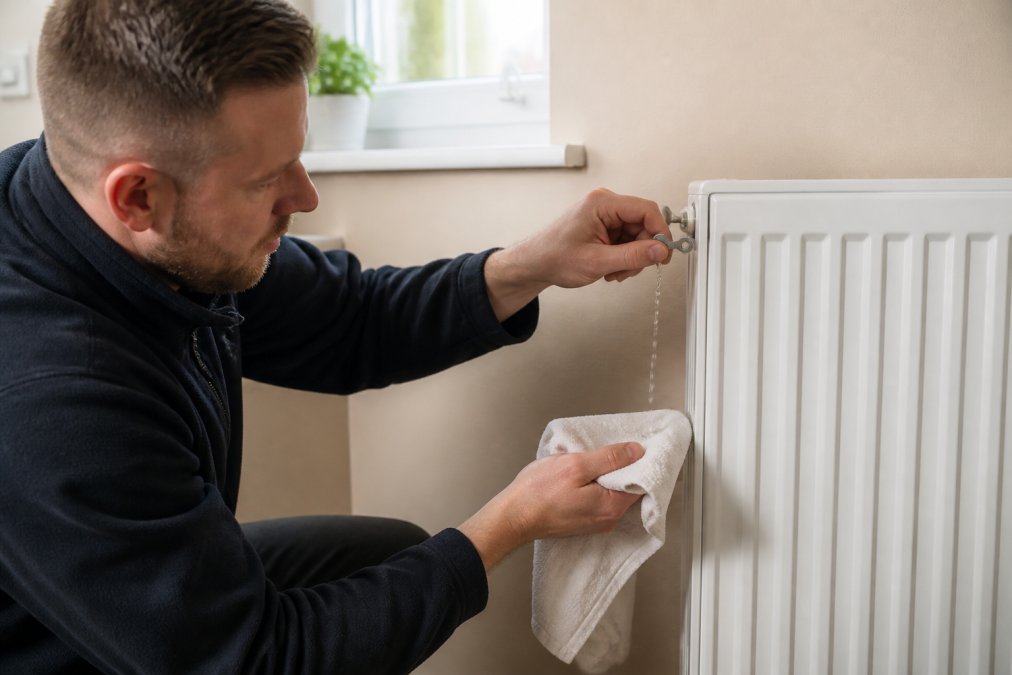
    Close-up of a hand using a radiator bleed key on a white radiator valve, releasing air with a cloth catching water droplets below
    Close-up of a hand using a radiator bleed key on a white radiator valve, releasing air with a cloth catching water droplets below

    You’ll notice radiators needing bleeding when the top stays cold while the bottom is hot, or entire radiators produce no heat. Bleeding is a simple DIY task taking 10 minutes per radiator.

    Step-by-Step Radiator Bleeding Process

    What you’ll need:

    • A radiator bleed key (available from any hardware shop for a few pounds)
    • A cloth or small container to catch water
    • Your boiler system switched off and cooled slightly

    The process:

    1. Turn off your boiler and wait 15 minutes for the system to cool.

    2. Locate the small valve at the top corner of your radiator.

    3. Place your cloth underneath to catch water drips.

    4. Insert the bleed key and turn it anticlockwise slowly until water flows steadily (not air).

    5. Turn the key clockwise to close the valve firmly.

    6. Turn your boiler back on and check your boiler pressure.

    Bleed all cold radiators, starting with those furthest from your boiler. After bleeding, check your boiler pressure and repressurize if needed.

    If radiators remain cold after bleeding, the problem is likely insufficient boiler pressure or a blockage deeper in your heating circuit. Contact a professional heating engineer to diagnose the issue.

    4. Protect External Pipes and Condensate Lines from Freezing

    Frozen pipes are one of the most common winter heating emergencies. When water inside external pipes freezes, it expands and can crack the pipe, causing leaks that damage your property and leave you without heating.

    Your boiler’s condensate pipe runs from the heat exchanger to an external drain and is vulnerable to freezing. A frozen condensate pipe stops your boiler from operating, leaving you without heating or hot water.

    Insulate all external pipes with foam pipe lagging, paying particular attention to pipes in unheated spaces like lofts, under porches, or on external walls.

    Book a boiler repair or service →

    For your condensate pipe, consider installing a specialist condensate pipe heater or insulation jacket. These are designed specifically for boiler condensate lines and prevent freezing without damaging the pipe.

    Check external pipes weekly during winter for frost or ice. If frozen, wrap the pipe in warm towels or use a heat gun on a low setting, never pour boiling water on it.

    Pro Tip
    Lagging your pipes in autumn takes an hour and costs very little. It’s far cheaper than emergency repairs for burst pipes or a boiler that won’t start because the condensate line is frozen.

    5. Test Your Boiler and Heating Controls Before Peak Winter

    As part of the top 5 boiler maintenance tips for winter, test your entire heating system in late autumn to catch any issues before winter peaks.

    Turn your thermostat up to trigger the boiler. Listen for the fan starting, then a click as ignition lights the pilot light. Heat should build in your radiators within a few minutes.

    If your boiler makes unusual noises, fails to ignite, or produces no heat, contact a professional immediately. Do not wait until December when engineers are busiest and response times are longer.

    What to Check on Your Thermostat and Timer

    Check that your thermostat responds correctly by setting it higher than your current room temperature. Your boiler should fire up within seconds.

    Check your timer or programmer by manually triggering heating at an unusual time and confirming it responds.

    Smart heating controls like Tado thermostats detect open windows and prevent heat loss. If upgrading, autumn is ideal before winter demand peaks.

    Check that your boiler’s fault code display is clear. If you see any error codes, consult your manual or contact a professional. Fault codes are your boiler’s way of telling you something needs attention before it becomes a breakdown.

    Common Winter Boiler Issues and When to Call a Professional

    Some boiler problems you can address yourself; others require a qualified Gas Safe engineer. Knowing the difference saves time and money.

    Use this decision matrix to determine whether to troubleshoot yourself or contact a professional:

    Low Boiler Pressure

    Symptom: Pressure gauge reads below 1 bar; heating is weak or absent.

    DIY action: Check your pressure gauge. If it’s below 1 bar, try repressurizing using your filling loop (the flexible hose underneath or behind your boiler with two small valves).

    Cold Radiators

    Symptom: Top of radiator is cold, bottom is warm; or entire radiator produces no heat.

    Boiler Won’t Ignite

    Symptom: You hear the fan start but no click or ignition; no heat or hot water.

    Strange Noises

    Symptom: Kettling sounds (like a kettle boiling inside pipes); banging or clunking from the boiler or pipework.

    No Hot Water But Heating Works

    Symptom: Your radiators are warm but your taps produce only cold water.

    Visible Leaks

    Symptom: Water dripping from your boiler, pipework, or radiators; wet patches on walls or ceilings.

    Decision Summary

    Call a professional immediately if:

    • Your boiler won’t ignite and reset doesn’t work
    • You see any visible leak
    • Pressure drops repeatedly after repressurizing
    • You smell gas
    • Your boiler locks out repeatedly
    • You’re unsure whether a fault is safe to address

    Safe to attempt yourself:

    • Repressurizing (one attempt only)
    • Bleeding radiators
    • Checking thermostat and timer settings
    • Tightening loose pipe clips

    When in doubt, contact a professional. At Apex Gas & Heating Ltd, our Gas Safe registered engineers diagnose issues quickly and provide transparent advice on whether boiler repair or replacement is the most cost-effective option. We serve Crawley and surrounding areas with 24/7 emergency support, so you’re never left without heating during winter.

    Frequently Asked Questions

    Should a boiler be serviced every 12 months?

    Yes, annual boiler servicing is essential for safety, efficiency, and warranty compliance. A Gas Safe registered engineer checks the heat exchanger, flue, pilot light, and pressure during servicing. This prevents carbon monoxide risks and catches problems before they develop into costly breakdowns during winter. Most boiler warranties require annual servicing to remain valid.

    How do I know if my boiler pressure is too low?

    Check your boiler’s pressure gauge, usually located on the front panel. The needle should sit between 1.0 and 1.5 bar when the system is cold. If it drops below 1.0 bar, your heating system won’t work efficiently and radiators may stay cold. Common causes of low boiler pressure include small leaks, a faulty expansion vessel, or air in the system. You can repressurize manually using the filling loop, but persistent pressure loss requires professional inspection.

    How do I bleed radiators to remove trapped air?

    Use a radiator bleed key to open the small valve at the top corner of each radiator. Hold a cloth underneath to catch water, then turn the key slowly anti-clockwise until air hisses out, then water flows. Close the valve immediately. Start with radiators furthest from the boiler and work backwards. Bleeding radiators improves heat distribution and eliminates cold spots. If radiators remain cold after bleeding, the issue may be system pressure or circulation problems requiring professional attention.

    What temperature should I set my boiler to in winter?

    Set your boiler flow temperature between 60-80°C for most modern condensing boilers. Lower settings (around 60°C) improve efficiency and reduce energy consumption, while higher settings provide faster heat-up times. Your thermostat should be set to your comfort level, typically 18-21°C. Using a smart thermostat or timer allows you to programme heating schedules, reducing waste during periods when you’re away or asleep. Check your boiler manual for manufacturer recommendations.
    Book online, it takes a minute →

  • How to Maintain Gas Boiler Pressure: A 2026 Guide

    How to Maintain Gas Boiler Pressure: A 2026 Guide

    Table of Contents

    Last Updated: September 16, 2026

    What Is Boiler Pressure and Why It Matters

    Boiler pressure is the water pressure inside your central heating system, and it is the most common reason homeowners in Crawley and across Sussex wake up to no heating. This guide from Apex Gas & Heating Ltd explains how to maintain it.

    Key Takeaway
    Pressure loss is a symptom, not a problem. Fixing the symptom without finding the cause means you will be topping up again next month.

    How to Check Your Boiler Pressure

    Checking boiler pressure takes under a minute and needs no tools. Locate the gauge, read it cold, and compare it against your boiler manual.

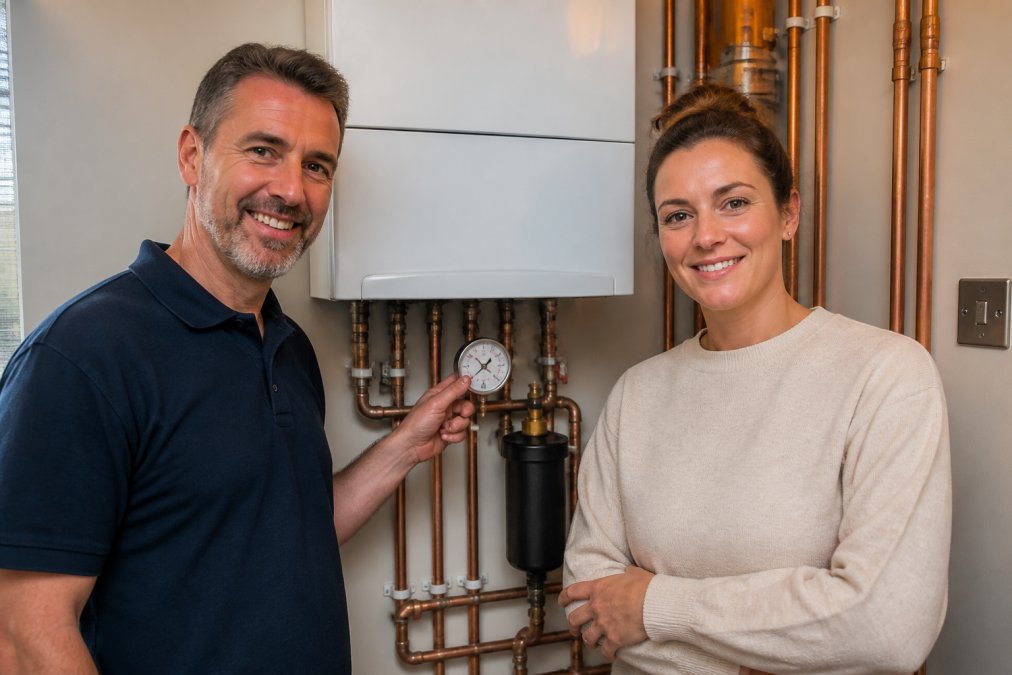
    Homeowner checking the boiler pressure gauge on a wall-mounted unit during a sunny morning
    Homeowner checking the boiler pressure gauge on a wall-mounted unit during a sunny morning

    Reading the Pressure Gauge

    The gauge is usually a small circular dial on the front of the boiler, behind the control panel flap, or under the casing on older models. Many modern Worcester and Glowworm units show it digitally.

    Visual Identification Guide: Which Gauge Do You Have?

    Use this quick reference to identify your gauge type before you read it:

    Gauge Type What It Looks Like Where to Find It How to Read It
    Analogue dial (most common) Circular face, numbered 0-4 bar, black needle Front panel, behind flap, or under casing Read where the needle points when cold
    Digital display LCD or LED screen showing numbers Front control panel Press the info or pressure button if not always visible
    Dual-scale dial Two number rings (bar and psi) Same as analogue Read the bar scale only
    Remote or app gauge No physical gauge; reading in app Smartphone app or wall thermostat Check the manufacturer’s app

    What the Correct Pressure Should Be

    Most sealed heating systems want 1.0 to 1.5 bar cold. How to interpret your reading:

    Gauge Reading (Cold) What It Means Action
    Below 1.0 bar Pressure too low, lockout likely Top up using the filling loop
    1.0 to 1.5 bar Correct operating range No action needed
    1.5 to 2.0 bar Slightly high but often fine Monitor for changes
    Above 2.5 bar Pressure too high Check filling loop is closed, call an engineer

    Fault Code Interpretation Table

    When pressure drops, many boilers also show a fault code. This table covers the codes most commonly seen alongside low pressure on Worcester, Glowworm, Vaillant and Ideal models. Always confirm against your own manual, as codes vary.

    Code Common Meaning Likely Cause DIY Action
    F1 / E1 Ignition lockout Low pressure, gas supply issue, or flame sensor fault Check pressure; if below 1.0 bar, top up. If pressure is fine, call an engineer
    F22 / E22 Low water pressure Pressure below minimum Top up via filling loop; if it drops again within days, call an engineer
    F28 / E28 Flame loss during operation Air in system, blocked condensate, or pressure fluctuation Check pressure and bleed radiators; if code returns, call an engineer
    F75 / E75 No pressure change detected Filling loop left open, sensor fault, or blocked pressure sensor pipe Close filling loop; if code persists, call an engineer
    F0 / E0 Flow or return temperature sensor fault Sensor or wiring issue Call an engineer
    F29 / E29 Flame extinguished too often Pressure instability or flue issue Check pressure; if stable, call an engineer
    Key Takeaway
    A fault code is a starting point, not a diagnosis. Use it to decide whether you can safely top up or whether the next step is a phone call.

    Common Causes of Low Boiler Pressure

    Low boiler pressure almost always traces back to water escaping the system, or to air introduced during routine maintenance. Understanding the common causes saves you from repeatedly topping up a system that is quietly leaking.

    Leaks in the Heating System

    Water loss is the leading cause. A pinhole leak on a radiator valve, a corroded pipe joint under the floorboards, or a failing pressure relief valve can drain pressure slowly over weeks. Look for damp patches, discoloured ceilings, or greenish crusting around radiator valves.

    Bleeding Radiators

    Bleeding radiators releases trapped air, so system pressure drops. This is normal, and a quick top-up restores it. Cold spots at the top of a radiator with warmth at the bottom usually mean trapped air, bleed it, then check the gauge and top up if needed.

    Seasonal Causes: Why Pressure Drops Differ in Summer and Winter

    The cause of pressure loss often changes with the season, and knowing which pattern you are seeing speeds up diagnosis.

    Winter (high demand)

    • Thermal expansion and contraction. More heating cycles stress joints and seals, so a weak joint that holds in summer may weep in winter.
    • Frozen condensate pipe. Not a pressure fault itself, but it can cause a lockout homeowners mistake for low pressure. Check for ice on the external pipe.
    • Higher system temperatures. Pressure swings more between hot and cold, so a marginal expansion vessel shows up as repeated low-pressure lockouts.
    • Increased radiator bleeding. Trapped air rises as systems heat up, so more homeowners bleed radiators in winter, each bleed dropping pressure.

    Summer (low usage)

    See our boiler repair and servicing →

    • Standing pressure loss. With the heating off for weeks, a slow leak becomes obvious because nothing masks it.
    • Corrosion inhibitor degradation. Warm-weather stagnation lets inhibitor levels drop, accelerating internal corrosion and pinhole leaks.
    • Expansion vessel charge loss. A vessel that has lost its air charge over winter may only become noticeable when the system is cold for long periods.
    • Seal drying. Rubber seals and washers can dry out when not exposed to warm water, leading to small weeping joints when the system restarts in autumn.

    Fault Codes That Accompany Low Pressure

    The most common low-pressure codes are F22/E22 (low water pressure), F1/E1 (ignition lockout, often pressure-related), and F75/E75 (no pressure change detected). Top up first, then monitor. If the code returns within days, the cause is still present and needs an engineer.

    Watch Out
    Never keep topping up a system that loses pressure repeatedly without investigating. A constant fresh water supply dilutes the corrosion inhibitor in your system, which accelerates internal rust and can lead to premature boiler failure.
    Pro Tip
    Keep a simple log: date, cold pressure reading, and whether you topped up. After a few weeks you will see whether the loss is seasonal, constant, or linked to heating use, which helps an engineer diagnose faster.

    How to Use a Boiler Filling Loop to Top Up Pressure

    Using a boiler filling loop is a straightforward job most homeowners can complete safely. The filling loop is a braided flexible hose, usually with two valves, that temporarily connects your mains cold water supply to the heating circuit. Some boilers have an internal filling loop operated by a key or lever; others use an external hose stored near the boiler.

    Step-by-Step Guide

    Total time: 10 minutes
    Difficulty: Beginner

    What you’ll need:

    • Your boiler manual (to confirm the target pressure)
    • A cloth for drips
    1. Turn the heating off and let the system cool. Pressure must be read cold; topping up a hot system gives a false reading.
    2. Locate the filling loop and pressure gauge. The gauge needs to be visible while you work.
    3. Open one valve slowly. On a two-valve loop, open the valve nearest the boiler first. You should hear water flowing.
    4. Open the second valve slowly. Watch the gauge, pressure can jump from 1.0 to 2.0 bar in seconds.
    5. Stop at 1.2 to 1.3 bar. Aim slightly below the maximum so there is headroom for expansion.
    6. Close both valves firmly. Close the valve nearest the heating circuit first, then the mains side.
    7. Disconnect the hose if it is removable. Leaving a filling loop permanently connected is against water regulations.
    8. Run the heating and recheck. After an hour, confirm the cold reading still sits in range.

    Boiler Pressure Keeps Dropping After Topping Up: What to Do

    Pressure that falls again within days points to an active fault rather than normal expansion and contraction, an unresolved leak, a failed pressure relief valve, or a faulty expansion vessel.

    Work through this diagnostic sequence:

    • Check every visible radiator valve and joint for weeping or crusting.
    • Inspect the pressure relief valve discharge pipe outside the property. If it drips constantly, the valve is passing and needs replacing.
    • Look at the expansion vessel charge. A vessel that has lost its air charge causes pressure to swing wildly between hot and cold.
    • Check for air ingress. If radiators need bleeding every few weeks, air is being drawn in somewhere.

    When to Call a Gas Safe Registered Engineer

    Call a Gas Safe registered engineer for any work involving the gas supply, the combustion chamber, or components inside the boiler casing. In the UK, it is a legal requirement that anyone working on a gas appliance is on the Gas Safe Register, and you can verify an engineer’s credentials through the official Gas Safe Register.

    • Pressure drops repeatedly within days of topping up
    • The pressure relief valve is discharging
    • You can smell gas or see soot or yellow staining around the boiler
    • The boiler shows a fault code you cannot clear
    • The boiler is over ten years old and has never been serviced
    Pro Tip
    Note your pressure reading and the date every time you top up. A written record turns a vague “it keeps dropping” into hard evidence an engineer can work from, and it often reveals whether the loss is seasonal or constant.

    Conclusion

    Pressure loss is one of the most common boiler complaints, and the fix is rarely just topping up. Finding the underlying cause, a weeping valve, a failed expansion vessel or air from bleeding radiators, is what keeps your heating reliable through the coldest months.

    Frequently Asked Questions

    What is the correct pressure for a gas boiler?

    Most gas boilers should be set between 1.0 and 1.5 bar when the system is cold. This is the ideal range for efficient operation. If the pressure reads below 1.0 bar, you may need to top it up using the filling loop. If it reads above 2.0 bar, you should bleed a radiator or call an engineer. Always check your boiler manual for the manufacturer’s specific recommendation, as some models vary slightly.

    Why does my boiler pressure keep dropping after topping up?

    If your boiler pressure keeps dropping after topping up, there is likely a leak somewhere in the heating system. Common culprits include a faulty pressure relief valve, a leaking radiator valve, or a hidden pipe leak. It could also be trapped air that needs bleeding. If the pressure falls again within days, it is best to call a Gas Safe registered engineer to investigate and fix the underlying issue.

    Is it safe to top up my own boiler pressure?

    Yes, topping up boiler pressure using the filling loop is generally safe for homeowners and is considered routine maintenance. However, you must never open the boiler casing or attempt repairs on gas components. If you are unsure how to use the filling loop, or if the pressure keeps dropping, contact a Gas Safe registered engineer. They can safely diagnose and repair any faults.

    When should I call a Gas Safe registered engineer for pressure issues?

    Call a Gas Safe registered engineer if your boiler pressure drops repeatedly after topping up, if you notice water leaks around the boiler, if the pressure relief valve is discharging, or if you smell gas. Also seek professional help if you are unsure how to operate the filling loop or if the boiler shows a fault code. Engineers can safely repair leaks, replace faulty valves, and ensure your system is safe.

    Book your visit online →

  • How to Reset a Boiler After Lockout: A 2026 Guide

    How to Reset a Boiler After Lockout: A 2026 Guide

    Table of Contents

    Last Updated: September 16, 2026

    What a Boiler Lockout Means and Why It Happens

    A boiler lockout is a safety shutdown: the control board has detected a fault it cannot safely clear and has cut the gas supply to the burner. Unlike a normal switch-off, it is deliberate, and the boiler stays off until someone resets it manually.

    The most common triggers are ignition failure, flame failure, low system pressure, a frozen condensate pipe, or a power cut that interrupted the startup sequence. In each case the boiler is protecting you, not failing on you.

    At Apex Gas & Heating Ltd, we attend lockouts across Sussex and Surrey every week.

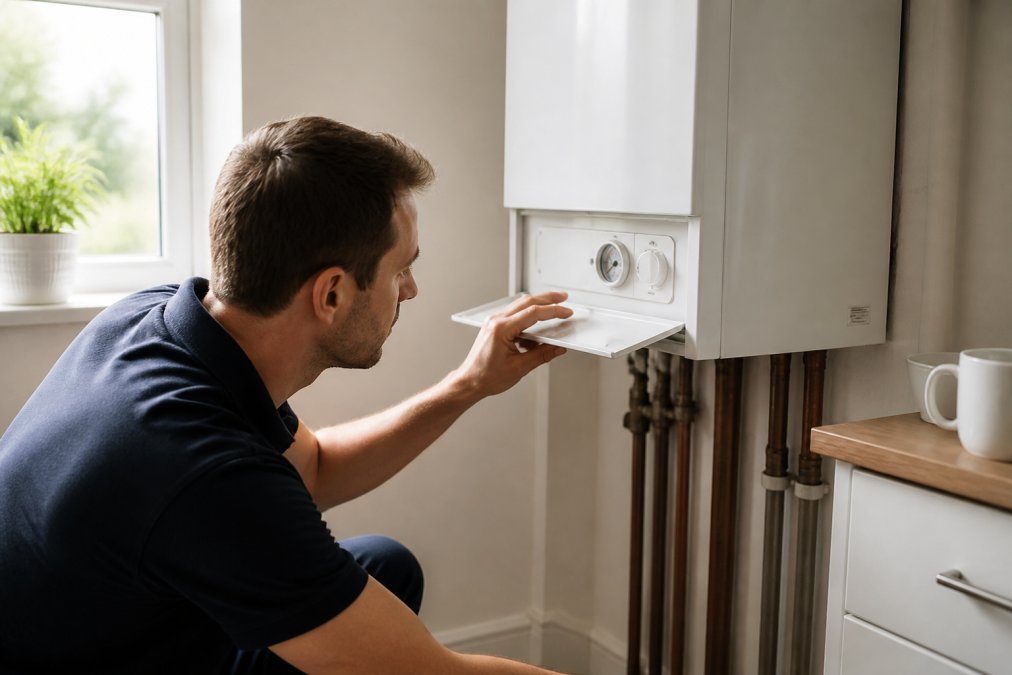
    Close-up of a homeowner's hand pressing the reset button on a modern white wall-mounted boiler control panel in a bright kitchen, with a fault code visible on the digital display
    Close-up of a homeowner’s hand pressing the reset button on a modern white wall-mounted boiler control panel in a bright kitchen, with a fault code visible on the digital display
    Key Takeaway
    A lockout is a safety mechanism, not a breakdown. The boiler has shut itself down because something in the startup sequence did not check out.

    Safety Checks Before You Reset a Boiler

    Before you touch anything, confirm three things: no smell of gas, no signs of leaking water, and a clear area around the boiler. If you smell gas, do not reset the boiler. Turn off the gas at the meter, open windows, leave the property, and call the National Gas Emergency Service on 0800 111 999.

    The Gas Safe Register’s guidance for homeowners is clear that gas work must only be carried out by a registered engineer. Pressing a reset button is a user control, not gas work, so it sits outside that restriction. Anything beyond it does not.

    Checking Gas Supply and Power

    Two failure points cause more false alarms than any other: an interrupted gas supply and a power cut.

    • Check other gas appliances. If the hob lights, gas is reaching the property.
    • Check the boiler’s power. Look for a lit display or standby light.
    • Check the programmer or thermostat is calling for heat.
    • Check the pressure gauge reads between 1 and 1.5 bar when the system is cold.

    If the display is dead, the issue is electrical and resetting will do nothing. If the gauge reads below 1 bar, pressure has dropped and you must top up the filling loop before resetting.

    How to Locate the Reset Button on Your Boiler

    The reset button is almost always on the front control panel, either as a dedicated button marked with a flame symbol or circular arrow, or as a combined button that also serves as the pressure or mode selector. On most modern wall-mounted boilers it sits to the right of the display, below the pressure gauge, or behind a flip-down flap.

    If you cannot find it, the boiler manual is the fastest answer: every manufacturer publishes a digital copy, and searching your model number plus “manual” will bring it up.

    Visual Identification Guide for Common Boiler Brands

    Where the reset control sits varies by manufacturer.

    Brand Reset Control Location Typical Marking
    Worcester Bosch Right of the display, below the pressure gauge Flame symbol or “Reset”
    Glow-worm Left side of the control panel Circular arrow
    Baxi Centre panel, beside the mode selector Flame with a line through it
    Vaillant Far right of the fascia Flame symbol
    Ideal Below the display, separate button “Reset” text

    If your boiler is not listed, look for any button carrying a flame or a circular arrow, that is the reset control on most models.

    Step-by-Step: How to Reset a Boiler After Lockout

    Here is the sequence that works on almost every domestic boiler.

    Get your boiler looked at →

    1. Note the fault code. Before you reset anything, write down what the display shows. This is the single most useful piece of information for an engineer, and it disappears once the boiler restarts.
    2. Turn the thermostat down. Set the room thermostat to its lowest setting so the boiler does not immediately fire at full demand.
    3. Locate the reset button using the guide above or your manual.
    4. Press and hold for three seconds. Most boilers require a sustained press, not a tap. Some models need up to five seconds.
    5. Release and wait. The boiler will run a purge cycle, usually 30 to 60 seconds, before attempting ignition.
    6. Watch the display. A steady flame symbol or a temperature reading means it has fired successfully.
    7. Turn the thermostat back up and check that radiators begin to warm within 15 minutes.

    How Long to Hold the Reset Button

    Three seconds is the common figure, but the correct hold time is model-specific, and getting it wrong is a frequent reason a reset appears not to work.

    • Worcester Bosch and Vaillant models typically need a firm press of around three seconds until the display flashes or the fault code clears.
    • Baxi and Ideal units often respond to a shorter press of one to two seconds, and holding longer can push the boiler into a service mode rather than a reset.
    • Glow-worm controls generally require the button to be held until the display changes, which can take up to five seconds.

    If nothing happens after a five-second press, release and wait ten seconds before trying once more. A button that feels loose or fails to register points to a control panel fault rather than a lockout, and no amount of pressing will clear it.

    What Happens During the Purge Cycle

    After a successful reset the boiler does not fire immediately. It runs a pre-purge, drawing air through the combustion chamber to clear residual gas before ignition, which is why you hear the fan run for 30 to 60 seconds with no flame. Do not press reset again during this window: interrupting a purge cycle is the fastest way to trigger a second lockout.

    Once the purge completes you should hear the ignition spark, then the flame establishing, and the display will move from a flashing fault code to a steady temperature reading. If the boiler fires, runs a few minutes and locks out again, the fault is intermittent, note that pattern for the engineer.

    If the First Reset Fails

    A single failed reset is not unusual, particularly after a power cut or a period of inactivity.

    Watch Out
    Never hold the reset button down continuously or press it more than three times in succession. On some models this can cause unburnt gas to accumulate in the combustion chamber, which is a genuine safety risk when the boiler next attempts ignition.
    Pro Tip
    If your boiler locks out after a power cut, check the programmer has retained its settings before you reset. A programmer that has defaulted to ‘off’ will let the boiler fire, satisfy nothing, and lock out again within minutes, which looks like a boiler fault but is not.

    Boiler Error Codes Explained: What the Display Is Telling You

    Code Type Common Meaning Action
    F1 / E1 / EA Ignition failure or flame failure Check gas supply, then reset once
    F22 / E119 Low system pressure Top up via filling loop to 1-1.5 bar
    F28 / E133 Flame detected when none expected Do not reset. Call an engineer
    F75 / E110 Overheat thermostat tripped Check pump and radiator valves
    F29 / E168 Flame lost during operation Check condensate pipe for freezing

    Common Causes of Low Boiler Pressure and Lockouts

    Low boiler pressure is the most frequent cause of lockout we see, and the most misunderstood.

    Seasonal Lockout Causes: Winter Versus Summer

    Lockouts cluster at two points in the year, with a different cause each time.

    Lockouts After Running Out of Fuel

    If your property runs on LPG or oil rather than mains gas, running the tank low is a common lockout trigger.

    Lockouts After a Power Cut

    Key Takeaway
    Match the lockout to the season and the fuel type before you reach for the reset button. A frozen condensate pipe, an empty LPG tank and a pressure drop all present as the same lockout, but each needs a different first response.

    When to Call a Gas Safe Registered Engineer

    Pro Tip
    Photograph the fault code and the pressure gauge reading before you call. Engineers can often identify the likely part needed from those two images alone, which means a first-visit fix instead of a second appointment.

    Frequently Asked Questions

    How long should I wait before trying to reset a boiler after lockout?

    Wait at least 10 to 15 minutes after the lockout occurs before pressing the reset button. This gives the boiler’s safety mechanisms, such as the overheat thermostat, time to cool and reset internally. If you try immediately, the boiler may lock out again straight away. If it fails to restart after two attempts, stop and call a Gas Safe registered engineer.

    Why does my boiler keep locking out after a reset?

    Repeated lockouts usually point to an underlying fault rather than a one-off glitch. Common causes include low system pressure, a blocked condensate pipe, ignition failure, or a faulty pump. If your boiler locks out more than twice in a row, do not keep pressing reset. Book a boiler repair with a Gas Safe registered engineer to diagnose the root cause properly.

    Is it safe to reset a boiler multiple times?

    No. Resetting a boiler more than twice in quick succession can mask a serious fault and may damage components. The lockout is a safety mechanism designed to protect you. If the boiler will not stay running after two reset attempts, switch it off and arrange for a qualified engineer to inspect it. This is especially important if you smell gas or see warning lights.

    What should I do if the reset button does not work?

    If pressing the reset button has no effect, check that the boiler has power and the gas supply is on. Also check the pressure gauge; if it reads below 1 bar, you may need to repressurise the system. If the button still does nothing, the fault likely requires professional attention. Call Apex Gas & Heating Ltd for a fast emergency call-out across Sussex and Surrey.

    Request a call back →

  • How to Check If Your Boiler Is Leaking: 2026 Guide

    How to Check If Your Boiler Is Leaking: 2026 Guide

    Table of Contents

    Last Updated: September 15, 2026

    How to Check If Your Boiler Is Leaking: A Step-by-Step Guide

    Knowing how to check if your boiler is leaking is one of the most valuable maintenance skills a homeowner can have. A leaking boiler wastes water, corrodes internal components, and in the worst cases points to a gas or carbon monoxide problem. At Apex Gas & Heating Ltd, we attend boiler leaks across Sussex, and homeowners who catch the leak early can potentially save on repairs.

    This guide walks you through a full visual inspection in under fifteen minutes and tells you when to call a heating engineer.

    Close-up of a homeowner's hands inspecting a white wall-mounted boiler for water droplets and damp patches, with a pressure gauge visible in the background, in a typical British kitchen
    Close-up of a homeowner’s hands inspecting a white wall-mounted boiler for water droplets and damp patches, with a pressure gauge visible in the background, in a typical British kitchen

    What You’ll Need Before You Start

    You need three things: a torch, a dry cloth or paper towel, and your boiler’s pressure gauge reading. No tools and no opening the boiler casing.

    Safety comes first. The Gas Safe Register guidance for homeowners is clear that any work inside the boiler casing is legally restricted to a registered engineer. Your job is inspection only: look, touch, and note. If you smell gas at any point, stop, open windows, and call the National Gas Emergency Service on 0800 111 999 from outside the property.

    Step 1: Visual Inspection of the Boiler Casing and Surrounding Area

    Start by looking at the boiler casing and the wall, floor, and cupboard around it. Water droplets, rust streaks, or a small puddle beneath the unit are the clearest early indicators of a leak.

    Work methodically:

    • Shine your torch along the bottom edge of the boiler, where water collects first
    • Check the wall directly below and to the sides for damp patches or bubbling paint
    • Look at the floor or shelf under the boiler for a puddle or water staining
    • Smell the area. A musty smell suggests long-term moisture behind the casing

    A dry water stain may be old; active droplets or a fresh puddle mean the leak is current. Note the location before you move on.

    Step 2: Check the Pressure Gauge and System Pressure

    The pressure gauge is your fastest diagnostic tool. On most sealed systems, the needle should sit between 1 and 1.5 bar when cold. If it drops below 1 bar and keeps falling after a top-up, water is escaping somewhere in the system.

    A pressure drop with no visible water inside the house usually points to a leak in the pipework under floors or in the boiler itself. Top up using the filling loop, then check again 24 hours later; a repeated drop is your answer.

    Step 3: Look for Damp Patches, Water Droplets and Corrosion

    Corrosion is the slow-burn version of a leak and causes more damage than a sudden drip. Look for white or greenish crusting around pipe connections, rust on the casing, and damp patches on ceilings below upstairs boilers.

    Pay attention to:

    • White limescale deposits around joints, which indicate a slow, long-standing weep
    • Rust-coloured staining on the casing or pipework
    • Damp patches on walls or ceilings that feel cold to the touch
    • Any gurgling sounds from the boiler, which can indicate air drawn in through a leak

    Moisture left unchecked corrodes the heat exchanger, and replacement often costs more than a new boiler, so catching corrosion early protects your system.

    Step 4: Inspect Pipe Connections, the Pressure Relief Valve and Condensate Pipe

    Three components cause most boiler leaks: pipe connections, the pressure relief valve, and the condensate pipe.

    Book a boiler repair or service →

    • Pipe connections: Run your fingers (with the cloth) along visible joints. A damp cloth after touching a joint means a weep.
    • Pressure relief valve: This valve discharges water through a copper pipe that exits the property, usually to an outside wall. If that pipe drips constantly, the valve is passing and needs replacing.
    • Condensate pipe: Modern condensing boilers drain acidic water through a plastic pipe. In winter it freezes and backs up, causing water to appear inside the boiler. A frozen condensate pipe is the most common “leak” we see in a cold snap, and rarely a real leak at all.
    Pro Tip
    Before you panic about water under the boiler, check the outside wall for the pressure relief discharge pipe. If that pipe is wet or dripping, the fault is the valve, not a burst pipe, and the repair is straightforward.

    Common Causes of Low Boiler Pressure and Leaks

    Low boiler pressure almost always means one of four things: a leak, a faulty pressure relief valve, trapped air, or a failed expansion vessel.

    The most common causes we find on call-outs are:

    • Corroded pipe connections weeping slowly over months
    • A pressure relief valve that has scaled up and no longer seals
    • A failed expansion vessel, which lets pressure swing wildly
    • A pinhole leak in hidden pipework under floors

    If you keep topping up the pressure and it keeps dropping, stop. Repeated topping introduces fresh oxygen and accelerates corrosion, so a professional assessment saves you money.

    Signs of Carbon Monoxide Leak from Boiler: What to Watch For

    A carbon monoxide leak is a different emergency from a water leak, and far more dangerous. Carbon monoxide is invisible and odourless, so you rely on physical clues and an alarm.

    Watch for these warning signs:

    • Soot marks or scorch marks around the boiler casing
    • A yellow or orange lazy flame instead of a crisp blue one
    • A musty or metallic smell near the boiler
    • Increased condensation on windows in the room
    • Headaches, dizziness, or nausea that ease when you leave the property

    If you suspect carbon monoxide, do not touch the boiler. Open windows and doors, leave the property, and call the gas emergency line. A NHS guide to carbon monoxide poisoning advises seeking urgent medical help if anyone in the household feels unwell. Every home with a gas boiler should have a working CO alarm, tested monthly.

    Emergency Boiler Repair Services: When to Call a Heating Engineer

    Most guides stop at “call a professional”, leaving you next to a dripping boiler with no idea what to do while you wait. The practical gap is stop-gap action: what you can safely do to limit damage, and what you must never touch.

    Immediate stop-gap actions while you wait

    If water is actively escaping, your first job is to reduce the flow without putting yourself at risk.

    • Isolate the water supply to the boiler. On most sealed systems there is a valve on the filling loop or the cold feed. Turn it clockwise until it stops, or isolate the mains stopcock instead. This slows the leak but does not drain the system.
    • Switch the boiler off at the control panel, not the fuse spur. If water is anywhere near electrics, do not touch the boiler at all.

    When it is a genuine emergency

    What to have ready when you call

    Watch Out
    Never attempt to open the boiler casing or tighten gas-side connections yourself. Beyond the safety risk, unauthorised work can invalidate your boiler warranty and your home insurance cover.

    Documenting the leak for insurance and warranty

    Temporary Mitigation Techniques and Insurance Implications

    Situation Immediate Action Who to Call Typical Urgency
    Water pouring from boiler Switch off, isolate supply Emergency engineer Same day
    Gas smell or CO signs Leave property, open windows National Gas Emergency Immediate
    Pressure drops repeatedly Note readings, stop topping up Heating engineer Within days
    Slow weep at a joint Towel and bucket Heating engineer Routine booking
    Frozen condensate pipe Thaw with warm water Heating engineer Same day in winter

    Visual Identification Guide by Boiler Type

    Combi boilers

    System boilers

    Conventional boilers

    Back boilers

    Using fault codes to speed diagnosis

    Pro Tip
    Take a photo of the fault code and the leak area before the engineer arrives. It helps with diagnosis and is useful for any insurance claim.

    Frequently Asked Questions

    Can I still use my boiler if it’s leaking?

    No. Turn the boiler off at the isolator switch and close the gas supply if you smell gas. A leaking boiler is a safety hazard because water near electrical components can cause shocks, and reduced system pressure may damage the heat exchanger. If you suspect a carbon monoxide leak, open windows, leave the property and call the National Gas Emergency Service on 0800 111 999. Contact a Gas Safe registered engineer for emergency boiler repair services before using the boiler again.

    How do I check my boiler for leaks safely?

    Carry out a visual inspection only. Look for water droplets, damp patches, corrosion or a puddle under the boiler casing. Check the pressure gauge: if system pressure has dropped below 1 bar, note it but do not attempt repairs. Do not remove the boiler casing or touch pipe connections. If you see soot marks, scorch marks or smell a musty odour, isolate the supply and call a heating engineer immediately.

    What are the signs of a carbon monoxide leak from a boiler?

    Watch for yellow or orange flames instead of blue, soot marks or scorch marks around the boiler casing, a musty or burning smell, and gurgling sounds from the condensate pipe. Physical symptoms include headaches, dizziness, nausea and breathlessness that ease when you leave the property. If you notice any of these signs of carbon monoxide leak from boiler, open windows, turn off the appliance, evacuate and call the National Gas Emergency Service on 0800 111 999.

    Can a leaking boiler cause low pressure?

    Yes. Common causes of low boiler pressure include leaks from the pressure relief valve, pump seals, heat exchanger or pipe connections. When water escapes, system pressure drops, often below 1 bar. You may need to top up via the filling loop, but if pressure keeps falling, a heating engineer must find and fix the leak. Repeated topping up without repair can introduce air and cause corrosion in the central heating system.

    Book online, it takes a minute →

  • 7 Signs Your Boiler Needs an Emergency Repair

    7 Signs Your Boiler Needs an Emergency Repair

    Table of Contents

    Last Updated: September 10, 2026

    When a Boiler Fault Becomes a Genuine Emergency

    A boiler that bangs, leaks or refuses to fire is more than an inconvenience. It can signal a fault that puts your household at risk, and knowing when to call for emergency boiler repair is a safety decision as much as a practical one. At Apex Gas & Heating Ltd, we attend breakdowns across Sussex and Surrey every week, and the pattern is always the same: the faults people dismiss as “just a noise” are often the ones that need attention fastest.

    A boiler emergency is any fault that poses a risk to life, leaves your home without heat or hot water in cold weather, or causes water damage. Everything else can usually wait until morning.

    Below, we’ll walk through the 7 signs your boiler needs an emergency repair, plus the faults that can safely wait, so you can make that call with confidence.

    [Gas Safe(/2026/09/08/how-to-find-a-reliable-247-heating-engineer/) Register safety guidance | gassaferegister.co.uk] is clear that anyone working on a gas appliance must be on the register. That applies whether you’re booking a routine service or a 2am call-out.

    The Faults That Can Wait Until Morning

    Not every problem is an emergency. If your boiler is running but noisy, or one radiator stays cold while the rest heat normally, you can book a standard appointment.

    • A single cold radiator that still heats after bleeding
    • A boiler that’s due its annual service but still running
    • Minor cosmetic corrosion on pipework with no active leak
    • A thermostat that needs recalibrating
    Watch Out
    The one exception is anything involving gas or carbon monoxide. If you smell gas or suspect a leak, treat it as an emergency regardless of how minor it seems.

    1. Strange Noises: Banging, Clunking, Gurgling or Whistling

    Unusual noises are one of the 7 signs your boiler needs an emergency repair, and the sound tells you a lot about the cause. Banging or clunking often points to a failing pump or limescale buildup in the heat exchanger. Gurgling usually means trapped air or low boiler pressure. Whistling can indicate a blocked flue or restricted airflow.

    The distinction matters. A single gurgle after bleeding a radiator is harmless. A boiler that clunks every time it fires up, or whistles continuously, needs a Gas Safe engineer to inspect it before the fault worsens.

    Pro Tip
    Write down what the noise sounds like and when it happens. An engineer can often diagnose the fault before arriving if you can describe whether it occurs on startup, during heating, or when the hot water runs.

    2. No Heating or Inconsistent Hot Water Supply

    Losing heating in winter is uncomfortable. Losing it while also getting no hot water points to a more serious fault. Inconsistent temperature, where the water runs hot then cold, often signals a failing diverter valve or a thermostat issue.

    Check the obvious first: is the thermostat calling for heat, and is the boiler pressure within range? If those check out and the system still won’t fire, the fault sits inside the boiler and requires professional diagnosis.

    3. Common Causes of Low Boiler Pressure and What They Signal

    Low boiler pressure is one of the most frequent reasons homeowners in Crawley and across Sussex call us out. It’s also one of the most misunderstood. Pressure drops for a handful of reasons, and only some of them are serious.

    How to Read Your Pressure Gauge

    Your boiler pressure should typically sit between 1 and 1.5 bar when the system is cold. Below 1 bar, the boiler may lock out. Above 2.5 bar, you risk stressing seals and joints.

    On a sealed system, which is what almost every modern combi and system boiler uses, the pressure gauge is your single best early-warning instrument. Check it when the heating is off and the system is cold, because pressure rises by roughly 0.3 to 0.5 bar when the water heats and expands. A reading of 1.8 bar on a hot system is normal; the same reading on a cold one is not.

    Topping Up Safely

    If pressure has dropped slightly, topping it up via the filling loop usually solves it. The filling loop is the braided hose or rigid pipe beneath the boiler with a valve at each end. Open both valves slowly, watch the gauge, and close them the moment it reaches 1.2 bar. Leaving a filling loop open is one of the most common causes of over-pressurisation we see, and it can force water out through the pressure relief valve.

    When Low Pressure Points to a Bigger Fault

    Repeated pressure loss points to a leaking radiator, a failed expansion vessel, or a corroded pipe. These need proper investigation rather than repeated top-ups. A system flush may also be needed if sludge is restricting flow.

    Symptom Likely Cause Urgency
    Pressure drops once, holds steady Air in system Routine
    Pressure drops weekly Small leak or faulty valve Book within days
    Pressure drops daily Significant leak or expansion vessel failure Emergency
    Pressure climbs above 2.5 bar Filling loop left open or faulty valve Emergency
    Gauge reads zero and boiler won’t fire Major leak or failed component Emergency

    The DIY Versus Gas Safe Line

    Topping up a filling loop is a reasonable DIY task for most homeowners, and it’s the one pressure-related job you can safely do yourself. Everything beyond that, replacing an expansion vessel, tracing a hidden leak, repressurising a system that keeps losing water, sits firmly on the Gas Safe side of the line. Anyone working on a gas appliance must be on the Gas Safe Register, and that includes pressure-related repairs that involve opening the casing.

    Pro Tip
    If you’re in Crawley or the surrounding Sussex area and your pressure drops more than once a month, don’t keep topping it up. Book a diagnostic visit, repeated top-ups introduce fresh oxygenated water into the system, which accelerates corrosion from the inside.

    4. Leaks, Dripping Water and Corrosion Around the Unit

    Water where it shouldn’t be is never a small problem. A dripping pipe under the boiler can corrode the casing, damage electrics, and lead to ceiling damage if it’s upstairs.

    Signs to act on immediately include:

    • Puddles or damp patches beneath the boiler
    • Rust-coloured staining on the casing or pipework
    • A dripping sound when the boiler is running
    • Green or white crusting around joints

    Turn the water supply off at the isolation valve and call an engineer. If water is near electrics, switch off the power at the consumer unit first.

    5. Signs of Carbon Monoxide Poisoning From Your Boiler

    Carbon monoxide is the single most dangerous boiler fault, and it’s the reason a carbon monoxide detector should sit near every gas appliance. Unlike a gas leak, CO has no smell, no colour and no taste, which is why the symptoms and the appliance warning signs matter so much.

    Recognising the Symptoms

    The signs of carbon monoxide poisoning from a boiler include headaches, dizziness, nausea, breathlessness, and confusion, often easing when you leave the building. A pattern worth noting: symptoms that improve when you go outside or away for the weekend, then return when you’re back home, are a classic CO indicator. Children, older adults and anyone with a heart or lung condition tend to be affected first.

    If more than one person in the household develops the same symptoms at the same time, treat it as a potential CO event until proven otherwise.

    Warning Signs on the Appliance Itself

    • A yellow or orange flame instead of a crisp blue one
    • Black sooty marks around the boiler casing or above the flue
    • A pilot light that keeps going out
    • Excessive condensation on windows in the room where the boiler sits
    • A pilot light that burns orange rather than blue
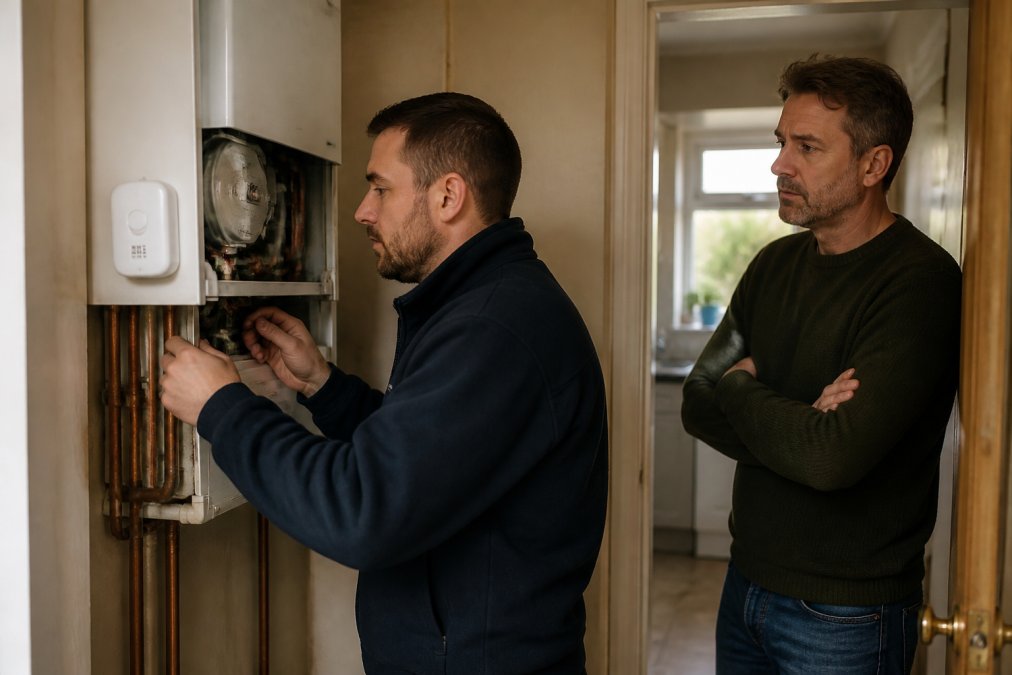
    A Gas Safe registered engineer in uniform inspecting a wall-mounted boiler with a carbon monoxide detector clipped nearby, homeowner watching from a doorway in a typical British home
    A Gas Safe registered engineer in uniform inspecting a wall-mounted boiler with a carbon monoxide detector clipped nearby, homeowner watching from a doorway in a typical British home

    The Emergency Protocol, Step by Step

    If you suspect carbon monoxide, the order of actions matters:

    1. Get everyone outside immediately. Don’t stop to gather belongings.
    2. Open windows and doors on your way out if you can do so without delay.
    3. Do not switch anything on or off, no lights, no extractor fans, no doorbells.
    4. Do not re-enter the property until a Gas Safe engineer has declared it safe.
    5. Call the National Gas Emergency Service on 0800 111 999 from outside, or 999 if anyone is unconscious or struggling to breathe.
    6. Seek medical attention for anyone with symptoms, tell the clinician you suspect CO exposure.
    7. Arrange a Gas Safe engineer to inspect the appliance before it is used again.

    Detectors and Alarms

    A carbon monoxide detector is not optional if you have a gas boiler. Fit one on every floor and test it monthly. Look for an alarm that meets the relevant British Standard and replace the unit at the end of its manufacturer-stated life, most have a five-to-seven-year sensor lifespan, after which they can fail silently.

    Key Takeaway
    A carbon monoxide detector is not optional if you have a gas boiler. Fit one on every floor, test it monthly, and replace it at the end of its stated life. If you live in rented accommodation in Crawley or anywhere in Sussex, your landlord is legally required to provide one.

    6. What to Do If Your Boiler Smells Like Gas

    A gas smell is always an emergency. What to do if your boiler smells like gas comes down to three steps: don’t touch anything electrical, get outside, and call the National Gas Emergency Service.

    • Do not turn lights on or off
    • Do not use your phone inside the property
    • Do not light matches or use any naked flame
    • Open doors and windows as you leave
    • Call 0800 111 999 from outside

    A burning smell is different. That usually points to dust on the heat exchanger or an overheating component. Turn the boiler off and book an inspection, but it’s less urgent than a gas smell.

    National Gas Emergency Service guidance confirms that anyone smelling gas should avoid electrical switches and evacuate before calling.

    7. Yellow Flame, Pilot Light Problems and Repeated Lockouts

    A healthy gas flame burns blue with a crisp inner cone. A yellow or orange flame means incomplete combustion, which produces carbon monoxide. This is an emergency, not a maintenance item.

    Pilot light issues and repeated lockouts often share a root cause: a blocked flue, a failing thermocouple, or a gas valve fault. Error codes on modern boilers usually point to the specific component. If your boiler locks out more than twice in a week, stop resetting it and book an engineer.

    Pro Tip
    If your boiler breaks down every winter, the fault is rarely the boiler itself. It’s usually an undersized system, a sludge-clogged heat exchanger, or a pressure issue that was never fully resolved. A proper diagnosis beats another round of repairs.

    Age matters too. Boilers over 12 to 15 years old are more prone to recurring faults, and at that point repair costs start to outweigh the value of the appliance.

    Frequently Asked Questions

    Is a broken boiler classed as an emergency?

    It depends on the fault. No heating or hot water in cold weather is urgent but rarely dangerous, so it can often wait until the next working day. A gas smell, yellow flame, carbon monoxide alarm sounding or water pouring from the unit is a genuine emergency. In those cases, turn the boiler off, ventilate the property and call a Gas Safe engineer immediately. Apex Gas & Heating Ltd runs a 24/7 emergency call-out across Sussex and Surrey for exactly these situations.

    What is the most common boiler fault?

    Loss of pressure is the fault engineers see most often. It usually traces back to a small leak, a faulty pressure relief valve or a problem with the expansion vessel. Other frequent issues include boiler lockouts, error codes on the display, and pilot light failures on older models. Many of these start as minor symptoms, which is why catching low boiler pressure early can prevent a full system breakdown later.

    How can I tell if my boiler pressure is too low?

    Check the pressure gauge on the front of the unit. Most boilers should sit between 1 and 1.5 bar when cold. Below 1 bar is too low and will often stop the boiler firing altogether. If you need to top up the pressure more than once or twice a year, there is likely an underlying cause, such as a leak or a failing expansion vessel, that needs a Gas Safe engineer to investigate.

    What should I do if my boiler starts making loud banging noises?

    Turn the boiler off and let it cool before doing anything else. Banging or clunking usually points to trapped air, a failing pump or limescale build-up in the heat exchanger. Whistling or gurgling can indicate kettling or a blocked condensate pipe. None of these should be ignored, because continued use can damage the heat exchanger and turn a straightforward repair into a full system breakdown.

    When does a boiler fault become a safety risk?

    Any sign of carbon monoxide, a gas smell or a yellow rather than blue flame is an immediate safety risk. Carbon monoxide has no smell or taste, so a detector is your only reliable warning. Other red flags include soot around the flue, a burning smell or the boiler repeatedly locking out. If any of these appear, stop using the boiler, open windows and call a Gas Safe registered engineer without delay.


    A boiler fault that keeps returning is a sign the underlying issue was never fixed. Apex Gas & Heating Ltd provides 24/7 emergency call-out across Sussex and Surrey, with Gas Safe registered engineers, approved Glowworm and Worcester Installers, and transparent pricing before any work begins. If you’re in Crawley, Redhill or anywhere nearby and your boiler is showing any of these seven signs, get a quote from Apex Gas & Heating Ltd and get your heating back to safe, reliable operation.

    Get your boiler looked at →