Rated Excellent Rating Gas Safe Registered BPEC Certified 25 Years’ Experience 2 Year Guarantee Card Payments AcceptedApple Pay, Mastercard, Visa, Amex, Google Pay Worcester BoschVaillantBaxiGlow-wormAccredited

Category: Blog

  • How to Reduce Home Energy Bills: A 2026 Guide

    How to Reduce Home Energy Bills: A 2026 Guide

    Table of Contents

    Last Updated: August 19, 2026

    Quick Energy-Saving Wins You Can Start Today

    The fastest way to reduce home energy bills is to fix what’s broken right now, not wait for a full system overhaul. Most homeowners waste money on habits they could change in an afternoon.

    Start with the obvious: turn off appliances at the wall instead of leaving them on standby. Standby power drains money silently, a television left on standby uses roughly the same energy as watching it for an hour each week. Next, check your hot water cylinder. If it’s uninsulated, wrapping it in a cheap insulation jacket cuts heat loss by up to 75%. Finally, seal obvious draughts around doors and windows with weatherstripping or foam excluders. These three steps typically cost under £50 combined and show results on your next energy bill.

    At Apex Gas & Heating Ltd, we recommend tackling these quick wins first because they require no engineer visits and deliver immediate savings. The psychological win matters too, seeing your bills drop motivates you to tackle the bigger projects.

    | Quick Win | Cost | Time | Estimated Saving |
    | — | — — — |
    | Standby power elimination | £0 | 30 mins | £10-20/year |
    | Hot water cylinder jacket | £15-25 | 1 hour | £20-40/year |
    | Door and window sealing | £20-40 | 2 hours | £30-60/year |
    | LED bulb replacement | £30-50 | 1 hour | £15-30/year |

    The real energy drain, though, lives in your heating system. That’s where the serious savings happen.

    Boiler Efficiency Tips That Lower Your Heating Costs

    Your boiler accounts for roughly 60% of your annual energy bill. A poorly tuned boiler wastes thousands of pounds over its lifetime. The good news is that three simple adjustments can reclaim much of that waste without replacing the unit.

    Flow Temperature and Boiler Settings

    Flow temperature is the temperature of the water leaving your boiler into the radiators. Most boilers ship with a default flow temperature of 80°C, which is excessive for modern homes with decent insulation. Reducing it to 60°C or even 55°C cuts fuel consumption noticeably whilst maintaining comfort.

    Here’s why this works: lower flow temperature means your boiler runs more efficiently because it doesn’t waste energy pushing water hotter than necessary. The trade-off is that your radiators take slightly longer to warm up, but in a well-insulated home, you won’t notice the difference. Test it by lowering the flow temperature by 5°C and living with it for a week. If the house stays warm, lower it another 5°C.

    Check your boiler’s control panel for the flow temperature setting. Many modern boilers display it on the screen. Older models may require a manual adjustment, consult your boiler manual or contact a qualified engineer. This single adjustment typically saves 8-10% on heating costs annually.

    Regular Servicing and Maintenance

    A boiler service is the difference between a system that limps along and one that runs at peak efficiency. During a service, an engineer cleans internal components, checks for carbon monoxide leaks, and ensures all safety features work properly.

    Boilers lose efficiency gradually. After five years, an unserviced boiler can lose 15% of its efficiency compared to a newly serviced one. The cost of an annual service (typically £120-200) pays for itself within months through reduced fuel consumption. For landlords, an annual boiler service is also a legal requirement under Gas Safety Regulations, you must have a CP12 certificate to prove it.

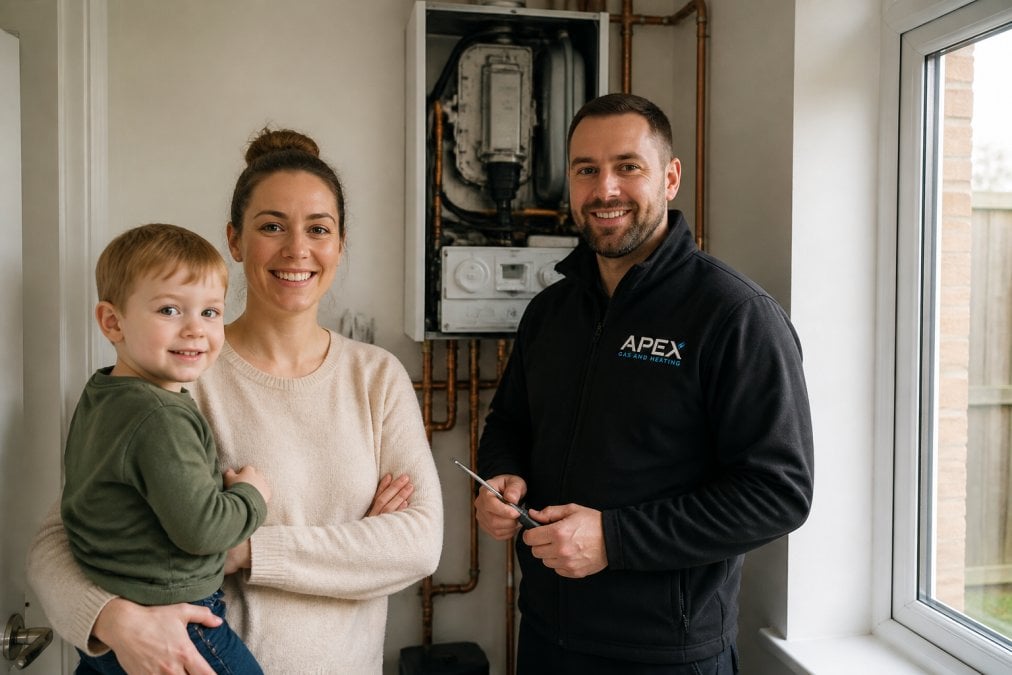
    At Apex Gas & Heating Ltd, our boiler servicing helps maintain your boiler’s efficiency and safety. A properly maintained boiler keeps your home warm reliably whilst protecting your energy budget.

    How to Bleed Radiators and Improve Heat Distribution

    Radiators with trapped air refuse to heat properly, forcing your boiler to work harder and longer. Bleeding radiators, releasing trapped air, is a five-minute job that restores full heating performance.

    You’ll need a radiator bleed key (about £3 from any hardware shop). Start with the radiator furthest from the boiler. Turn off your heating system. Locate the small bleed valve at the top of the radiator, usually a small square socket. Insert the key and turn it anticlockwise slowly. Air hisses out. Once water starts trickling, stop immediately and close the valve. Move to the next radiator and repeat.
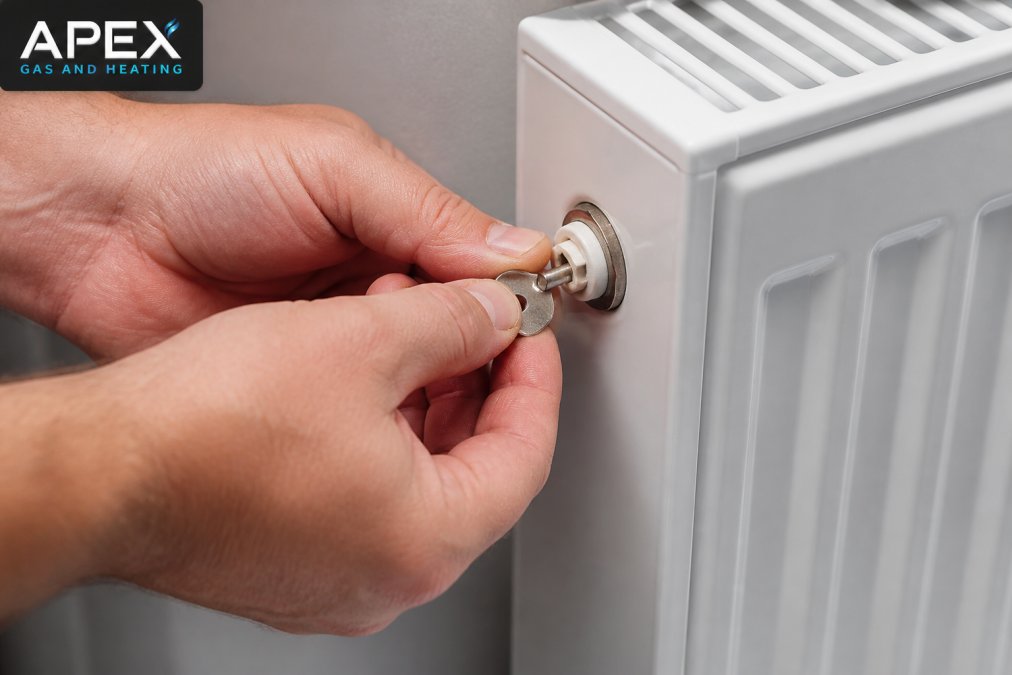
    Close-up of hands using a radiator bleed key on a white radiator valve, showing proper technique and positioning with clear view of the square socket and key insertion
    Close-up of hands using a radiator bleed key on a white radiator valve, showing proper technique and positioning with clear view of the square socket and key insertion

    Do this once a year, ideally before winter. Many homeowners never bleed radiators and wonder why some rooms stay cold whilst others overheat. Trapped air creates uneven heat distribution, forcing your boiler to compensate by running longer cycles. Bleeding radiators typically improves heat distribution by 20-30%, meaning your boiler reaches the target temperature faster and uses less fuel.

    If radiators require bleeding more than once yearly, you likely have a water leak or a problem with the system’s air release valve. Contact a heating engineer to investigate. For rental properties, this is a maintenance issue the landlord must address, tenants shouldn’t need to bleed radiators repeatedly.

    Smart Thermostat Benefits and Temperature Control

    A smart thermostat learns your schedule and adjusts heating automatically, eliminating the guesswork of manual control. Unlike a basic thermostat that simply turns the boiler on or off at a set temperature, a smart thermostat can lower the temperature when you’re away and restore it before you arrive home.

    The benefit is measurable: households using smart thermostats typically reduce heating energy consumption by 10-15% annually. The device costs £150-400 upfront, but the energy savings often cover the cost within three years. Beyond savings, you gain convenience, adjusting your heating from your phone whilst at work or on holiday removes the temptation to leave the system running unnecessarily.

    Look for models that offer:

    • Scheduling by day and time
    • Geolocation awareness (adjusts based on whether you’re home)
    • Radiator-level control (some systems let you heat only occupied rooms)
    • Integration with your energy supplier’s data (shows real-time consumption)

    Set your thermostat to 19-20°C during the day when occupied and 15-16°C at night or when away. Each degree of reduction saves roughly 3% on heating costs. A family reducing their daytime temperature from 21°C to 19°C saves approximately £80-120 annually on heating alone.

    Draught-Proofing and Insulation to Stop Heat Loss

    Heat escapes through gaps and poor insulation. Draught-proofing seals the gaps; insulation slows the heat loss through walls, lofts, and floors.

    Draught-proofing targets visible air leaks: gaps around doors, windows, letterboxes, and pipework. Foam excluders, weatherstripping, and caulk cost little and work immediately. A gap of just 3mm around a door frame loses as much heat as leaving a window open. Seal all gaps and your heating system doesn’t fight a losing battle against cold air pouring in.
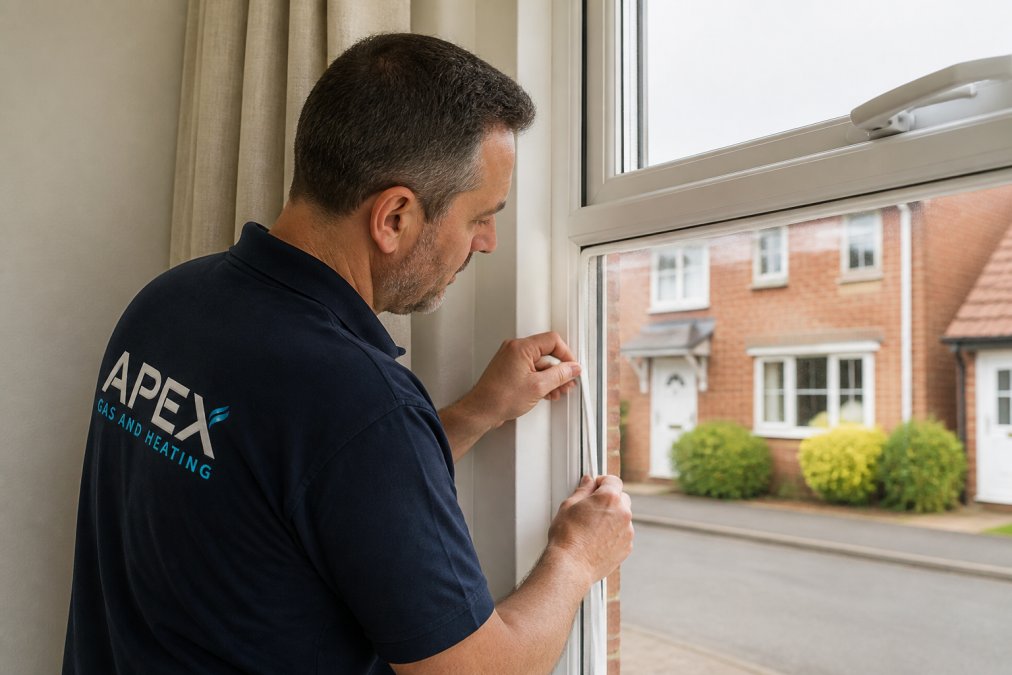
    Homeowner installing white foam draught excluder around a window frame, with daylight visible through the gap being sealed and clear view of the installation technique
    Homeowner installing white foam draught excluder around a window frame, with daylight visible through the gap being sealed and clear view of the installation technique

    Insulation is the bigger project. Loft insulation is the highest priority, heat rises, and an uninsulated loft loses 25% of your home’s warmth. Upgrading loft insulation from 100mm to 250mm costs £300-600 and saves £150-250 annually. Wall insulation and floor insulation follow in priority, depending on your home’s construction.

    Get a fixed-price boiler installation quote →

    The Government’s energy efficiency schemes sometimes fund insulation upgrades. Check whether you qualify for support through current programmes. Even without grants, the payback period for loft insulation is typically three to four years.

    Understanding Your Smart Meter and Energy Tariffs

    A smart meter measures your energy consumption in real time and sends readings to your supplier automatically. This removes the guesswork from billing, you pay for what you actually use, not estimates.

    Most importantly, a smart meter shows you how your consumption changes hour by hour. This data reveals your energy habits. You might discover that your morning routine uses more energy than you thought, or that certain appliances drain far more than expected. Armed with this insight, you can shift usage to off-peak hours if your tariff offers cheaper rates during specific times.

    Time-of-use tariffs charge different rates depending on when you consume energy. Heating water, running the washing machine, or charging devices during off-peak hours (typically 9pm-7am) costs significantly less than during peak times. Families with flexibility can reduce their bills by 10-20% simply by shifting usage to cheaper hours.

    Check your supplier’s tariff options. Some offer fixed rates (same price all day), others offer time-of-use rates (cheaper at night), and some offer economy-7 rates (seven hours of cheap electricity nightly). The best tariff depends on your consumption pattern. A smart meter’s data helps you choose the right one.

    Appliance Usage Habits and Standby Power Management

    Appliances on standby consume power even when off, televisions, microwave ovens, computer monitors, and chargers all draw electricity waiting for you to use them. Collectively, standby power accounts for 5-10% of a typical household’s energy bill.

    The fix is simple: switch appliances off at the wall or use power strips. A power strip lets you cut standby power to multiple devices with one switch. This is especially effective for entertainment systems (television, sound system, streaming device) and home office equipment.

    Larger appliances demand attention too. Tumble dryers are energy-intensive, a typical cycle uses as much electricity as running a refrigerator for two days. Air-drying clothes saves £40-80 annually per household. Washing machines should run full loads only; two full loads use less energy than three half-loads. Dishwashers are efficient if full, but wasteful if half-empty.

    Refrigerators and freezers run continuously. Ensure they’re set to the correct temperature (3-5°C for fridges, -18°C for freezers). A fridge set to 0°C uses roughly 25% more energy than one at 5°C. Defrost manual-defrost freezers regularly, ice buildup forces the compressor to work harder.

    Government Grants and Financial Support for Energy Efficiency

    The Government offers several schemes to help homeowners improve energy efficiency. Eligibility depends on your income, property type, and current energy performance.

    The Energy Company Obligation (ECO) scheme requires energy suppliers to fund energy efficiency improvements for eligible households. Typical support includes loft insulation, wall insulation, boiler upgrades, and heating controls. You don’t repay this support, it’s a grant. Contact your energy supplier to ask about ECO eligibility and available improvements.

    The Warm Home Discount scheme provides a one-off payment (typically £140-150) on your winter energy bill if you’re on a low income or over 60. Application opens in autumn each year. Check the Government’s website for current eligibility criteria and application deadlines.

    For landlords, the Minimum Energy Efficiency Standards (MEES) require rental properties to achieve an Energy Performance Certificate (EPC) rating of E or above. Properties below this rating cannot be let legally. If your property falls short, you must upgrade insulation, heating, or controls to meet the standard. Some grants exist for landlords making these improvements, check your local authority’s website.

    At Apex Gas & Heating Ltd, we can assist landlords in understanding MEES compliance and recommend suitable solutions. Our approved boiler installations and heating controls can help ensure your rental properties meet legal standards whilst potentially reducing tenant energy bills.


    Reducing home energy bills doesn’t require expensive technology or major renovations. Start with boiler efficiency, lower your flow temperature and schedule annual servicing. Bleed radiators, seal draughts, and upgrade insulation in stages. Use a smart thermostat to automate temperature control based on your schedule. Shift appliance usage to off-peak hours if your tariff allows it. These steps, taken together, typically reduce annual energy bills by 20-30%.

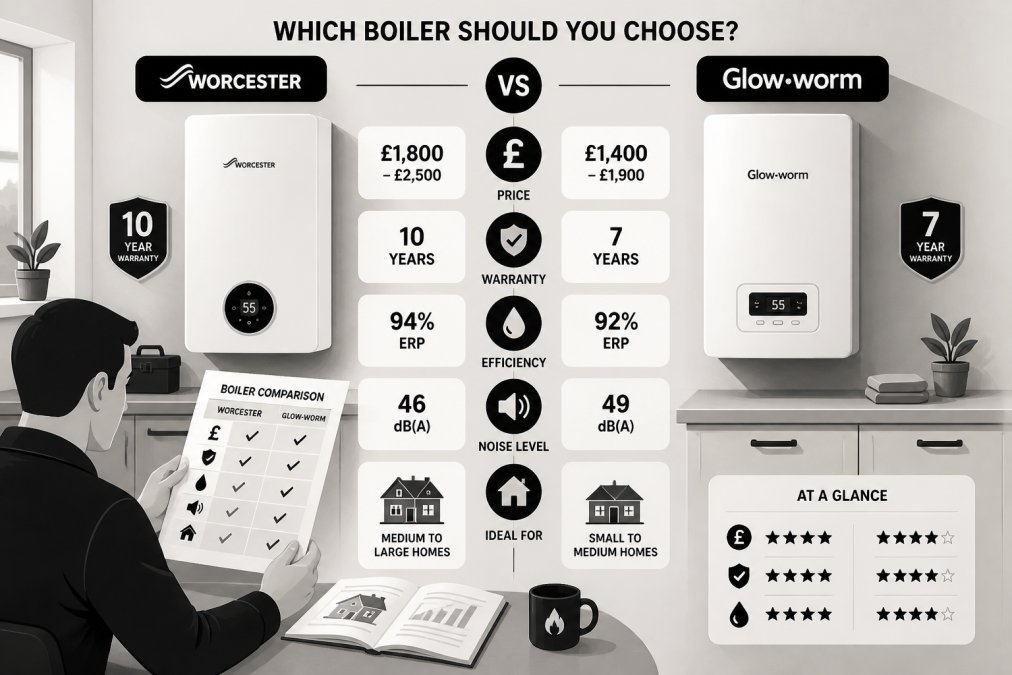
    If your boiler is over 15 years old or requires frequent repairs, replacement becomes more cost-effective than ongoing fixes. Get a quote from Apex Gas & Heating Ltd for a new boiler installation, our Worcester and Glowworm approved engineers deliver reliable, efficient systems with transparent pricing and 24/7 support. A modern boiler, combined with the habits above, maximises your savings and ensures your home stays warm and comfortable through winter.

    Frequently Asked Questions

    What appliances run up your electric bill the most?

    Tumble dryers, electric showers, and space heaters consume the most kilowatt-hours. Older fridges and freezers left running 24/7 also add significantly to bills. Switching to air-drying clothes and reducing shower time can cut consumption noticeably. Checking your appliance rating labels helps identify which items drain the most energy.

    How can regular boiler servicing help lower energy bills?

    A well-maintained boiler burns fuel more efficiently, converting more of it to heat rather than waste. During servicing, engineers clean internal components, check the burner, and verify the boiler is running at the correct flow temperature. A boiler running inefficiently can waste 10-15% of fuel. Annual servicing catches problems early and keeps your heating system operating at peak efficiency, directly reducing your utility bills.

    What impact does smart thermostat installation have on heating costs?

    Smart thermostats learn your heating patterns and adjust temperatures automatically, preventing unnecessary heating when you're away or asleep. Many users report 10-15% reductions in heating costs by managing peak demand more effectively. They provide real-time energy consumption data, helping you understand which behaviours drive up bills. Remote control via smartphone also means you can avoid heating an empty property.

    Are there government grants available for home energy efficiency improvements?

    The Energy Company Obligation (ECO) and various regional schemes offer support for insulation, heating upgrades, and draught-proofing. Eligibility depends on your property type, income, and energy performance certificate rating. Grants may cover cavity wall insulation, loft insulation, or boiler replacements. Contact your local council or visit the government's energy support pages to check what schemes apply to your situation and property.

    How does insulation affect long-term energy expenditure?

    Proper insulation reduces heat loss through walls, roofs, and floors, meaning your heating system works less hard to maintain thermal comfort. Homes with good insulation can save 20-30% on heating costs annually. The initial investment in loft or cavity wall insulation typically pays for itself within 5-10 years through lower bills. Better insulation also improves comfort in winter and reduces reliance on peak demand heating periods.

    What is the best way to reduce energy costs at home?

    A combination of quick wins and long-term investments works best. Start by adjusting thermostat settings, bleeding radiators, and checking for draughts around windows and doors. Then move to draught-proofing and insulation upgrades. Install a smart thermostat to automate heating control. Finally, upgrade to a modern, efficient boiler if yours is over 15 years old. Monitoring your smart meter and understanding your energy tariff also helps identify peak-cost periods to avoid.

    What is the 4pm rule on heating?

    The 4pm rule refers to avoiding peak demand periods when electricity rates are highest. Shifting energy use away from 4-9pm (when demand peaks) to off-peak hours can reduce bills if you're on a time-of-use tariff. This means running appliances like washing machines, dishwashers, and tumble dryers outside peak times. Smart meters make it easier to track when you're using most energy and adjust habits accordingly to lower your overall costs.
    Book online, it takes a minute →

  • What to Do During a Boiler Breakdown: Step-by-Step Guide

    What to Do During a Boiler Breakdown: Step-by-Step Guide

    Table of Contents

    Last Updated: August 18, 2026

    Immediate Safety Steps During a Boiler Breakdown

    When your boiler stops working, stay calm and follow a clear sequence of safety checks before anything else.

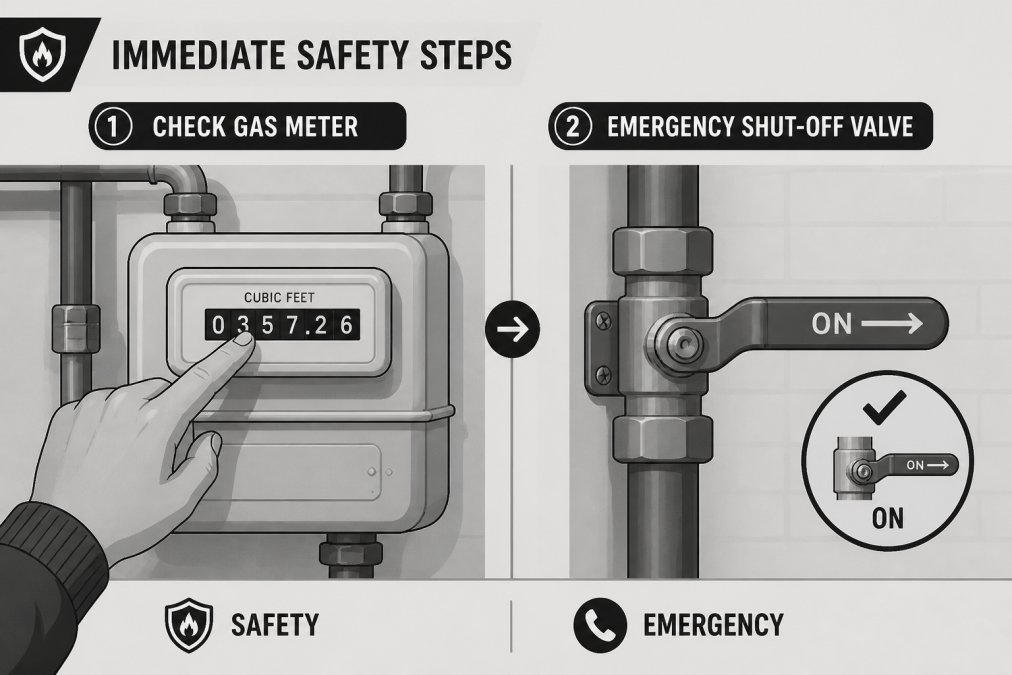
    Start by checking for gas leaks. If you smell gas (a distinctive rotten-egg odour), do not attempt repairs yourself. Open windows and doors immediately, leave the property, and call your gas supplier’s emergency number from outside.

    Next, locate your emergency shut-off valve, typically found near your boiler or where gas enters your property. If you suspect a leak, turn this valve clockwise to stop the gas supply.

    Check your boiler’s pressure gauge. Normal pressure is typically between 1 and 2 bar. If the needle has dropped to zero, your system may have lost pressure, one of the most common reasons for a boiler breakdown.

    Ensure the area around your boiler is clear and well-ventilated. Boilers need adequate airflow to operate safely. If your boiler is in a cupboard, check that vents are not blocked.

    Do not attempt to disassemble or repair your boiler yourself. Modern boilers contain complex components and working on them without proper training can be dangerous and may invalidate your warranty. Gather information instead: note any error codes on the control panel, check whether the pilot light is lit, and record when the problem started.

    Close-up of a homeowner's hand checking a gas meter and emergency shut-off valve location in a residential property, showing the correct valve position
    Close-up of a homeowner's hand checking a gas meter and emergency shut-off valve location in a residential property, showing the correct valve position

    Check Your Boiler Troubleshooting Checklist

    Before assuming you need an emergency repair, work through this systematic checklist. Many boiler breakdown situations resolve with simple checks that take minutes.

    Check the thermostat and control panel

    Confirm your thermostat is set to the desired temperature and heating mode is switched on. If your thermostat has a battery, check it’s not dead and replace if needed.

    Look at your boiler’s control panel. Most modern boilers display error codes when something is wrong. Write down any code you see, it’s a diagnostic tool engineers use to identify the exact problem. Your boiler’s manual or the manufacturer’s website can help you decode these.

    Check that the boiler’s power switch is turned on. The switch is usually a simple on/off button near the base of the unit. If it’s off, turn it on and wait 30 seconds for the boiler to initialise.

    Inspect the pilot light

    The pilot light is a small flame inside your boiler that ignites the main burner. Look through the boiler’s inspection window to see if the pilot light is burning. It should be a steady, blue flame about the size of a pea.

    If the pilot light is out, some boilers have a reset button (usually marked with an "r" or spark symbol) that you can press to reignite it. Press and hold this button for 10-15 seconds while listening for a clicking sound. If the pilot light reignites, hold the button for another 30 seconds before releasing it. If it goes out again immediately, do not keep trying, this suggests a faulty thermocouple or ignition system that needs professional repair.

    Check for tripped switches or blown fuses

    Your boiler’s electrical supply is protected by a switch or fuse. Check your home’s fuse box or circuit breaker panel for any switches in the "off" position or fuses that appear blackened or damaged. If you find a tripped switch, flip it back to "on". If a fuse has blown, replace it with one of the same amperage.

    After resetting a tripped switch, wait a minute for the boiler to restart. If the switch trips again immediately, this indicates an electrical fault requiring professional diagnosis.

    Some boilers also have a reset button on the electrical control box. Press this button once and wait 10-15 seconds for the boiler to ignite. If it doesn’t restart or restarts but stops again within minutes, you have a persistent fault needing professional attention.

    How to Repressurise a Boiler

    A loss of pressure is one of the most common reasons for a boiler breakdown, and it’s one of the few issues you can often resolve yourself.

    Before you repressurise, identify whether you have a slow leak. Check under your boiler and around radiators for drips or damp patches. If you find active leaking, do not repressurise, call a [heating engineer for boiler repair](https://apexgasandheating.com/services/boiler-repair-service/).

    If there’s no visible leak, you can repressurise using the filling loop, a flexible pipe with shut-off valves at each end, usually located beneath the boiler. Open both valves slowly and watch the pressure gauge on your boiler as it rises. Stop when the pressure reaches 1 to 1.5 bar. Do not exceed 2 bar, as this can damage seals.

    Close both valves on the filling loop, then wait 10 minutes. Check the pressure gauge again. If the pressure has dropped, you have a leak needing professional repair. If it holds steady, your system is repressurised and should work normally.

    Some older boilers have a screw-down valve rather than a filling loop. If you’re unsure which type you have, consult your boiler’s manual or contact a heating engineer.

    When to Call a Gas Safe Registered Engineer

    Knowing when to stop troubleshooting and call a professional is crucial. A Gas Safe registered engineer has the training, tools, and legal authority to work on gas appliances safely.

    You must call a Gas Safe registered engineer immediately if you suspect a gas leak, smell gas, see carbon monoxide warning signs (dizziness, nausea, headaches), notice the pilot light won’t stay lit after multiple reset attempts, see water leaking from your boiler or pipes, or if your boiler displays an error code you cannot resolve.

    You should also call an engineer if your boiler has lost pressure multiple times within a short period, if it keeps shutting down unexpectedly, or if you’ve completed all troubleshooting steps and the boiler still won’t start.

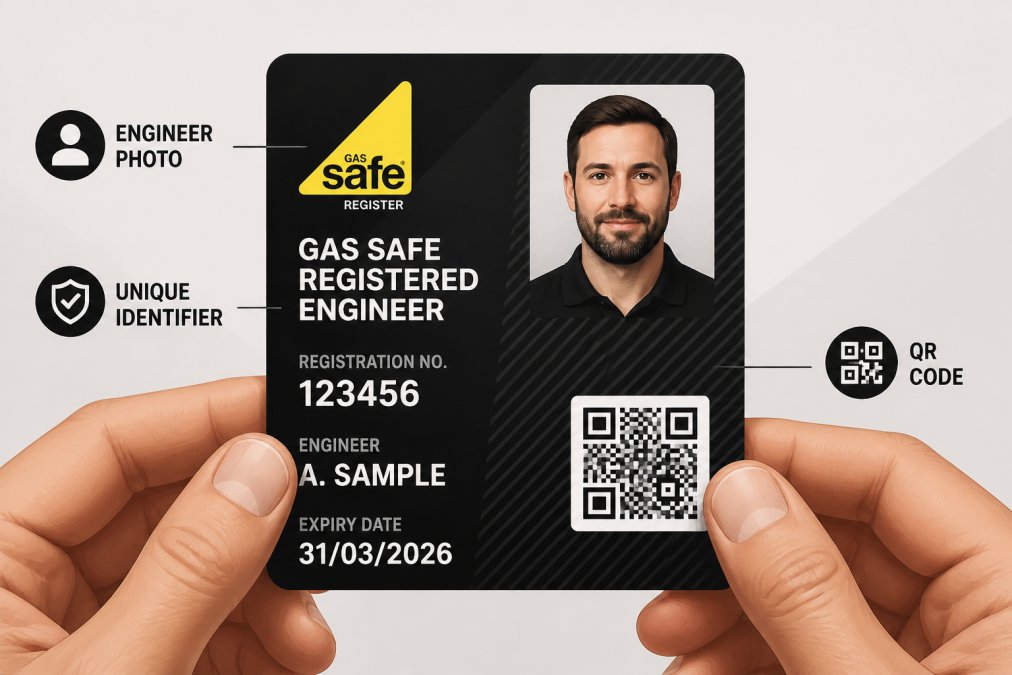
    Gas Safe registration is a legal requirement. Any engineer working on a gas boiler must be registered with Gas Safe Register. You can verify an engineer’s credentials by asking for their Gas Safe ID card or checking the register at Gas Safe Register’s online verification tool. Never allow an unregistered person to work on your boiler.

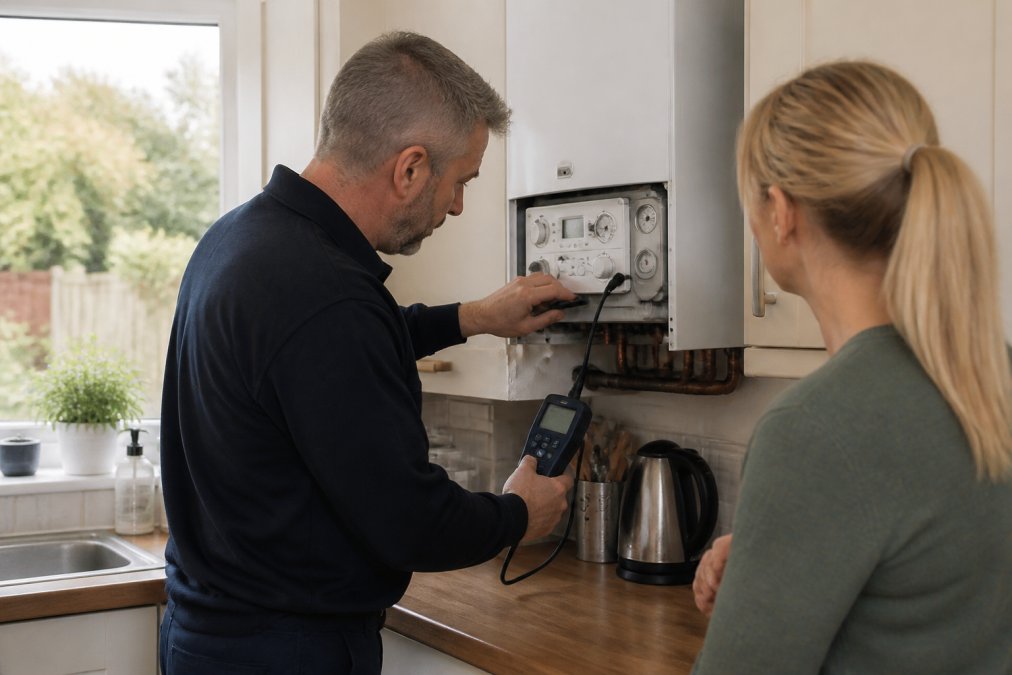
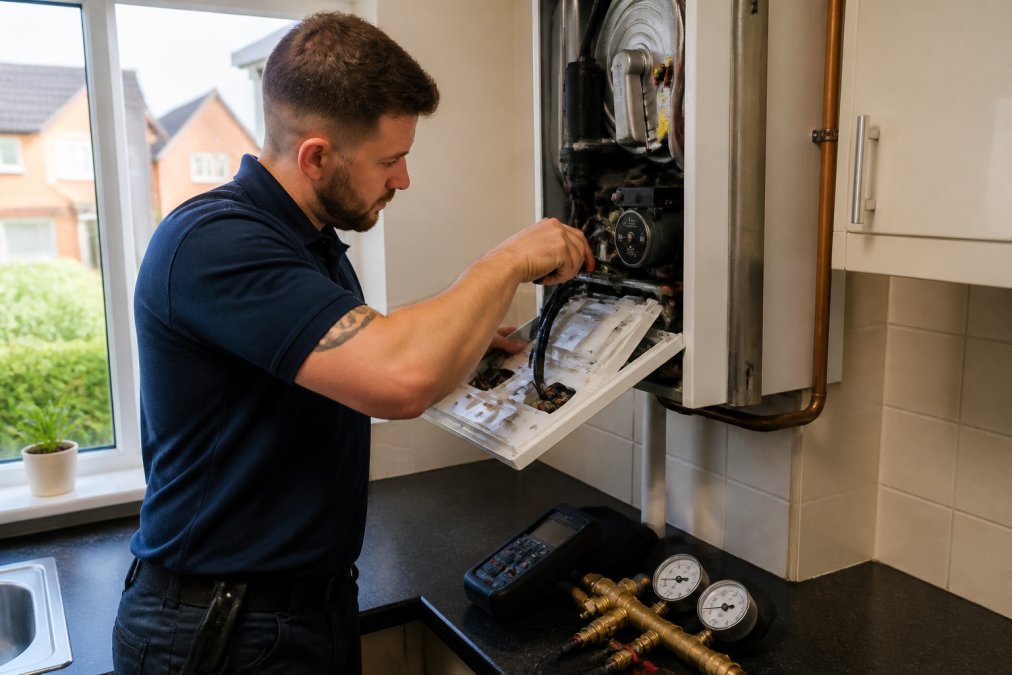
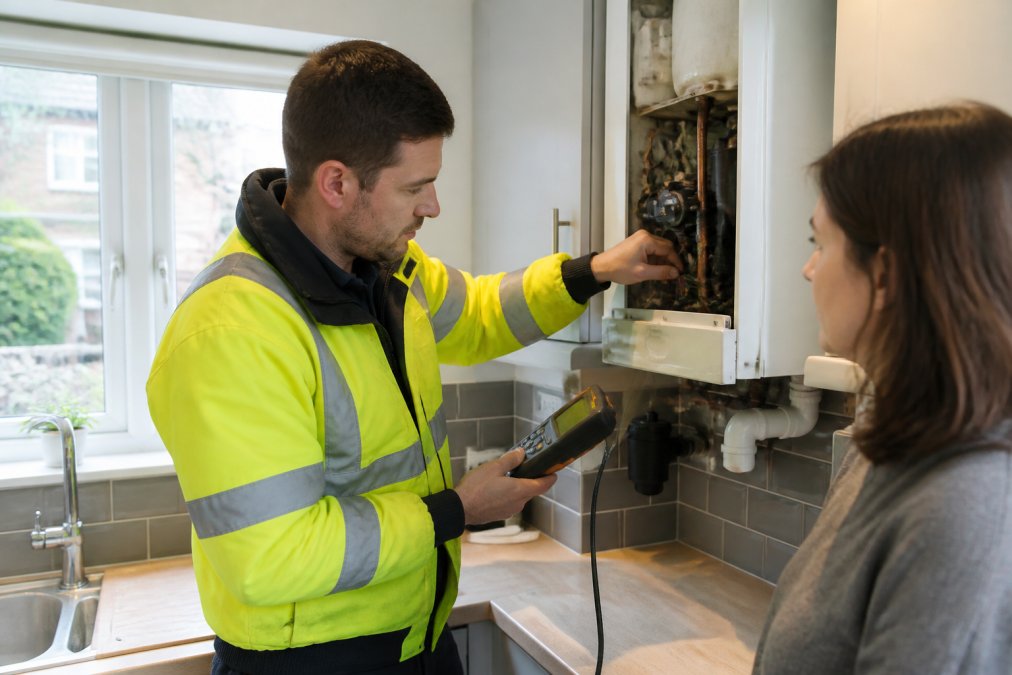
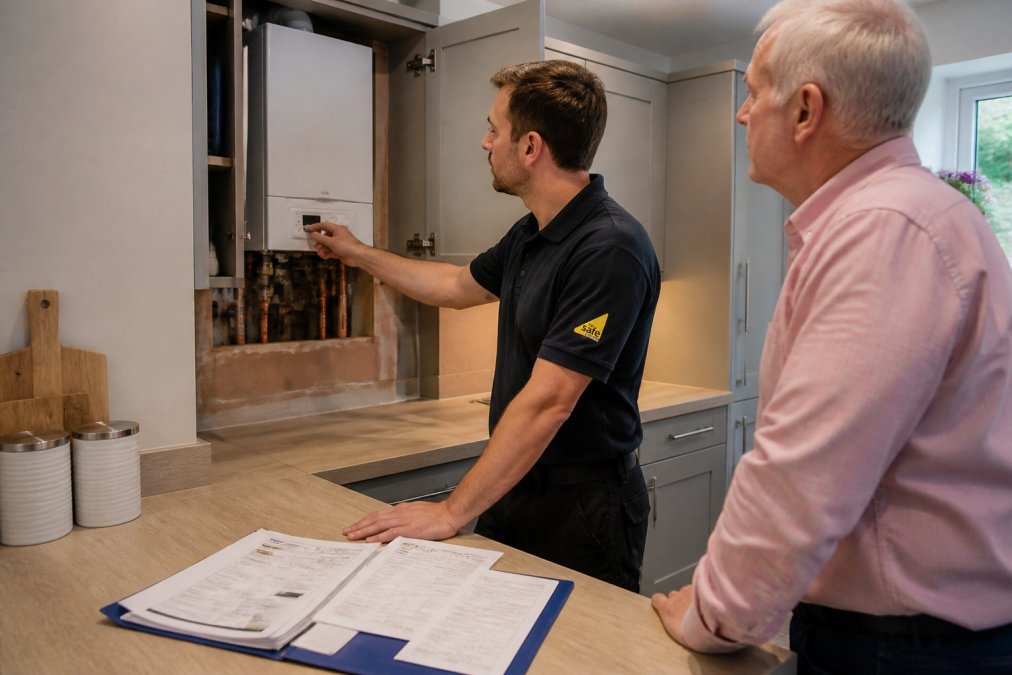
    A Gas Safe registered heating engineer in uniform examining a boiler control panel with diagnostic tools and meter in a residential home kitchen
    A Gas Safe registered heating engineer in uniform examining a boiler control panel with diagnostic tools and meter in a residential home kitchen

    Apex Gas & Heating Ltd employs Gas Safe registered engineers trained to diagnose and repair all common boiler faults. With 24/7 emergency call-out availability across Sussex, including Crawley and surrounding areas, you won’t be left without heat for long. A professional engineer can also identify whether your boiler needs boiler repair or new boiler installation.

    Staying Warm While Your Boiler Is Down

    A broken boiler in winter is uncomfortable and stressful. While you wait for an engineer, you need to keep your home warm and safe.

    Use portable heaters as a temporary measure, but do so carefully. Electric fan heaters are safe when placed on a flat surface away from flammable materials. Gas heaters should only be used in well-ventilated spaces and never in bedrooms. Never use your oven or stovetop as a heating source; this is a fire and carbon monoxide hazard.

    Insulation is your best friend during a breakdown. Close doors to unused rooms to concentrate warmth in living areas. Hang heavy curtains or blankets over windows at night to reduce heat loss. Wear layers and use blankets on sofas and beds.

    If you have friends or family nearby, consider staying with them temporarily. This is especially important if you have young children, elderly relatives, or anyone with health conditions that make cold exposure risky.

    Run hot water from your taps regularly. This keeps pipes from freezing and prevents additional damage to your heating system.

    If your boiler breakdown occurs during winter and you’re a tenant, your landlord is legally required to provide adequate heating. If they fail to do so, contact your local authority’s environmental health team.

    Emergency Repair vs. Replacement: What You Need to Know

    When an engineer assesses your boiler, they’ll recommend either repair or replacement. This decision depends on the boiler’s age, repair cost, likelihood of future breakdowns, and your budget.

    Boilers typically last 10-15 years. If your boiler is over 12 years old and the repair cost exceeds 50% of a new boiler‘s price, replacement is usually more economical. Older boilers are also less efficient, costing more to run each year.

    If your boiler is younger than 10 years and the repair is straightforward, repair makes sense. Consider the boiler’s repair history. If it has broken down multiple times in the past two years, it’s showing signs of age-related wear.

    New boilers come with warranties, typically 5-10 years depending on the model and installer. This warranty covers parts and labour, giving you peace of mind. Older boilers have no warranty.

    Apex Gas & Heating Ltd can assess your boiler and give you an honest recommendation. If repair is viable, they’ll do it quickly. If replacement is the better choice, they’ll explain the options and help you select a new boiler suited to your home’s size and heating needs.

    Your Rights as a Tenant or Homeowner

    Your rights during a boiler breakdown depend on whether you own your home or rent it.

    As a homeowner: You are responsible for maintaining your boiler and paying for repairs or replacement. You have the right to choose any qualified engineer you wish. If you have a boiler service plan or insurance, check your policy to see what’s covered.

    As a tenant: Your landlord is legally required to provide a safe, habitable home with adequate heating. They must repair or replace a broken boiler promptly. You have the right to request repairs in writing, and your landlord must respond within a reasonable timeframe. If they do not, contact your local authority or seek legal advice.

    Landlords must also provide a Gas Safety Certificate (CP12) annually. This certificate proves the boiler and gas appliances have been inspected by a Gas Safe registered engineer. If your landlord cannot produce a current CP12, they are breaking the law.

    If your landlord is unresponsive to repair requests, document everything: dates you reported the problem, temperatures in your home, any communication.

    For landlords: You are legally required to have all gas appliances, including boilers, inspected annually by a Gas Safe registered engineer. You must provide tenants with a copy of the Gas Safety Certificate within 30 days of the inspection. Failure to do so can result in significant fines. Emergency repairs must be addressed promptly to avoid tenant disputes and legal issues.

    Apex Gas & Heating Ltd provides Gas Safety & CP12 certification and landlord and letting agent services across Sussex. They understand the legal requirements and can help landlords maintain compliance whilst keeping tenants warm and safe.

    Frequently Asked Questions

    What should I do first if my boiler breaks down?

    First, check for safety hazards. If you smell gas, turn off the gas supply at the meter and leave the property immediately, call the National Gas Emergency Service on 0800 111 999. If there's no gas smell, check your thermostat settings, pilot light, and whether the boiler has lost pressure. Look for error codes on the control panel. If basic checks don't restore heating, contact a Gas Safe registered engineer for a professional diagnosis.

    Can I repressurise my boiler myself during a breakdown?

    You can repressurise a boiler yourself if the pressure has simply dropped below the minimum (usually around 1 bar). Locate the filling loop, a flexible pipe with isolation valves beneath the boiler, and slowly open both valves to increase pressure to 1.5 bar. Close the valves once complete. However, if pressure drops repeatedly, this signals an internal leak requiring a professional engineer. Never attempt to fix anything beyond repressurising; other repairs need Gas Safe certification.

    When should I call a Gas Safe registered engineer instead of trying DIY fixes?

    Call a Gas Safe registered engineer immediately if you smell gas, see water leaking, the boiler won't ignite after you've checked the pilot light, error codes persist after a reset, or pressure keeps dropping. Gas Safe registration is a legal requirement for anyone working on gas appliances, attempting repairs without certification is dangerous and may invalidate your boiler warranty. Engineers are trained to diagnose faults safely and ensure your heating system meets safety standards.

    Can I use my heating system at all if the boiler is broken?

    No, if the boiler is broken, you cannot use central heating or hot water from that system. You can use an immersion heater if your property has one (usually in the hot water cylinder), which provides hot water independently. For heating, use portable heaters in occupied rooms, but ensure they're kept away from curtains and furniture. Landlords must provide a working heating system; tenants should report breakdowns to their landlord immediately, as this may qualify as an emergency repair.


    A boiler breakdown is stressful, but most issues can be resolved quickly with the right approach. Start with safety checks, work through the troubleshooting checklist, and call a Gas Safe registered engineer if the problem persists. Whether you need emergency repair or are considering replacement, Apex Gas & Heating Ltd offers fast, professional service with transparent pricing and a 24/7 emergency call-out line. Get a quote today and ensure your home stays warm and safe year-round.

    See our boiler repair and servicing →

  • Boiler Installation Pricing Guide 2026

    Boiler Installation Pricing Guide 2026

    Table of Contents

    Last Updated: August 17, 2026

    What Affects Boiler Installation Pricing

    The cost of a boiler installation depends on several interconnected factors that go well beyond the price of the boiler itself. Understanding these variables helps homeowners in Crawley and across Sussex make informed decisions about their heating investments.

    The primary factors include the boiler type, complexity of your existing heating system, labour rates, and any upgrades needed to pipework and flue systems. A straightforward like-for-like replacement costs considerably less than a full system conversion or installation requiring significant structural work. Property size, heating demand, building regulations compliance, and whether power flushing or new flue installation is needed all influence total costs.

    At Apex Gas & Heating Ltd, we’ve found that transparent pricing begins with understanding these variables upfront. When you request a quote, a qualified Gas Safe registered engineer should assess your specific situation and provide a detailed breakdown covering supply costs, labour, materials, and any additional work required.

    Combi Boiler Installation Cost 2026

    A combi boiler installation represents one of the most popular heating solutions for properties across Sussex. These units combine heating and hot water in a single compact appliance, eliminating the need for a separate hot water cylinder or storage tank.

    Combi boiler installation costs vary based on whether you’re replacing an existing combi with a like-for-like unit or converting from a different system type. A straightforward replacement typically involves fewer labour hours because existing pipework can often be reused. Converting from a system boiler with a cylinder requires additional work to cap off old pipework and reconfigure your heating circuit.

    Modern condensing boilers recover heat from flue gases, delivering better efficiency ratings than older models. This translates to lower annual heating bills, though the upfront investment is slightly higher. Over a boiler’s typical 10-15 year lifespan, the efficiency gains often justify the premium.

    Installation duration for a combi boiler typically ranges from one to two days for a straightforward replacement. More complex installations involving flue relocation or extensive system reconfiguration may take longer, extending both labour costs and home disruption.

    Gas Safe registered installers in Crawley and surrounding areas follow strict building regulations when fitting any boiler. This includes safety checks on gas connections, pressure testing of the heating system, and verification that the flue installation meets current standards. These regulatory requirements are essential for your safety and the boiler’s warranty validity.

    System and Regular Boiler Installation Costs

    System boilers and regular (conventional) boilers represent alternatives to combi units, particularly suited to larger properties with higher hot water demands or homes where multiple people need simultaneous access to hot water.

    A system boiler works with a separate hot water cylinder but integrates the expansion vessel and pump into the boiler unit itself. This reduces complexity compared to a regular boiler, which requires a separate expansion vessel, pump, and often a feed and expansion tank in the loft. System boiler installation pricing typically falls between a combi and a full regular boiler installation.

    Regular boilers represent the traditional heating approach. They require more ancillary equipment including a hot water cylinder, expansion vessel, and feed tank. However, regular boilers excel in properties with high hot water demand because they deliver sustained volumes of hot water without the pressure fluctuations that sometimes affect combi units.

    The labour involved in installing either system differs from combi installation. A system boiler installation may require modifications to existing pipework if converting from a combi, including capping off redundant connections and installing a new hot water cylinder. A regular boiler installation typically involves the most extensive work, potentially requiring new flue installation, upgraded pipework, and installation of the cylinder and expansion equipment.

    Building regulations compliance applies equally to system and regular boiler installations. Your installer must verify that your flue installation meets current standards, conduct pressure testing, and ensure all safety devices function correctly.

    Boiler Supply Versus Installation Labour Costs

    Understanding the split between boiler supply costs and installation labour costs helps you evaluate quotations more effectively. Labour often represents 40-50% of the total boiler installation pricing, with the boiler unit itself accounting for the remainder.

    The boiler supply cost depends on the model, brand, and energy efficiency rating you select. Premium brands command higher prices than budget alternatives, though the relationship between price and quality isn’t always linear. A mid-range condensing boiler from a reputable manufacturer often delivers better value than either the cheapest option or the most expensive premium model.

    Installation labour costs reflect the complexity of your existing heating system, time required for assessment and quotation, actual installation time, and any additional work such as power flushing, flue relocation, or pipework upgrades. A Gas Safe registered installer in Crawley will charge based on their experience, qualifications, and local market rates.

    Additional materials beyond the boiler itself add to your total costs, including new pipework sections, fittings, flue components, thermostatic radiator valves, and smart controls. A detailed quotation should itemise these materials separately.

    When comparing quotations from different installers, ensure each one breaks down supply and labour separately. This transparency allows you to identify whether price differences stem from variations in the boiler model itself or differences in labour charges, and helps you spot unusually low quotations that may indicate corner-cutting.

    Gas Safe Registered Installer Requirements

    Every boiler installation in the UK must be completed by a Gas Safe registered engineer. This regulatory requirement exists to protect your safety and ensure your heating system operates correctly.

    Gas Safe registration is the legal standard for anyone working on gas appliances in the UK. The scheme maintains a register of qualified engineers who have demonstrated competence in gas safety and continue to meet professional standards. You can check an engineer’s credentials on the official Gas Safe Register website.

    A qualified Gas Safe registered installer understands building regulations compliance requirements, can assess whether your existing flue installation meets current standards, and knows when upgrades are necessary. They’re trained to conduct pressure testing of your heating system, verify that safety devices function correctly, and ensure all gas connections are secure and leak-free.

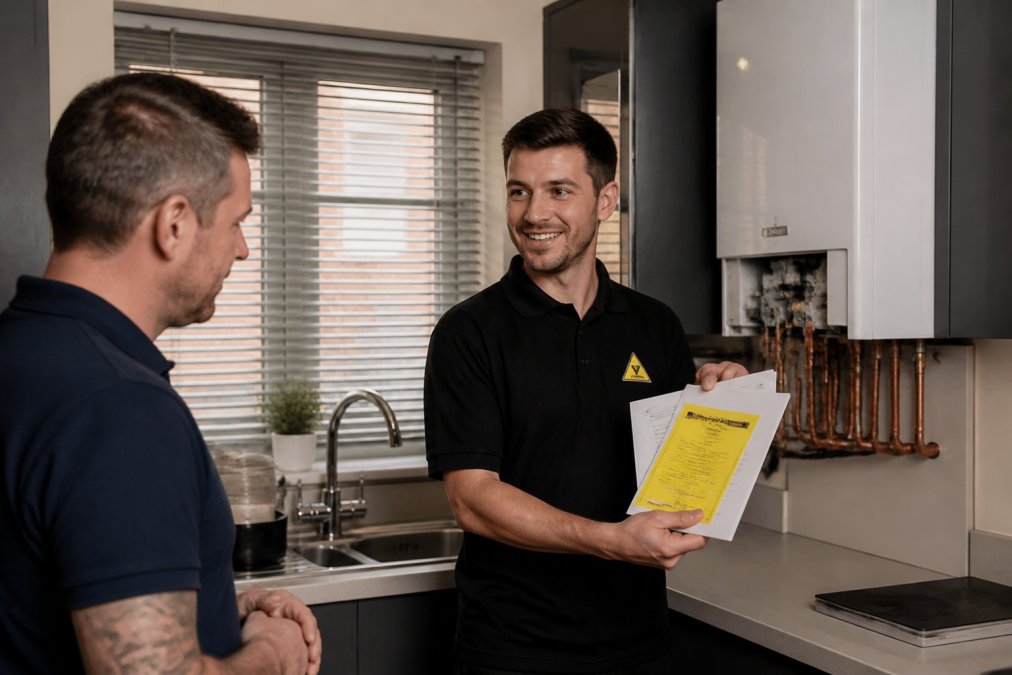
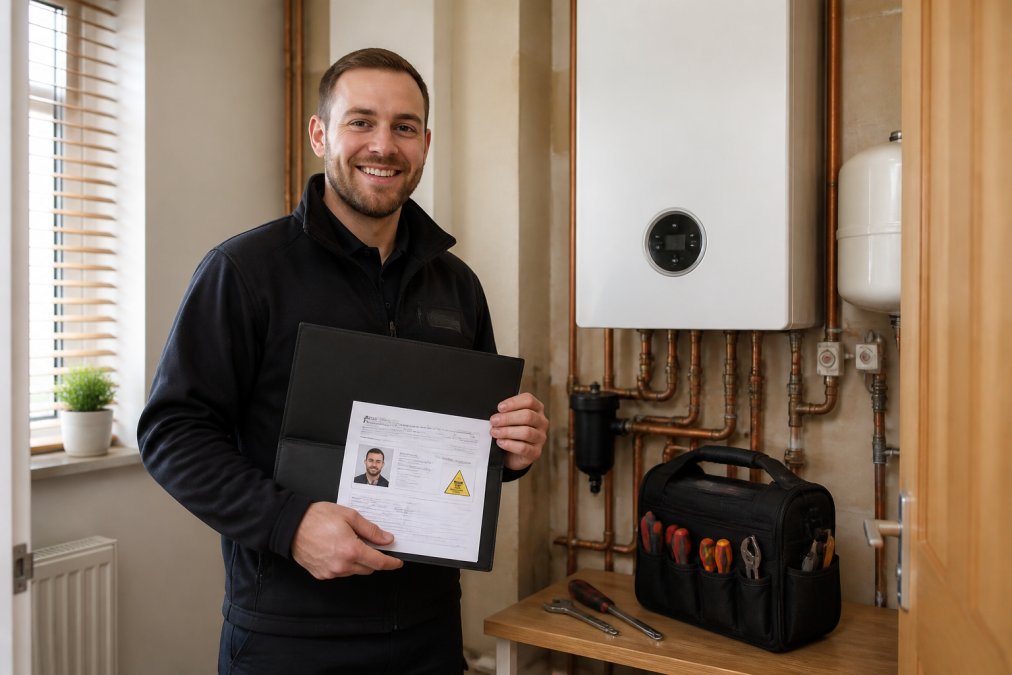
    Professional heating engineer in uniform holding Gas Safe certification documents while standing beside a modern boiler installation in a residential kitchen with modern cabinetry and neutral tones
    Professional heating engineer in uniform holding Gas Safe certification documents while standing beside a modern boiler installation in a residential kitchen with modern cabinetry and neutral tones

    A Gas Safe registered installer provides documentation that protects you after the work is complete. They issue a Gas Safe Installation Certificate confirming the installation complies with building regulations and safety standards. This certificate is essential if you’re selling your property, as buyers’ surveyors will request it. For landlords, it’s a legal requirement to maintain gas safety certificates for rental properties.

    You should be cautious of any installer offering significantly lower prices by claiming they can bypass this process. Legitimate engineers factor their Gas Safe registration costs and compliance obligations into their pricing.

    Boiler Installation Duration and Hidden Costs

    Most boiler installations take between one and three days, depending on the complexity of your existing system and whether the work is a like-for-like replacement or involves system conversion.

    A straightforward combi-to-combi replacement typically takes one day. The installer disconnects the old boiler, removes it, installs the new unit, connects the pipework and flue, conducts safety checks, and completes the Gas Safe certification. This timeline assumes your existing flue installation is compatible and no additional work is needed.

    More complex scenarios extend installation duration. Power flushing to remove sludge from the heating system typically takes an additional day and must be completed before the new boiler is installed. A flue relocation or installation of a new flue system can add another day or more, depending on the structural work required. Converting between boiler types involves additional labour because the installer must cap off old pipework, remove redundant components, and reconfigure your heating circuit.

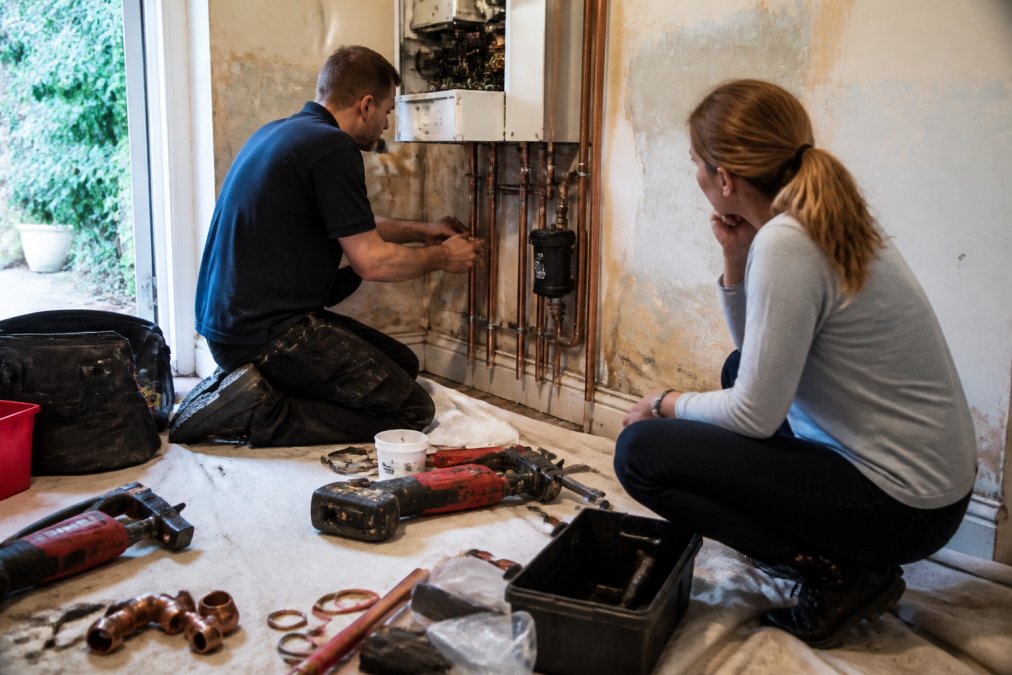
    Professional installer working on boiler pipework and flue installation with tools and materials visible on the floor of a residential property, demonstrating the complexity of the work
    Professional installer working on boiler pipework and flue installation with tools and materials visible on the floor of a residential property, demonstrating the complexity of the work

    Hidden costs often catch homeowners by surprise. Power flushing is frequently necessary when replacing an old boiler because sludge accumulation can damage the new boiler’s heat exchanger. If your existing flue installation doesn’t meet current building regulations, you’ll need to upgrade it. This might involve installing a new flue terminal, rerouting the flue, or converting to a balanced flue system.

    Thermostatic radiator valve installation is another cost that varies between properties. Modern building regulations often require TRVs on radiators to improve energy efficiency. Smart thermostat integration pricing depends on whether you’re adding a new smart control system or upgrading an existing one.

    Choosing the Right Boiler for Your Home

    Selecting the appropriate boiler type for your property is fundamental to getting good value from your boiler installation pricing investment. The wrong choice leads to either inadequate heating and hot water supply or paying for unnecessary capacity.

    Start by assessing your home’s heating demand. A property’s size, insulation quality, and the number of occupants all influence the kilowatt output you require. A professional heating engineer can calculate your specific needs based on factors like floor area, building age, and current energy efficiency rating.

    Your hot water usage patterns matter significantly. If multiple people in your household frequently need hot water simultaneously, a combi boiler may struggle because it heats water on-demand rather than storing it. A system boiler with a cylinder or a regular boiler provides better performance in this scenario. A small household with modest hot water needs benefits from a combi boiler’s compact size and efficiency.

    Your existing heating system infrastructure influences which boiler type makes sense. If you already have a cylinder and expansion equipment, converting to a combi requires removing these components and reconfiguring your pipework, which adds cost. A like-for-like replacement typically costs less than a system conversion.

    Energy efficiency ratings deserve careful consideration. All modern boilers must meet minimum efficiency standards, typically around 90% for condensing boilers. Over a 10-15 year lifespan, a boiler with a marginally higher efficiency rating delivers measurable fuel savings that can offset its higher purchase price.

    Brand reputation and warranty coverage should factor into your decision. Established manufacturers offer reliability and support that budget brands may not provide. Extended warranty options are available from most manufacturers and installers.

    Apex Gas & Heating Ltd provides guidance on boiler selection as part of our new boiler installation service. Our Gas Safe registered engineers assess your specific property requirements and recommend the most suitable boiler type and model for your needs and budget, ensuring you make an informed decision about your heating investment.

    Frequently Asked Questions

    What factors influence the total cost of a boiler installation?

    Boiler installation pricing depends on the boiler type (combi, system, or regular), your property size, existing pipework condition, fuel type, and whether you need additional work like flue installation or power flushing. Labour costs vary by region and complexity. Gas Safe registered installers typically charge based on the scope of work required. Contact Apex Gas & Heating Ltd for a detailed quotation that reflects your specific circumstances.

    How long does a professional boiler installation typically take?

    Boiler installation duration usually ranges from 4 to 8 hours for a straightforward like-for-like replacement in an existing system. More complex installations involving new pipework, system upgrades, or significant modifications to your central heating system may take longer. The exact boiler installation duration depends on your property layout, the boiler type selected, and any additional work needed. Our team will provide a time estimate during your quotation process.

    Why do I need a Gas Safe registered installer?

    Gas Safe registered installer requirements exist to protect your safety and comply with building regulations. Only Gas Safe registered engineers can legally install boilers and gas appliances in the UK. They carry proper insurance, follow safety standards, and issue certification upon completion. This protects your home, your warranty, and your family from carbon monoxide risks and faulty installation. Apex Gas & Heating Ltd's engineers are fully Gas Safe registered and approved by leading manufacturers.

    Are there hidden costs I should budget for beyond the boiler and labour?

    Yes. Hidden costs can include disposal and recycling fees for your old boiler, power flushing to clean your heating system, thermostatic radiator valve upgrades, carbon monoxide alarm installation, pipework modifications, flue work, and building regulation certification. Some installations may also require system pressure adjustments or smart control integration. Request a full quotation breakdown from your installer to identify all costs upfront and avoid surprises.


    Choosing the right boiler and installer protects your investment and keeps your home warm and safe for years to come. Get a detailed quotation from a Gas Safe registered engineer who can assess your property, explain the boiler installation pricing breakdown, and recommend solutions tailored to your specific needs. Contact Apex Gas & Heating Ltd today to discuss your boiler installation requirements and receive transparent pricing for your heating upgrade.

    Ask us about a new boiler →

  • Local Gas Engineers: Sussex Reviews & Guide

    Local Gas Engineers: Sussex Reviews & Guide

    Table of Contents

    Last Updated: August 16, 2026

    What to Look for in Local Gas Engineers

    When you need a qualified heating engineer for your home, the choice matters. A poorly installed boiler or missed safety issue can cost thousands in repairs or put your family at risk. The right local gas engineers Sussex reviews will show you professionals who combine Gas Safe registration, transparent communication, and proven reliability.

    What separates a trustworthy engineer from a risky one comes down to three things: credentials, customer feedback, and how they handle the job itself. Gas Safe registered status is non-negotiable, it’s the legal requirement proving an engineer has passed formal competence tests and can legally work on gas appliances. Real homeowners describe what actually happened: whether the engineer was punctual, whether they left the property clean, and whether the work held up over months. You’re looking for patterns, not perfection.

    Apex Gas & Heating Ltd represents the standard you should expect: Gas Safe registered engineers, full public liability insurance, transparent pricing, and a 24/7 emergency call-out service. When evaluating any local gas engineers Sussex reviews, ask yourself whether the company demonstrates these same fundamentals.

    How to Check Gas Safe Registration

    Verifying Gas Safe registration is straightforward and essential. Before any engineer touches your boiler or gas appliance, confirm their credentials yourself.

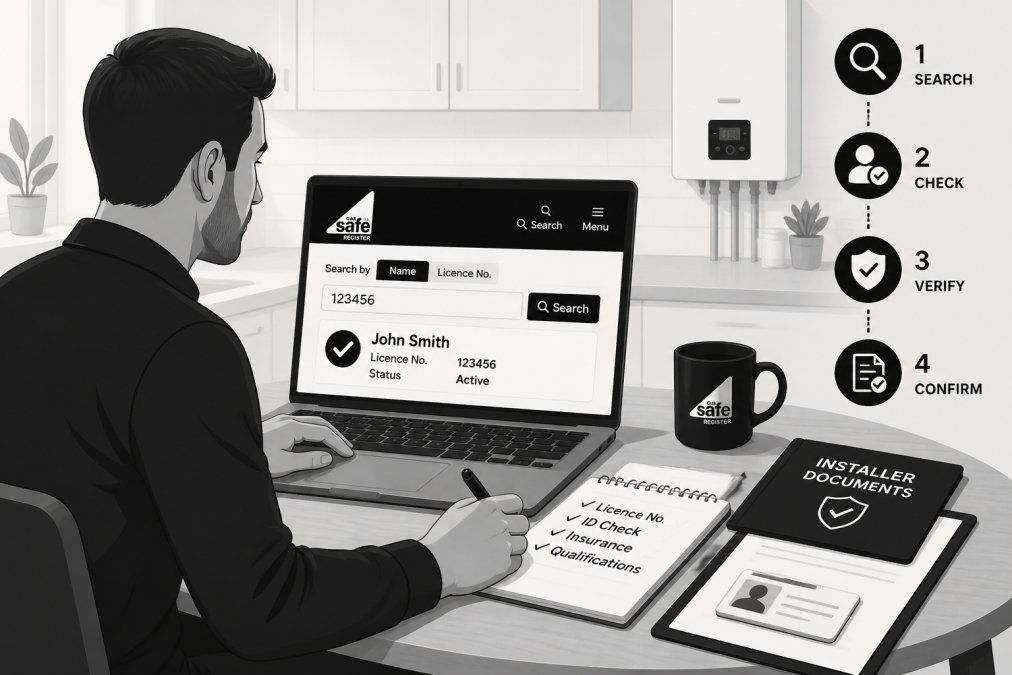
    Visit the official Gas Safe Register website and use their search tool. You can search by engineer name, registration number, or company name. The register will show you exactly which types of gas work that engineer is qualified to perform. When you find the engineer’s entry, check the registration status shows "active" with a valid certificate of gas safety competence. Note the expiry date, Gas Safe certificates require renewal every five years.

    Ask the engineer for their registration number and verify it independently before booking. Legitimate professionals expect this check. If an engineer resists providing their number, walk away. This single step protects you from unqualified work and ensures your home meets legal safety standards.

    Top-Rated Gas Engineers Serving Sussex

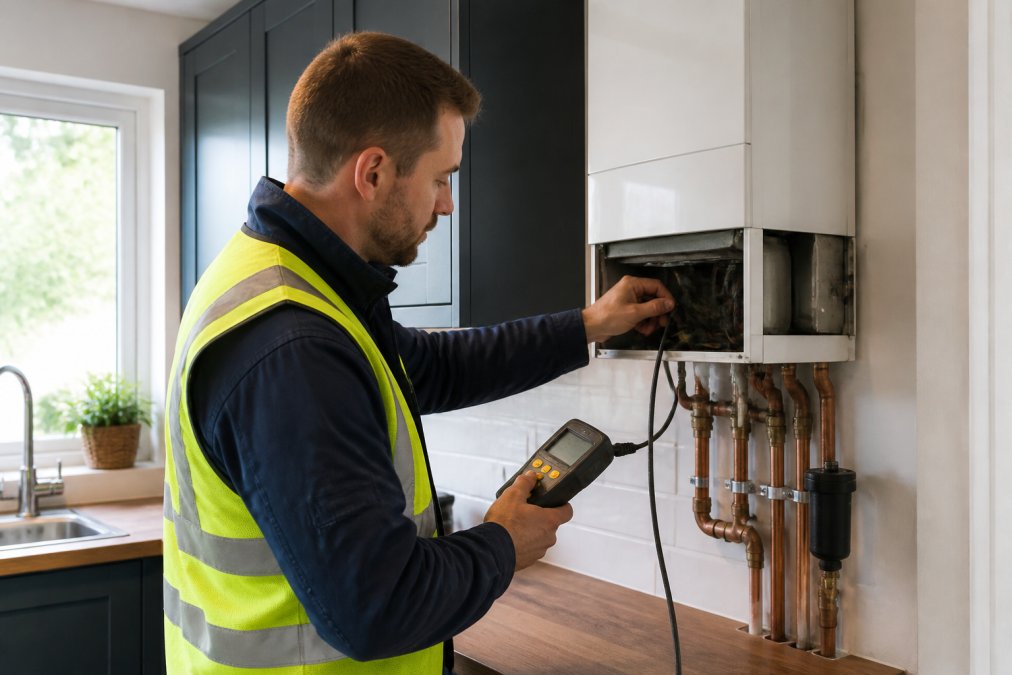
    Professional heating engineer in uniform checking a boiler system in a residential kitchen, with diagnostic tools and gauges visible on the work surface, natural daylight from window
    Professional heating engineer in uniform checking a boiler system in a residential kitchen, with diagnostic tools and gauges visible on the work surface, natural daylight from window

    Apex Gas & Heating Ltd

    Apex Gas & Heating Ltd delivers professional gas, heating, and plumbing services to homeowners and businesses throughout Sussex and Surrey. Their team holds approvals from Baxi, Glowworm, and Worcester, three of the most respected boiler manufacturers. Approved installers have undergone rigorous training and must maintain quality standards to keep their accreditation.

    What sets them apart is transparent pricing and 24/7 emergency availability. Homeowners consistently praise their fast response times and professional workmanship. The company holds full public liability insurance, protecting you if anything goes wrong. Their engineers handle boiler servicing, repairs, new installations, and gas safety certificates for landlords.

    Customer feedback highlights reliability and knowledge. One homeowner noted: "Fast response decent price highly recommend." Another stated: "Excellent experience with Apex will definitely be using them next year. Adam is very thorough."

    Pro Tip
    Apex Gas & Heating Ltd offers quotations, so you can understand costs upfront before committing to work.

    The Sussex Heating Care Company

    Based in Bognor Regis, The Sussex Heating Care Company is a family-run operation focused exclusively on boiler and central heating services. Their Gas Safe registered engineers handle installations, servicing, and emergency repairs across Sussex. Homeowners report prompt arrival times and tidy, professional work. The team communicates clearly throughout the job, explaining what they’re doing and why.

    The Sussex Boiler Company

    Specialising in boiler installation, replacement, and servicing, The Sussex Boiler Company brings focused expertise to the market. They handle combi, system, and regular boiler types, plus general plumbing and gas safety checks. Customer reviews consistently praise punctuality and professionalism. One homeowner wrote: "Exceptional service during boiler installations. Punctual, polite, and knowledgeable engineers."

    AquaGas (Sussex) Plumbing & Heating Solutions

    AquaGas offers a broader service range than boiler-only specialists. Beyond heating, they handle gas appliance installation and repair, bathroom installations, and comprehensive plumbing. Water Safe and CIPHE registration ensures compliance with water regulations. The company offers quotations, making them useful for larger renovation projects combining heating work with bathroom or plumbing upgrades.

    West Sussex Heating

    West Sussex Heating is a family-run specialist in boiler replacement and central heating installation. They handle Gas, Oil, and LPG boilers, plus emergency repair services. Their engineers are Gas Safe and OFTEC registered, covering both gas and oil appliances. Customers highlight speed and efficiency, with engineers described as highly experienced and knowledgeable.

    What to Expect During a Boiler Service

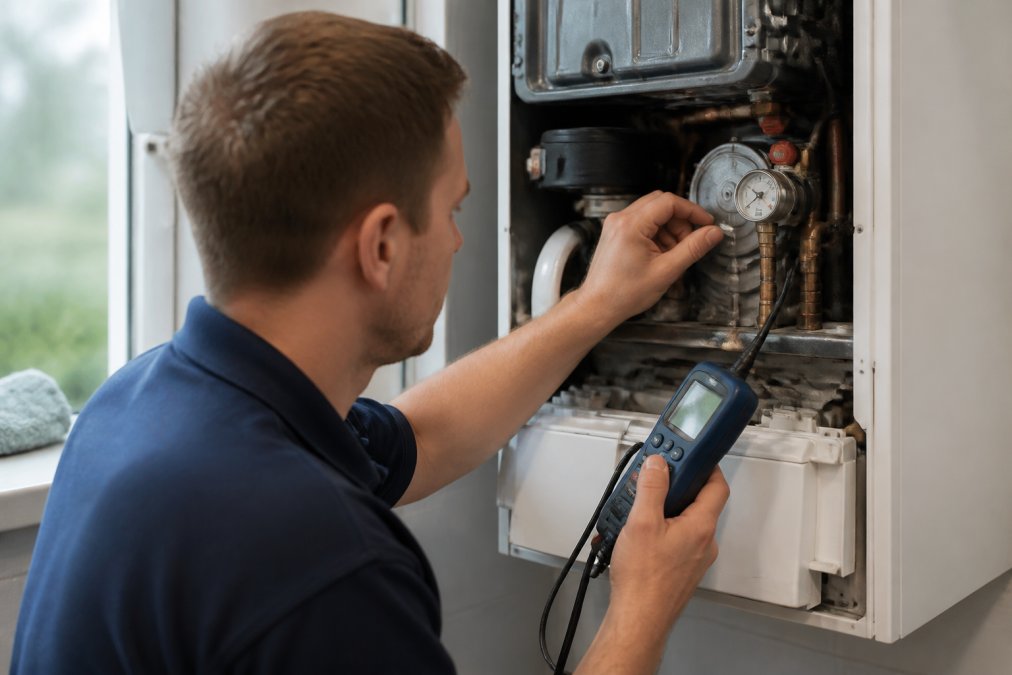
    Close-up of Gas Safe registered engineer performing safety inspection on boiler, holding diagnostic equipment and checking pressure gauges in residential setting
    Close-up of Gas Safe registered engineer performing safety inspection on boiler, holding diagnostic equipment and checking pressure gauges in residential setting

    A boiler service typically takes 45 to 60 minutes for a standard domestic system. The engineer will inspect, test, and clean key components to ensure safe operation and efficiency.

    The engineer begins by checking your boiler’s external condition and controls, verifying that the pressure gauge reads correctly, usually between 1 and 1.5 bar for most systems. They’ll then remove the boiler casing and inspect internal components including the heat exchanger, burner, and combustion chamber for signs of wear, corrosion, or carbon buildup.

    The engineer will test the boiler’s ignition and flame, confirming safety devices function properly. They’ll also check the flue to ensure it’s clear and properly sealed. Gas safety is the final check, the engineer measures carbon monoxide levels around the boiler and verifies gas supply pressure is correct.

    At the end, the engineer provides a record of what was checked, cleaned, and tested. This document is important for your records and for proving the boiler was serviced if you need to claim on warranty or insurance.

    Watch Out
    If the engineer finds a fault during servicing, such as a cracked heat exchanger or unsafe gas pressure, don’t ignore their recommendations. A small repair now prevents a costly breakdown later and keeps your home safe.

    If you rent out a property, you have a legal obligation to ensure gas appliances and pipework are safe. This is not optional, and breaching these requirements can result in significant penalties.

    The key requirement is the Gas Safety (Installation and Use) Regulations 1998. You must have a Gas Safe registered engineer inspect all gas appliances and pipework in your property at least once every 12 months. This inspection is documented on a CP12 certificate (the official Gas Safety Certificate).

    You must provide your tenant with a copy of the CP12 within 28 days of the inspection. Keep a copy for yourself and retain records for at least two years. The CP12 covers all gas appliances: boilers, cookers, fires, water heaters, and any other gas-powered equipment. If an appliance is unsafe, the engineer will mark it as such on the certificate. You must then repair or remove the appliance before the tenant continues using it.

    Apex Gas & Heating Ltd provides CP12 certificates and specialises in landlord gas safety services. They understand the legal requirements and handle the documentation, ensuring you stay compliant.

    Book a boiler repair or service →

    Key Takeaway
    The 12-month inspection cycle is a legal deadline, not a guideline. Mark your calendar now to ensure you don’t miss it. Failing to provide a valid CP12 is a breach of tenancy law.

    Finding Verified Reviews and Customer Testimonials

    Customer reviews reveal what actually happens when you hire an engineer. Real feedback from real homeowners tells you whether a company delivers on its promises.

    Checkatrade requires customers to book through their platform and verifies reviews come from genuine transactions. Rated People and MyBuilder work similarly, homeowners post jobs, hire tradespeople, and then leave reviews. When reading reviews, look for specific details rather than vague praise. "Engineer arrived on time, explained the work clearly, and cleaned up afterwards" tells you the company values professionalism.

    Pay attention to how the company responds to negative reviews. A professional response that acknowledges the issue and explains how it was resolved suggests a business that takes customer concerns seriously. For Apex Gas & Heating Ltd, customer testimonials emphasise speed, reliability, and fair pricing.

    Don’t rely on reviews alone. Ask the engineer directly for references from recent customers who can speak to the quality of their work.

    Seasonal Maintenance Checklist for Heating Systems

    Heating systems need attention at different times of year to maintain efficiency and prevent winter breakdowns.

    Spring and Summer (April to August):
    Have your boiler serviced by a Gas Safe registered engineer. Check your radiators for cold spots and bleed them if necessary. Inspect your heating pipes for leaks or corrosion. Test your thermostat and controls.

    Autumn (September to October):
    Confirm your boiler service is completed before winter. Check your central heating pump is running smoothly. Inspect your flue and ensure it’s clear of debris. Test your heating system on a cool day.

    Winter (November to March):
    Monitor your boiler for warning signs: pilot light issues, unusual noises, or loss of pressure. Keep your boiler’s air vents clear of snow or ice. If you experience a breakdown, call your emergency service immediately. Check radiators weekly to ensure they’re heating evenly.

    Year-Round:
    Bleed radiators if you notice cold spots. Check your system pressure monthly and top up if needed. Keep the area around your boiler clear and well-ventilated. Note any changes in how your heating performs and report them to your engineer.

    Season Task Frequency Priority
    Spring/Summer Annual boiler service Once yearly Critical
    Spring/Summer Radiator bleeding As needed High
    Autumn Heating system test Once yearly High
    Autumn Flue inspection Once yearly High
    Winter Pressure check Weekly Medium
    Year-round CO detector check Monthly Critical

    Emergency Call-Out Services and Response Times

    When your boiler breaks down in winter, response time matters. A 24-hour wait without heating is uncomfortable; a week-long wait is unacceptable.

    Most emergency heating services operate 24/7, including weekends and bank holidays. However, "24/7" doesn’t mean the engineer arrives immediately. Response times typically fall into same-day response (within 4 hours), next-day response (standard for many services), or scheduled appointments for non-emergency repairs.

    Apex Gas & Heating Ltd offers 24/7 emergency call-out service. Their reputation for fast response times, noted repeatedly in customer feedback, suggests they actually deliver on this promise.

    When calling an emergency service, describe your problem clearly. "My boiler won’t turn on" is more useful than "my heating isn’t working." The engineer can then assess whether it’s an emergency requiring immediate attention or something that can wait for a scheduled visit.

    Pro Tip
    Keep your boiler’s model number and age handy. When you call an emergency service, having this information helps them diagnose the problem faster and ensure they bring the right parts.

    Ask about call-out charges upfront. Understanding the cost structure before you’re in crisis mode helps you make informed decisions. For landlords, having a reliable emergency service on speed dial is essential. Tenants expect heating to be restored quickly, and you have a legal obligation to maintain safe, habitable conditions.


    Finding the right local gas engineers in Sussex comes down to checking credentials, reading genuine customer feedback, and choosing a provider who prioritises your safety and comfort. Gas Safe registration, transparent pricing, and proven reliability are the standards you should expect. Apex Gas & Heating Ltd delivers these fundamentals consistently, with 24/7 emergency availability and approved manufacturer accreditation giving you peace of mind. Get a quote today and experience the difference professional, trustworthy service makes.

    Frequently Asked Questions

    How do I verify if a gas engineer is Gas Safe registered?

    Visit the Gas Safe Register website and search by the engineer's name or registration number. You can also ask the engineer directly for their registration number and verify it on the spot. Gas Safe registration confirms the engineer holds certificates of gas safety competence and is legally qualified to carry out gas work. Never hire an unregistered engineer, as this poses serious safety risks and may invalidate your boiler warranty.

    What should I expect during a boiler service?

    A professional boiler service typically lasts 30-60 minutes. The engineer will inspect the boiler internally and externally, check all safety controls, test for carbon monoxide leaks, clean components, and verify the flue is working correctly. They'll also check your central heating system and provide a written report. A thorough service identifies potential problems before they become dangerous, ensuring your heating system runs efficiently and safely throughout the year.

    How often should I have my gas boiler serviced?

    Your boiler should be serviced annually, ideally before winter when demand is highest. Regular servicing keeps your heating system safe, maintains efficiency, and helps avoid costly breakdowns. If you're a landlord, annual gas safety inspections are a legal requirement under the Gas Safety (Installation and Use) Regulations 1998. Many engineers recommend scheduling your service in autumn to ensure your system is ready for the heating season.

    What are the signs I need an emergency gas engineer?

    Contact an emergency engineer immediately if you smell gas, suspect a gas leak, see yellow flames in your boiler (should be blue), hear unusual noises, or if your boiler stops producing hot water or heating. Carbon monoxide alarms sounding is also a red flag. These symptoms indicate safety hazards that require urgent professional attention. Many local gas engineers offer 24/7 emergency call-out services to address these issues quickly.

    How can I compare quotes from local gas engineers?

    Request quotes from at least three Gas Safe registered engineers, specifying the exact work needed. Compare the scope of work, parts included, labour costs, and guarantees offered. Check verified customer reviews on Checkatrade, Rated People, or MyBuilder to assess reliability and workmanship quality. Ask about their response times, insurance cover, and whether they provide written guarantees on their work. The cheapest quote isn't always the best; prioritise engineers with strong testimonials and transparent pricing.

    Book online, it takes a minute →

  • Reliable Plumber in Crawley: What to Know

    Reliable Plumber in Crawley: What to Know

    Table of Contents

    Last Updated: August 15, 2026

    What Makes a Reliable Plumber in Crawley Area

    Finding a reliable plumber in Crawley area requires knowing what separates trustworthy professionals from those who cut corners. The most important factor isn’t price, it’s verifiable credentials, transparent communication, and a proven track record of showing up when promised.

    At Apex Gas & Heating Ltd, we’ve seen countless homeowners frustrated after hiring plumbers who disappeared mid-job, quoted low then charged high, or left problems unsolved. A reliable plumber in Crawley area should have Gas Safe registration, full public liability insurance, and a willingness to provide written quotes upfront. These aren’t nice-to-have extras, they’re the foundation of trustworthy service.

    The difference between a reliable plumber and an unreliable one often comes down to three things: whether they answer the phone, whether they show up on time, and whether the work actually lasts. A plumber who takes emergency calls at 11 PM and arrives within the hour has built their reputation on reliability. A plumber who gives vague timescales and avoids written agreements is signalling that accountability isn’t their priority.

    When you’re evaluating a reliable plumber in Crawley area, ask yourself: Can I verify their credentials? Do they provide a written quote? Are they insured? Will they explain what they’re doing? A professional should answer yes to all four.

    Pro Tip
    Before booking, ask the plumber directly: “Are you Gas Safe registered?” and request their registration number. You can verify it instantly on the Gas Safe Register website. If they hesitate or can’t provide it, move on.

    Gas Safe Registered Plumber: Why It Matters

    A Gas Safe registered plumber is legally required to work on gas appliances and heating systems in the UK. This registration isn’t a suggestion, it’s a regulatory requirement that protects you from carbon monoxide poisoning, gas leaks, and faulty installations that could damage your property.

    Professional Gas Safe registered engineer in work uniform holding certification documents standing in front of modern boiler installation with tools visible
    Professional Gas Safe registered engineer in work uniform holding certification documents standing in front of modern boiler installation with tools visible

    Gas Safe registration means the engineer has passed competency assessments and agreed to follow strict safety standards. When you hire a Gas Safe registered plumber, you’re hiring someone who’s been vetted by an independent body. The registration covers boiler installations, repairs, servicing, and any work involving gas pipework. Without it, the work is illegal and voids your boiler warranty.

    Many homeowners don’t realise that an unregistered plumber working on your gas system can result in a fine for you, not just them. The responsibility falls on the property owner to ensure work is done by a registered professional. This is why Gas Safe registration should be your first checkbox when hiring anyone to touch your heating system.

    How to Verify Gas Safe Registration

    Verification takes two minutes. Visit the Gas Safe Register website and search for the engineer’s name or registration number. The database shows their registration status, which appliances they’re qualified to work on, and any enforcement history. A legitimate Gas Safe registered plumber will have no problem providing their registration number, they’re proud of it.

    When you call a plumber, ask for their registration number before booking. Write it down. Then verify it yourself rather than taking their word. This single step eliminates the risk of hiring someone operating illegally.

    Watch Out
    If a plumber claims to be Gas Safe registered but their name doesn’t appear on the official register, do not hire them. This is a red flag for fraud or misrepresentation. Report them to Gas Safe if you suspect they’re falsely claiming registration.

    How to Verify Plumbing Credentials and Insurance

    Gas Safe registration covers gas work, but a reliable plumber in Crawley area needs more than that. They should carry full public liability insurance, which protects you if they damage your property or cause injury while working. Insurance isn’t optional, it’s essential.

    Ask to see the insurance certificate before work begins. A legitimate business will have no problem producing it. The certificate should show coverage for at least £1 million in public liability. If they can’t produce it, they’re operating without insurance, which means you’re liable for any damage they cause.

    Beyond insurance, look for plumbers who are members of trade bodies like the Institute of Plumbing and Heating Engineering (IPHE) or the Chartered Institute of Plumbing and Heating Engineering (CIPHE). These memberships require ongoing training and adherence to professional standards. A plumber with professional memberships has invested in their credibility.

    Check online reviews on independent platforms. Look for patterns in what customers say. One negative review might be an outlier, but multiple complaints about the same issue, missed appointments, poor workmanship, hidden charges, indicate a pattern. A reliable plumber in Crawley area will have consistently positive feedback across multiple platforms.

    Ask for references from recent jobs. A confident plumber will provide contact details for customers who can speak to the quality of their work. Call those references and ask specific questions: Did they arrive on time? Did they explain what they were doing? Did the problem stay fixed?

    Emergency Response: 24/7 Availability and Fast Turnaround

    When your boiler breaks down in winter or a pipe bursts at 2 AM, you need someone who answers the phone and arrives quickly. A reliable plumber in Crawley area offers 24/7 emergency call-out service. This isn’t luxury, it’s essential for homeowners and landlords.

    Apex Gas & Heating Ltd prioritises rapid response for genuine emergencies, understanding that a burst pipe or boiler failure can’t wait until Monday morning. When you call, ask what their response time is. If they can’t give you a specific timeframe, they’re not organised enough to handle emergencies reliably.

    Fast response matters because every hour a pipe leaks is water damage spreading through your property. Every hour without heating in winter is your home getting colder and your family getting more uncomfortable. An emergency plumber who arrives quickly makes a measurable difference.

    Document the time you call and the time they arrive. If they consistently miss their stated response time, you’ve found a pattern that matters. A reliable plumber in Crawley area builds their reputation on keeping promises about arrival times.

    Key Takeaway
    The difference between a £500 water damage repair and a £5,000 one often comes down to how fast the plumber arrived. Fast response time isn’t a luxury, it’s damage prevention.

    Plumbing Repair Checklist: What to Expect

    A reliable plumbing repair follows a predictable process. Knowing what to expect helps you spot professionals from cowboys who rush through jobs.

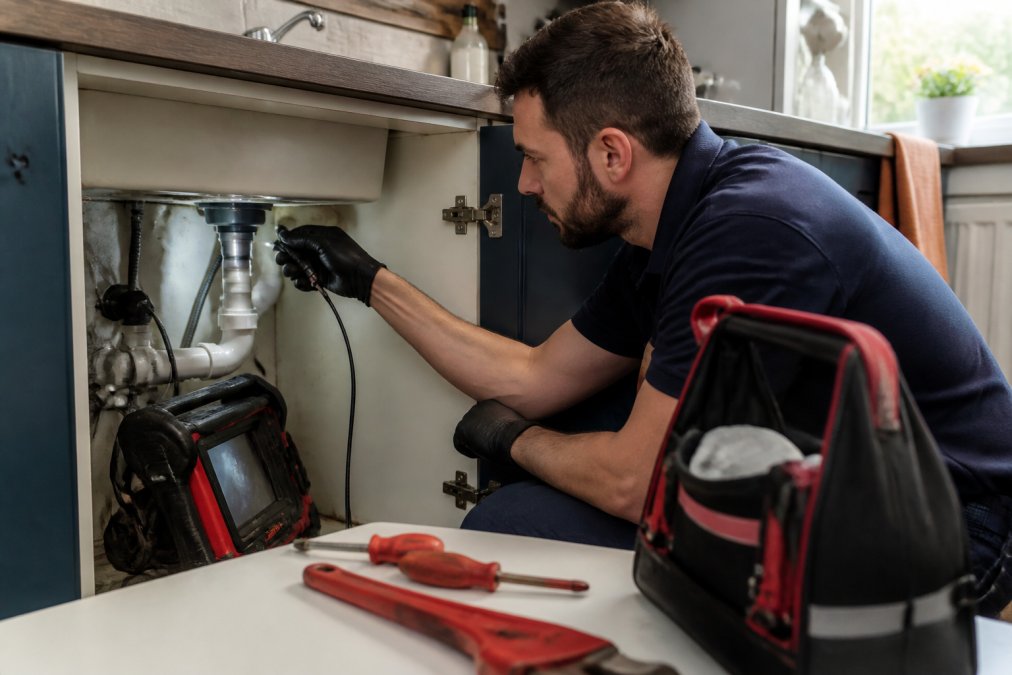
    Professional plumber using advanced leak detection equipment under kitchen sink with inspection tools and diagnostic equipment visible on work surface
    Professional plumber using advanced leak detection equipment under kitchen sink with inspection tools and diagnostic equipment visible on work surface

    When a plumber arrives, they should:

    • Inspect the problem thoroughly before quoting. A plumber who quotes over the phone without seeing the issue is guessing.
    • Explain what they’ve found in plain language. You should understand the problem and the solution.
    • Provide a written quote before starting work. The quote should itemise labour, parts, and any call-out fee separately.
    • Show you the problem if possible. Photos or pointing out the issue builds confidence.
    • Discuss options if multiple solutions exist. A burst pipe might be fixable with a patch or require a full section replacement. A reliable plumber explains the trade-offs.
    • Get your approval before proceeding. They shouldn’t start work without your sign-off on the quote.

    During the repair, the plumber should keep you informed. If they discover a bigger issue than initially thought, they should stop and discuss it with you rather than running up the bill without permission.

    After the repair, they should:

    See our plumbing services →

    • Test the fix to confirm it works. A leak repair should be tested under pressure.
    • Explain what they’ve done and how to maintain it.
    • Provide an invoice matching the quote. No surprise charges.
    • Offer a guarantee on the work. Most reliable plumbers guarantee their repairs for 12 months.

    Leak Detection and Diagnostic Steps

    Modern leak detection saves time and prevents unnecessary damage. Instead of ripping open walls to find a leak, professional plumbers use acoustic detection, thermal imaging, and pressure testing to pinpoint the exact location.

    When you suspect a leak, document what you’ve noticed: damp patches, reduced water pressure, unusually high water bills, or sounds of running water when taps are off. This information helps the plumber diagnose faster.

    A thorough leak detection process includes:

    • Visual inspection of accessible pipework
    • Pressure testing the system to confirm a leak exists
    • Acoustic detection to listen for water escaping
    • Thermal imaging to identify temperature changes suggesting water flow
    • Dye testing to trace water to its source

    This methodical approach costs more upfront than guessing, but saves money by avoiding unnecessary excavation or wall damage. A reliable plumber in Crawley area invests in proper diagnostics.

    Transparent Pricing and Upfront Quotes

    Transparent pricing is non-negotiable. A reliable plumber provides a written quote that breaks down labour, materials, and any call-out fees. You should know the total cost before work begins.

    Ask about the call-out fee upfront. Some plumbers charge a flat fee that’s credited against the repair cost. Others charge hourly labour rates. Understand the pricing structure before booking.

    For emergency calls, expect to pay a premium. A plumber who leaves their family at 2 AM to fix your burst pipe deserves compensation for the inconvenience. Emergency rates are typically higher than standard rates, and that’s fair. A reliable plumber in Crawley area will explain this upfront rather than shocking you with a bill later.

    Ask whether the quote includes VAT. The final invoice should match the quote exactly, with no surprises. If the plumber discovers additional work during the repair, they should contact you for approval before proceeding.

    Pro Tip
    Request the quote in writing via email. This creates a record and prevents misunderstandings. A professional plumber will have no problem sending a written quote.

    Boiler Servicing and Central Heating Maintenance

    Your boiler is the most important appliance in your home during winter. Regular servicing prevents breakdowns, maintains efficiency, and ensures safety. A reliable plumber in Crawley area includes boiler servicing as a core service.

    Annual boiler servicing should happen every 12 months, ideally before winter. The engineer checks gas pressure, combustion efficiency, safety controls, and all components. They clean the burner, check the flue, and test for carbon monoxide leaks. This comprehensive check catches problems before they become emergencies.

    Central heating maintenance goes beyond the boiler. It includes checking radiators for leaks, bleeding air from the system, checking pump operation, and testing thermostats. A well-maintained heating system runs more efficiently and lasts longer.

    When booking servicing, ask what’s included. A full annual service should cover the boiler inspection, safety checks, and efficiency testing. Some plumbers offer additional services like powerflushing (cleaning the entire system) or adding inhibitor to prevent corrosion. These are valuable for older systems prone to sludge buildup.

    After servicing, you should receive a Gas Safe certificate confirming the boiler is safe to use. This certificate is required for landlords and is important for insurance purposes. A reliable plumber in Crawley area always provides this documentation.

    Why Local Expertise and Approved Installer Status Matter

    A plumber with local expertise understands the common issues in your area. Sussex properties have specific characteristics, older Victorian terraces, newer builds, period properties with original pipework, and a local plumber knows what problems are typical and how to solve them efficiently.

    Approved installer status (like Apex Gas & Heating Ltd’s Glowworm and Worcester approval) means the plumber has been trained by the manufacturer and meets their standards. This approval matters when you need warranty support on boilers and heating systems. Work done by an approved installer is more likely to be covered under warranty than work done by a general plumber.

    When you need a new boiler installed, choosing an approved installer isn’t optional if you want the manufacturer’s warranty to be valid. Many warranties require installation by an approved engineer. A reliable plumber in Crawley area will have these approvals and will explain why they matter.

    Local plumbers also build relationships with local suppliers and emergency services. They know which suppliers stock parts quickly and which engineers to call for backup on complex jobs. This network saves time when you need urgent help.


    Finding a reliable plumber in Crawley area comes down to verifying credentials, checking insurance, reading reviews, and testing their communication before hiring. A plumber who answers questions clearly, provides written quotes, and shows up on time has already proven reliability. Apex Gas & Heating Ltd combines Gas Safe registration, approved installer status, and 24/7 emergency availability to deliver the reliability homeowners and landlords depend on. Get a quote and experience the difference professional, transparent service makes when your heating or plumbing needs urgent attention.

    Frequently Asked Questions

    How do I check if a plumber is Gas Safe registered?

    Visit the Gas Safe Register website and search for the engineer's name or registration number. A reliable plumber in Crawley should be able to provide their registration number immediately. Gas Safe registration is a legal requirement for anyone working on gas appliances and boilers. Always verify before booking work, as this protects your safety and ensures the engineer meets strict competency standards.

    What qualifications should a professional plumber hold?

    A qualified plumber should hold NVQ Level 2 or 3 in plumbing, or equivalent apprenticeship certification. For gas work, they must be Gas Safe registered. Many approved installers also hold manufacturer certifications from brands like Glowworm or Worcester. Full public liability insurance is essential. Ask for proof of qualifications and insurance before hiring; a trustworthy plumber will provide these without hesitation.

    How can I tell if a plumbing quote is reasonable?

    Obtain quotes from multiple plumbers to compare. A transparent quote should itemise labour, parts, and call-out fees separately. Be wary of quotes that seem unusually low or lack detail. Ask whether the price includes VAT and what the payment terms are. A reliable plumber will explain their pricing clearly and won't pressure you into deciding immediately. If something seems unclear, ask for clarification before proceeding.

    What should I look for in a reliable plumber for emergency repairs?

    Choose a plumber offering 24/7 emergency response with a fast turnaround time. Check customer reviews and testimonials to verify they actually arrive when promised. Confirm they are fully insured and Gas Safe registered if gas work is involved. A reliable plumber will provide upfront pricing, even for emergencies, and explain the problem and solution clearly. Avoid companies that refuse to give estimates or rush you into unnecessary work.

    Book your visit online →

  • How to Verify a Gas Safe Engineer: A Step-by-Step Guide

    How to Verify a Gas Safe Engineer: A Step-by-Step Guide

    Table of Contents

    Last Updated: August 14, 2026

    Why Verifying a Gas Safe Engineer Matters

    Hiring an unqualified tradesperson to work on your gas appliances isn’t just a risk, it’s a legal liability. Gas work carries genuine dangers: carbon monoxide poisoning, explosions, and fires are not theoretical concerns. They happen when unregistered workers cut corners or lack proper training. When you verify a gas safe engineer, you’re protecting your family, your property, and your legal standing as a homeowner or landlord.

    The Gas Safe Register exists for one reason: to keep people safe. Every qualified engineer on it has passed rigorous assessments and holds current qualifications. Hiring someone off the register means you’re working with someone who has proven they know what they’re doing. It also means you have recourse if something goes wrong, the engineer’s registration can be investigated, complaints can be filed, and you have consumer protection.

    Many homeowners assume that if someone turns up with a van and confidence, they must be legitimate. That assumption has cost people thousands in repairs, and in worst cases, their lives. Verification takes minutes. The consequences of skipping it can be catastrophic.

    In the UK, gas work isn’t optional regulation, it’s law. The Gas Safety (Installation and Use) Regulations 1998 requires that all gas work must be carried out by someone on the Gas Safe Register. This applies whether you’re a homeowner, landlord, or business owner. There are no exceptions.

    For landlords specifically, the legal requirement goes further. You must have a landlord gas safety record (also called a CP12 certificate) issued by a Gas Safe registered engineer every 12 months. Failure to do so can result in fines up to £6,000 per breach, or even prosecution. The responsibility is yours, not your tenant’s.

    Homeowners aren’t required to keep annual certificates in the same way, but the moment you hire someone to install, repair, or service a gas appliance, that person must be registered. If they’re not, you’re technically breaking the law by employing them. More importantly, if something goes wrong, a leak, a malfunction, an injury, your insurance may not cover it if the work wasn’t done by a qualified professional.

    The regulatory body overseeing all of this is the Health and Safety Executive (HSE). They investigate gas-related incidents and can prosecute both engineers and customers who knowingly hire unregistered workers. It’s not a grey area. It’s clear law with serious consequences.

    How to Check a Gas Safe Engineer’s Registration Status

    The most direct way to verify a gas safe engineer is to use the official Gas Safe Register online tool. This is the definitive source, not a website run by the engineer, not a third-party review site, but the actual register maintained by Gas Safe itself. It takes two minutes and gives you certainty.

    Using the Gas Safe Register Online Tool

    Go to the Gas Safe Register online search tool. You’ll see a search box. Enter either the engineer’s licence number (if they’ve given you one) or their name. The system will return their registration details if they’re legitimate.

    What you’re looking for: the engineer’s name, their unique licence number, and the categories of gas work they’re qualified to perform. Not all registered engineers can do all types of work. Some are qualified for boiler servicing but not installation. Some can work on cookers but not central heating. The register shows exactly what each engineer is authorised to do.

    If the search returns no results, stop. Don’t hire them. It doesn’t matter how good their references sound or how reasonable their quote is, if they’re not on the register, they’re not qualified.

    Required Information for Verification

    Before you even search, ask the engineer for their Gas Safe licence number. A legitimate engineer will have this memorised or on their ID card. If they hesitate, can’t find it, or give you a vague answer, that’s a red flag.

    You’ll also need their full name as it appears on their registration. Some engineers go by nicknames or shortened versions of their name professionally, but the register uses their legal name. If there’s any discrepancy, ask them to clarify.

    Phone number and business address are helpful too, but the licence number and name are what matter for verification. Once you have those, the register search takes seconds.

    Understanding the Gas Safe ID Card Check

    Every Gas Safe registered engineer must carry a physical ID card. This card is not optional, it’s a legal requirement. The card contains specific security features designed to prevent counterfeiting. If an engineer can’t produce one, or if the card looks fake, you’ve found an unregistered worker.

    What to Look for on a Real ID Card

    A genuine Gas Safe ID card has several distinctive features. The card itself is credit-card sized with a photo of the engineer. The photo should be clear and recent, if it looks decades old or doesn’t match the person in front of you, question it.

    The card displays the engineer’s unique licence number prominently. This is the same number you’d use to search the online register. Below that, you’ll see the categories of gas work they’re qualified to perform. The back of the card lists any conditions or restrictions on their registration.

    Look for a hologram on the card. This is a security feature that’s difficult to replicate. Tilt the card under light, a genuine hologram will show a 3D effect. Counterfeit cards often have a flat, printed image instead.

    The card should also display an expiry date. Gas Safe registration requires annual renewal, so check that the card hasn’t expired. An expired card means the engineer’s registration has lapsed, they’re no longer qualified, regardless of their experience.

    A genuine Gas Safe ID card held in someone's hands showing the front with the unique identifier, engineer's photo, and QR code clearly visible under natural lighting
    A genuine Gas Safe ID card held in someone's hands showing the front with the unique identifier, engineer's photo, and QR code clearly visible under natural lighting

    Using the QR Code on ID Cards

    Modern Gas Safe ID cards include a QR code. This is one of the fastest ways to verify a gas safe engineer on the spot. Pull out your phone, open your camera or a QR code reader app, and scan the code on their card.

    The QR code links directly to that engineer’s profile on the Gas Safe Register. It shows their current registration status, the categories they’re qualified for, and any complaints or enforcement action against them. If the QR code doesn’t scan, or if it takes you to a page that doesn’t load, the card is fake.

    This method is faster than searching by name or licence number because it eliminates any chance of typing errors. It also gives you real-time confirmation that the registration is current, if the engineer has been struck off the register since the card was printed, you’ll see that immediately.

    Red Flags of an Illegal or Unregistered Engineer

    Certain warning signs indicate you’re dealing with an unregistered or illegal engineer. Learning to spot these can save you from hiring someone dangerous.

    Arrange your landlord gas certificate →

    The most obvious red flag is reluctance to provide proof of registration. A legitimate engineer will hand over their ID card without hesitation. If they say "I left it in the van" or "I’ll email it to you later," that’s a stalling tactic. Legitimate engineers carry their cards with them, it’s a legal requirement and basic professional practice.

    Another warning sign is refusal to search the Gas Safe Register together. Suggest it casually: "Let me just verify you on the register while we’re here." If they object, resist, or claim the system is "down," they’re hiding something. The register is almost always accessible, and a legitimate engineer welcomes the verification.

    Pricing that’s significantly lower than other quotes is suspicious. Gas work requires proper training, insurance, and compliance with regulations. An engineer quoting half the price of competitors may be cutting corners, or worse, they may not be qualified at all. Unregistered workers often undercut legitimate engineers because they have no overhead from training, insurance, or regulatory compliance.

    Cash-only payments and no paperwork are major red flags. Legitimate engineers provide invoices, warranties, and documentation of the work completed. If someone insists on cash and refuses to provide written records, they’re operating outside the system for a reason.

    A homeowner examining documents and credentials at their front door, looking sceptical whilst speaking with a tradesperson in professional attire
    A homeowner examining documents and credentials at their front door, looking sceptical whilst speaking with a tradesperson in professional attire

    Vague answers about their qualifications are another warning sign. A qualified engineer can explain what they’re certified to do and why. If they give you generic answers or change the subject when you ask about their training, they’re likely not qualified.

    Finally, pressure to book immediately or start work before you’ve had time to verify them is a classic tactic. Legitimate engineers have work lined up and don’t need to pressure homeowners. Unregistered workers often use urgency to bypass your verification process.

    How to Report an Unregistered Gas Engineer

    If you’ve encountered an unregistered or illegal gas engineer, whether they’ve already done work at your property or you’ve simply discovered they’re not qualified, you should report them. This protects other homeowners and helps enforce the legal requirement that all gas work must be done by qualified professionals.

    The primary body to report to is Gas Safe itself. Contact them through their website at Gas Safe Register complaints process or call their helpline. You’ll need to provide as much detail as possible: the engineer’s name, the work they performed, the date, and your address. If you have their contact details or business name, include that too.

    If the engineer has already damaged your property or caused a safety hazard, you should also report the incident to your local authority’s environmental health team. They have enforcement powers and can investigate dangerous gas work. In cases where there’s immediate danger, a gas leak, a smell of gas, or symptoms of carbon monoxide poisoning, call the National Gas Emergency Service on 0800 111 999.

    For landlords, reporting is especially important. If a tenant has hired an unregistered engineer, or if you discover that someone has done gas work on your property without proper registration, report it immediately. The HSE takes landlord compliance seriously, and reporting unregistered work demonstrates that you’re taking your legal obligations seriously.

    You can also contact your local Citizens Advice Consumer Service if you’ve paid for work that wasn’t done properly. They can advise on your rights and help you pursue compensation.

    What to Do If an Engineer Cannot Provide Proof

    If an engineer cannot or will not provide proof of registration, your response is straightforward: do not hire them. Do not allow them to proceed with any work. Do not make any payment.

    If they’ve already started work without proof, stop them immediately. Ask them to leave your property. If they refuse, you can contact the police, they’re trespassing if they’re working without your consent, and you’ve withdrawn that consent.

    If you’ve already paid them for work and discovered afterwards that they weren’t registered, you have options. First, document everything: take photos of the work, keep all receipts and communications, and write down dates and details of what was done. This evidence will be important if you need to pursue a complaint or claim compensation.

    Contact Gas Safe and report the incident. They may investigate and take enforcement action against the engineer. You can also file a complaint with your local authority’s environmental health team.

    If the work has created a safety risk, a gas leak, improper installation, or anything that could cause carbon monoxide exposure, contact a qualified engineer immediately to assess the damage. Document the cost of remedial work. You may be able to recover these costs from the unregistered engineer through small claims court, though enforcement can be difficult.

    For landlords, if an unregistered engineer has done work on your property, you need to hire a registered engineer to inspect the work and issue a CP12 certificate if the work is safe, or to correct it if it isn’t. The cost of correction should ideally be recovered from whoever hired the unregistered worker.

    Prevention is far better than remedy. Always verify before work begins.


    Protecting your home and family from unsafe gas work starts with one simple step: verifying that your engineer is on the Gas Safe Register. It takes minutes, costs nothing, and gives you legal protection and peace of mind. At Apex Gas & Heating Ltd, we understand that trust matters, which is why all our engineers are fully registered and carry valid Gas Safe ID cards. When you need gas work done, whether it’s a boiler service, repair, or new installation, verification isn’t just recommended, it’s the law. Use the tools and methods in this guide to check any engineer before they set foot in your home. Your safety depends on it.

    Frequently Asked Questions

    How can I verify if a gas engineer is Gas Safe registered?

    You can verify a gas engineer's registration status using the Gas Safe Register's online search tool at gassaferegister.co.uk. Enter the engineer's licence number or name to check their current registration. You can also ask the engineer to show you their Gas Safe ID card, which displays their unique identifier and qualifications. If they cannot provide either, do not proceed with any gas work.

    What should I look for on a Gas Safe ID card?

    A genuine Gas Safe ID card contains the engineer's photograph, their unique licence number, the types of gas work they're qualified to perform, and an expiry date. The card also features a QR code that links to their registration details. Check that the card hasn't expired and that the photograph matches the person in front of you. Be wary of cards that appear damaged, blurry, or lack these security features.

    What information do I need to verify a gas engineer online?

    To verify a gas engineer using the Gas Safe Register website, you'll need either their licence number or their full name. The licence number is the quickest option as it provides a unique identifier. Once you've entered this information, the register will display their registration status, the types of gas appliances they're qualified to work on, and whether their registration is current or expired.

    What should I do if a gas engineer cannot provide proof of registration?

    If an engineer cannot provide proof of registration, either through a Gas Safe ID card or confirmation on the Gas Safe Register, do not allow them to proceed with any gas work. This is a serious red flag. Unregistered engineers pose safety risks to your home and family. Report the situation to Gas Safe by calling 0800 408 5500 or submitting a report online at gassaferegister.co.uk.

    Request a call back →

  • Gas Safety Check Requirements for Landlords

    Gas Safety Check Requirements for Landlords

    Table of Contents

    Last Updated: August 13, 2026

    Your legal duty as a landlord is straightforward: you must ensure every fixed gas appliance in your rental property is safe. This is a statutory requirement under the Gas Safety (Installation and Use) Regulations 1998. The law exists because gas appliances pose real risks, particularly carbon monoxide poisoning, which can be fatal and leaves no warning signs.

    Professional illustration showing Professional for gas safety check requirements
    Professional illustration showing Professional for gas safety check requirements

    Your responsibility covers all fixed gas appliances and flues, including boilers, cookers, fires, heaters, and pipework that forms part of the installation. You’re liable regardless of who owns the appliance, if it’s fixed to the property, you’re responsible for its safety.

    You must arrange annual inspections, maintain detailed records, and provide copies to your tenants. Failure to comply carries serious consequences: unlimited fines, criminal prosecution, and potential imprisonment for up to six months. A gas-related incident could result in injuries, deaths, and catastrophic liability claims.

    At Apex Gas & Heating Ltd, we work with landlords across Sussex to ensure compliance and tenant safety through transparent communication and reliable service.

    Annual Gas Safety Inspection Requirements

    Your gas safety check requirements demand an annual inspection by a registered engineer within 12 months of the previous one. You must keep detailed records of every check performed.

    The inspection covers all fixed gas appliances for safety, tests flues and ventilation, checks pipework for leaks or damage, and verifies that safety devices function correctly. The engineer also checks for signs of carbon monoxide spillage and ensures combustion is working as intended.

    Professional gas engineer in high-visibility clothing conducting a safety inspection on a residential boiler, holding testing equipment with digital display, checking flues and pipework connections in a modern kitchen with natural daylight
    Professional gas engineer in high-visibility clothing conducting a safety inspection on a residential boiler, holding testing equipment with digital display, checking flues and pipework connections in a modern kitchen with natural daylight

    A registered engineer must perform this work, they must be on the Gas Safe Register, the official list of qualified engineers. Using an unregistered engineer is illegal, invalidates your insurance, and leaves you exposed to prosecution. Always verify the engineer’s Gas Safe registration number before they arrive.

    The inspection typically takes 30 to 60 minutes depending on the number and complexity of appliances. The engineer will test each appliance’s operation, measure gas pressure, check for leaks, and inspect ventilation and flues.

    After the inspection, you’ll receive a Gas Safety Certificate (CP12) if all appliances pass. This certificate is your proof of compliance. If any appliance fails, you must arrange repairs immediately and have it retested before the property can be considered safe.

    Understanding Your Landlord Gas Safety Certificate CP12

    The CP12 is your legal proof that a gas safety check has been completed and your primary defence if questions arise about compliance. The certificate records every fixed gas appliance in the property, the date of inspection, the engineer’s details, and whether each appliance passed or failed.

    Your CP12 must be issued within 30 days of the inspection and remains valid for 12 months from the date of the check. You’re required to keep the original for your records and provide a copy to your tenant within 30 days of the check or before they move in, whichever comes first.

    The CP12 contains the property address, date of inspection, engineer’s name and Gas Safe registration number, a list of all fixed gas appliances tested, test results for each appliance, and any safety advice or recommendations. If an appliance fails, the certificate clearly indicates this, and you must not allow the tenant to use it until repairs are completed.

    Maintain a record system that tracks every certificate issued over the years. If you manage multiple properties, this becomes critical for staying organised and demonstrating compliance to enforcement officers. Digital storage of certificates is acceptable, provided you can produce them quickly if requested. Our Gas Safety & CP12 service handles certificate issuance and record management for landlords managing properties across Crawley and the surrounding area.

    Gaining Tenant Access for Gas Safety Checks

    You have a legal right to access your property for gas safety inspections under the Gas Safety (Installation and Use) Regulations 1998, but the law requires you to follow a formal procedure. Failure to document your access attempts properly can undermine your legal position if a local authority investigates.

    The 24-Hour Notice Requirement

    You must provide your tenant with at least 24 hours’ written notice before the inspection. This notice must specify the date, time window (ideally 2-4 hours), and the purpose of the visit. Written notice includes email, text message, or a formal letter sent to the address listed in your tenancy agreement.

    Example notice wording:

    "Dear [Tenant Name], I am writing to give you formal notice of a gas safety inspection required by law. The inspection will take place on [date] between [time] and [time]. A Gas Safe registered engineer will attend to test all fixed gas appliances and flues. Please ensure someone is home to provide access. If this time is unsuitable, please contact me within 24 hours to arrange an alternative appointment. This inspection is a legal requirement under the Gas Safety (Installation and Use) Regulations 1998."

    Keep a copy of this notice and record the date and method you sent it. This creates a documented trail.

    When a Tenant Refuses or Avoids Access

    If a tenant refuses access or repeatedly fails to be home, document each attempt formally.

    Step 1: First Refusal or Missed Appointment
    Send a follow-up letter (recorded delivery or email with read receipt):

    "I note that access was not provided on [date] for the mandatory gas safety inspection. The inspection is a legal requirement, and your tenancy agreement permits access for safety purposes. Please confirm your availability for a rescheduled inspection within 7 days, or I will arrange access at a time of my choosing with appropriate notice."

    Step 2: Continued Refusal
    If the tenant refuses again, send a second formal letter:

    "This is formal notice that you are in breach of your tenancy agreement by refusing access for a mandatory gas safety inspection. I require access by [specific date, at least 7 days away]. If access is not provided, I will pursue legal remedies available to me, which may include possession proceedings based on breach of tenancy terms."

    Step 3: Escalation to Local Authority
    If the tenant continues to refuse, contact your local authority’s environmental health or housing enforcement team. They have statutory powers to serve notice on the tenant requiring them to permit the inspection. Many councils will issue a notice under Section 16 of the Health and Safety at Work etc. Act 1974, which carries criminal penalties if ignored.

    Practical Solutions to Avoid Refusal

    Most tenant refusals stem from inconvenience rather than deliberate obstruction. Offering flexibility often resolves the issue:

    • Provide a choice of three or four appointment slots across different days and times
    • Offer early morning (7:00-8:30 a.m.) or late afternoon (5:00-6:30 p.m.) slots for working tenants
    • Schedule inspections on Saturdays if preferred
    • Confirm the appointment 48 hours in advance with a reminder text or email
    • Keep the inspection window as tight as possible

    For landlords managing multiple properties in areas like Crawley, batch scheduling inspections on the same day across nearby properties can reduce disruption and improve tenant cooperation.

    HMO and Multi-Occupancy Properties

    For Houses in Multiple Occupation (HMOs) or properties with multiple tenants, send notice to each tenant individually. If one tenant refuses but others cooperate, you can proceed with the inspection of accessible areas and document the refusal separately. Report this to the local authority as part of your compliance record.

    Documenting Reasonable Attempts

    Your defence against enforcement action rests on proving you made reasonable attempts to gain access. A documented trail of notices, follow-up letters, and escalation to the local authority demonstrates this. Keep all records for at least three years.

    Create a simple log for each property:

    Date Action Taken Method Response Notes
    15 Jan First notice sent Email + recorded delivery No response Tenant away on work
    22 Jan Inspection appointment In person Tenant refused Cited inconvenience
    24 Jan Follow-up letter Recorded delivery No response ,
    31 Jan Local authority notified Phone + email Authority issued notice Tenant complied 5 Feb

    Maintaining Records and Landlord Gas Safety Record Retention

    You must keep every CP12 certificate for at least two years after the date of inspection. This means at any given time, you’re holding certificates from the current year plus the previous two years.

    Create a filing system, either physical or digital, that organises certificates by property and year. If using digital storage, ensure you have reliable backups. You need to produce the relevant certificate within minutes if a local authority inspector visits or a tenant makes a complaint.

    You must provide a copy of the current certificate to your tenant within 30 days of the inspection or before they move in, whichever is sooner. Send it by email, post, or hand delivery and document how you provided it.

    If you have multiple properties, maintain a master spreadsheet listing each property, the date of its last inspection, the engineer who performed it, and the date you provided the certificate to the tenant. For properties with multiple tenants or HMO properties, keep records of which tenants received copies and when.

    Digital record management is increasingly common. Many landlords use cloud-based storage or property management software that automatically tracks inspection dates and reminds them when renewals are due.

    Consequences of Non-Compliance

    The penalties for failing to meet your gas safety check requirements are severe. Local authorities have powers to enforce compliance, and they use them.

    If you fail to arrange an annual inspection, you’re committing a criminal offence. The fine is unlimited, meaning there’s no cap on what you might pay. Local authorities typically issue fines ranging from several hundred to several thousand pounds, depending on the severity and duration of non-compliance.

    You could face prosecution, with magistrates able to impose sentences of up to six months’ imprisonment for serious breaches. If a tenant suffers harm or illness caused by an unsafe gas appliance, your liability extends far beyond regulatory penalties. You could face civil claims for damages, potentially running to tens of thousands of pounds.

    Your insurance may not cover you if you’ve breached your statutory duty. Many landlord insurance policies exclude claims arising from non-compliance with gas safety regulations, meaning you’d be paying damages out of your own pocket.

    Local authorities can issue enforcement notices requiring you to arrange an inspection within a specified timeframe. If you ignore an enforcement notice, further prosecution follows. Some councils have powers to arrange inspections themselves and charge you for the cost.


    Staying compliant with gas safety check requirements is straightforward when you treat it as a routine business process. Book your annual inspection well in advance, maintain clear records, and provide certificates to your tenants promptly. If you manage multiple properties, consider working with a reliable service provider who can coordinate inspections across all your rentals and handle the administrative burden.

    Apex Gas & Heating Ltd provides comprehensive Gas Safety & CP12 services for landlords managing properties across Sussex. Our registered engineers conduct thorough inspections, issue certificates promptly, and help you maintain compliant records. With transparent pricing and reliable scheduling, we make it simple to meet your legal obligations and protect your tenants.

    Frequently Asked Questions

    Do landlords have to do a gas safety check?

    Yes. Under the Gas Safety (Installation and Use) Regulations 1998, landlords have a statutory duty to ensure all gas appliances, pipework, and flues in rental properties are safe. An annual gas safety check by a registered engineer is a legal requirement. Failure to comply can result in prosecution and substantial fines. This applies to all rental properties with gas appliances, regardless of property size or type.

    What is included in a gas safety check?

    A registered engineer inspects all fixed gas appliances (boilers, cookers, fires, heaters), pipework, flues, and ventilation. They test for carbon monoxide leaks, check combustion performance, conduct pressure tests, and verify that all installations meet safety standards. The engineer will document findings on a CP12 certificate, noting any appliances that are immediately dangerous or at risk. Tenant-owned portable appliances are excluded from this statutory check.

    How should landlords manage tenant access for gas safety checks?

    Provide tenants with at least 24 hours' written notice of the inspection date and time. Access is a legal right under your tenancy agreement, and tenants must cooperate. If a tenant refuses access, document the refusal in writing and attempt to arrange alternative times. Persistent refusal may constitute a breach of the tenancy agreement. For properties in areas like Crawley, coordinate with your registered engineer to schedule inspections at convenient times while maintaining compliance deadlines.

    What happens if a landlord fails to provide a gas safety record?

    Tenants have a legal right to request a copy of the gas safety certificate (CP12). Failure to provide it is a breach of the Gas Safety Regulations and can result in prosecution, unlimited fines, or imprisonment for up to six months in serious cases. You must retain records for at least two years and make them available to tenants and enforcement officers upon request. Maintaining digital copies alongside physical records ensures compliance and quick access.

    Can landlords conduct their own gas safety checks?

    No. Only a Gas Safe Register engineer can conduct statutory gas safety inspections. The engineer must be registered and qualified to work on the specific appliances in your property. Using an unregistered person is illegal and leaves your property and tenants at risk. Non-compliance can result in enforcement action by local authorities or the Health and Safety Executive.

    What should landlords do if an appliance is found to be dangerous?

    If an engineer identifies an appliance as immediately dangerous or at risk, take it out of service immediately. Do not allow tenants to use it. Arrange urgent repairs or replacement by a qualified engineer. Document the action taken and inform your tenant in writing. If the issue poses an immediate risk to safety (such as carbon monoxide), inform the tenant and local authority without delay. Continuing to let a property with dangerous gas appliances is a criminal offence.

    How long should landlords retain gas safety records?

    Retain CP12 certificates and all related gas safety inspection records for at least two years. This period allows for enforcement investigations and tenant queries. Digital record management systems can help organize certificates and reduce storage issues, particularly useful for landlords managing multiple properties. Ensure records are accessible to tenants and enforcement authorities if requested.

    Are HMO landlords subject to different gas safety requirements?

    Houses in Multiple Occupation (HMOs) must comply with the same annual gas safety check requirements as standard rental properties. However, HMOs may have additional regulations depending on licensing requirements in your local authority area. All gas appliances, flues, and pipework must be inspected and certified annually. Records must be kept and made available to tenants and enforcement officers. Check your local authority's specific HMO regulations for any additional safety obligations.


    Requirement Frequency Record Retention Penalty for Non-Compliance
    Annual gas safety inspection Every 12 months 2+ years Unlimited fine, prosecution
    CP12 certificate issuance Within 30 days of inspection 2+ years Unlimited fine
    Copy to tenant Within 30 days or before move-in Evidence of provision Unlimited fine
    Registered engineer requirement Every inspection Verification of registration Unlimited fine, prosecution

    See our landlord and agent services →

  • How to Verify Worcester Approved Installers

    How to Verify Worcester Approved Installers

    Table of Contents

    Last Updated: August 12, 2026

    Why Verifying Worcester Approved Installers Matters

    Installing a new boiler or servicing your heating system is one of the most important investments you’ll make in your home. A qualified professional can mean the difference between reliable warmth and costly breakdowns, or worse, safety risks you might never see coming. This guide from Apex Gas & Heating Ltd covers how to verify Worcester approved installers so you can hire with confidence.

    When you hire someone claiming to be a Worcester approved installer, you’re trusting them with your safety, your warranty, and your money. The problem is that not everyone who claims to be approved actually is. Some installers may have let their certification lapse. Others might use outdated credentials or misrepresent their qualifications entirely. Without proper verification, you could end up with substandard work, voided warranties, and no recourse when things go wrong.

    The good news is that verifying an installer’s credentials is straightforward once you know where to look. Official registries exist specifically to protect homeowners. Using them takes minutes and gives you genuine peace of mind. This guide walks you through the exact steps to confirm a Worcester approved installer is legitimate, what to do if you spot a problem, and the questions that separate qualified professionals from those cutting corners.

    Pro Tip
    Before signing any contract, always verify credentials independently. Don’t rely on a business card or website claim. The official directories are free and take less than five minutes to check.

    How to Perform a Gas Safe Register Check

    The Gas Safe Register is the official list of engineers qualified to work on gas appliances in the UK. Every legitimate gas heating engineer must be registered here. This is your first and most critical verification step.

    Start by visiting the Gas Safe Register website directly, don’t click a link from an installer’s website, as this could lead to a fake lookalike page. Search for the engineer’s name, registration number, or business name. The registry will show their registration status, the date it expires, and which types of work they’re qualified to perform. If the engineer appears in the registry with an active status, that’s a strong signal they’re legitimate.

    Pay close attention to the expiry date. Registration must be renewed regularly. An engineer whose registration expired last month is no longer legally permitted to carry out gas work, even if they were previously qualified. The registry shows this clearly, so check it carefully.

    Homeowner sitting at kitchen table with laptop open to the Gas Safe Register website, reviewing documentation and taking notes with a pen and notepad beside them
    Homeowner sitting at kitchen table with laptop open to the Gas Safe Register website, reviewing documentation and taking notes with a pen and notepad beside them

    If you find the engineer in the registry, note their registration number. This number should match what appears on their documentation, quotes, and invoices. A mismatch is a red flag. Some fraudsters copy registration numbers from legitimate engineers or use fake numbers that look plausible but don’t actually exist in the system.

    The Gas Safe Register also shows which categories of work each engineer is qualified for. Boiler installation is different from servicing, for example. Make sure the engineer’s qualifications cover the specific work you need done. If you’re having a new boiler installed and the registry shows they’re only qualified for repairs, that’s a problem.

    One often-overlooked detail: the register shows whether an engineer has any enforcement action against them. This is rare, but it does happen when safety standards are breached. If you see a note about enforcement action, move on to another engineer.

    Watch Out
    If an engineer doesn’t appear in the Gas Safe Register at all, do not hire them under any circumstances. This is not negotiable. An unregistered gas engineer is breaking the law and putting your home and family at serious risk.

    Verify Worcester Bosch Accreditation Status

    Gas Safe registration covers legal permission to work on gas appliances. Worcester Bosch accreditation is a separate credential that confirms an installer has manufacturer-specific training and meets Worcester’s quality standards.

    Worcester maintains its own list of approved installers on their official website. Search by postcode or installer name to see if someone claiming to be a Worcester approved installer actually is. The directory shows their accreditation status, whether they’re approved for new installations or servicing, and their contact details.

    Using the Official Worcester Directory

    Visit the Worcester Bosch installer locator tool directly from their main website. Enter your postcode, the system will show all accredited installers in your area. You’ll see their business names, phone numbers, and sometimes customer ratings if they’re part of Worcester’s feedback system.

    Check that the installer’s name matches exactly what they’ve told you. Some businesses operate under multiple names or trading names. If there’s any discrepancy, contact the installer directly to clarify. It’s a simple question: "Are you listed on the Worcester directory under this exact name?" A legitimate installer will confirm immediately.

    The directory also shows whether an installer is approved for installation, servicing, or both. If you need a new boiler installed and they’re only listed for servicing, they may not be qualified for the full scope of your project. Some installers partner with others to cover all services, which is fine, but you need to know who’s doing what.

    Checking for Expired or Revoked Status

    Worcester accreditation must be maintained through ongoing training and audits. An installer’s status can expire or be revoked if they fail to meet standards. The directory shows current accreditation status, but it’s worth asking the installer directly: "When did you last renew your Worcester accreditation?" A recent renewal date (within the last year or two) shows they’re actively engaged with the manufacturer’s requirements.

    If an installer claims to be Worcester approved but doesn’t appear in the official directory, contact Worcester directly. You can call their customer service line or use their website contact form. They’ll confirm whether the installer is currently accredited. This takes minutes and removes all doubt.

    Some installers may have been accredited in the past but are no longer active. The directory typically shows only current accreditations, so absence from the list is itself a warning sign. Don’t assume someone is just new to the directory, ask them directly when they became accredited and request proof.

    Key Takeaway
    Worcester accreditation and Gas Safe registration are two separate things. An engineer might have one, both, or neither. You need both for a legitimate boiler installation: Gas Safe registration for legal compliance and Worcester accreditation for manufacturer-backed quality assurance.

    Essential Questions to Ask a Heating Engineer

    Beyond checking registries, ask direct questions that reveal whether an engineer is genuinely qualified and operating professionally. The answers tell you a lot about their standards and transparency.

    Homeowner in kitchen speaking with a professional heating engineer in work uniform, both reviewing paperwork on the counter with boiler documentation and a clipboard visible
    Homeowner in kitchen speaking with a professional heating engineer in work uniform, both reviewing paperwork on the counter with boiler documentation and a clipboard visible

    Start with the basics: "Can you provide proof of your Gas Safe registration number?" A legitimate engineer will have this ready. They might show it on their website, business card, or van. They should also offer to let you verify it independently on the Gas Safe Register. If they seem defensive or vague about this, that’s a warning.

    Ask about their Worcester accreditation status: "Are you currently listed as a Worcester approved installer?" If they say yes, ask them to confirm your postcode appears in their service area on the Worcester directory. This simple question catches people who are exaggerating their credentials.

    Next, ask about their insurance: "Do you carry public liability insurance?" Every professional installer should have this. It protects you if something goes wrong during the work. Ask to see a copy of their certificate. Legitimate engineers keep this readily available because they know it builds trust. The certificate should show current coverage dates.

    See our new boiler installations →

    Ask about warranty: "What warranty do you provide on your installation?" Worcester boilers come with a manufacturer’s warranty, but the installer’s workmanship warranty is separate and crucial. Get this in writing as part of your quote. If an installer can’t clearly explain the warranty terms, move on.

    A question many homeowners forget to ask: "How long have you been installing Worcester boilers?" Experience matters. There’s nothing wrong with newer installers, but you should know their experience level.

    Ask about the installation process: "Walk me through what the installation will involve and how long it typically takes." A professional will explain the steps clearly, mention safety checks they’ll perform, and give you realistic timelines. Vague answers suggest they haven’t done many installations.

    Finally, ask for references: "Can you provide contact details for customers you’ve worked for recently?" Real references from real customers are invaluable. Call them and ask about the quality of work, whether the installer turned up on time, and whether they’d hire them again. A reluctance to provide references is suspicious.

    What to Do If You Suspect a Fraudulent Installer

    If you discover an installer is misrepresenting their credentials or you suspect fraud, take action immediately. Don’t hire them, and report the issue to protect other homeowners.

    Start by reporting to Gas Safe. You can submit a report through their website if you believe someone is working without proper registration or has provided false credentials. They investigate these reports and take enforcement action when warranted. This is how the system catches bad actors.

    If the installer is claiming Worcester accreditation they don’t have, report it to Worcester Bosch directly. They maintain their approved installer network carefully and take misrepresentation seriously. Contact their customer service team with details of the installer’s name and the false claim.

    If you’ve already paid money to a fraudulent installer and work is incomplete or substandard, contact Citizens Advice Consumer Service. They can advise on your rights and whether you have grounds for a refund or compensation. Keep all documentation: quotes, invoices, photos of work, and communication records.

    In serious cases involving significant financial loss or safety risks, contact your local trading standards office. They handle consumer protection and can investigate businesses operating fraudulently in your area.

    Watch Out
    If an installer has already done gas work without proper Gas Safe registration, the work is unsafe and illegal. Do not use the system until it’s been inspected by a qualified engineer. Contact Gas Safe immediately to report the unsafe installation. Your safety is not worth saving money.

    Insurance, Warranty and Professional Indemnity

    Understanding the protection layers around your installation helps you make informed decisions and know what to do if problems arise.

    Professional indemnity insurance is different from public liability insurance. Public liability covers damage or injury to you or your property during the work. Professional indemnity covers the cost of putting things right if the installer makes a mistake in their workmanship. Ask to see both certificates before hiring.

    The warranty situation typically works like this: Worcester provides a manufacturer’s warranty on the boiler itself, usually 5-10 years depending on the model. The installer provides a separate warranty on their labour and installation quality. Both are important. If something goes wrong with the boiler itself within the manufacturer’s warranty period, Worcester covers it. If something goes wrong with how it was installed, the installer’s warranty covers it.

    Get all warranty terms in writing. Don’t rely on verbal promises. The quote should clearly state the length of the installer’s warranty, what it covers, and how to claim if needed. If an installer won’t put warranty terms in writing, that’s a red flag.

    If you hire an installer who later goes out of business or disappears, you’re left without recourse on their warranty. This is another reason to check their credentials thoroughly before hiring. Established, registered installers are less likely to vanish. For landlords and letting agents, Gas Safety & CP12 certification is a legal requirement, and only registered engineers can issue this certificate.

    For landlords, Gas Safe registration becomes even more critical. You’re legally required to have a Gas Safety Certificate (CP12) issued by a registered engineer every 12 months. An unregistered engineer cannot legally issue this certificate, leaving you non-compliant and at risk of enforcement action. Always verify registration before hiring.


    Verifying a Worcester approved installer protects your investment, your safety, and your peace of mind. The process is straightforward: check the Gas Safe Register, confirm Worcester accreditation, ask direct questions, and verify credentials independently. Don’t skip these steps to save time. A few minutes of checking now prevents costly problems later.

    When you’re ready to move forward, trust professionals who are transparent about their qualifications and happy to provide proof. At Apex Gas & Heating Ltd, we maintain full Gas Safe registration and Worcester Bosch accreditation across our team. We carry comprehensive public liability insurance and provide written warranties on all new boiler installations and boiler servicing work. Get a quote today and experience the difference professional, verified expertise makes.

    Frequently Asked Questions

    How do I check if a heating engineer is Gas Safe registered?

    Visit the official Gas Safe Register website and search by the engineer's name, company, or registration number. The register displays their qualifications, expiry date, and any enforcement history. You can also ask the engineer directly for their registration number and verify it on the spot. Never hire someone who cannot provide a valid, current Gas Safe registration, it is a legal requirement for anyone working on gas appliances.

    What is a Worcester Bosch accredited installer?

    A Worcester Bosch accredited installer is an engineer who has completed Worcester's technical training, holds current qualifications, and meets their standards for professional competence. Accreditation demonstrates the installer has been vetted and audited by Worcester. You can verify accreditation through the official Worcester directory on their website. Accredited installers often provide extended warranties and prioritised support, giving you greater peace of mind.

    Is it mandatory to use an accredited installer for a warranty?

    Most boiler manufacturers, including Worcester, require installation by an accredited professional to validate the warranty. Using a non-accredited installer may void your warranty coverage, leaving you without protection if faults develop. Always confirm warranty terms before hiring an engineer. Accredited installers ensure compliance with installation standards and regulatory requirements, protecting both your investment and your home's safety.

    What should I do if I suspect a heating engineer is fraudulent?

    Contact Gas Safe Register immediately if you believe an engineer is operating without valid registration or using false credentials. Report the issue with as much detail as possible, including the company name, engineer's name, and the work performed. You can also report to Citizens Advice Consumer Service. If work has already been done unsafely, contact your local authority's building control team. Document everything and keep copies of all quotes and invoices.

    Book your visit online →

  • Worcester vs Glowworm Boilers: Which Suits Your Home?

    Worcester vs Glowworm Boilers: Which Suits Your Home?

    Table of Contents

    Last Updated: August 11, 2026

    Worcester vs Glowworm Boilers at a Glance

    When you’re comparing Worcester boiler installation vs Glowworm systems, you’re weighing two of the most established names in domestic heating. Both manufacturers deliver solid efficiency ratings and reliable performance, but they serve different household needs and budgets. At Apex Gas & Heating Ltd, we install both brands across Sussex and Surrey, and the choice between them often comes down to your property size, hot water demand, and long-term maintenance expectations.

    Worcester Bosch boilers tend to command a premium price but offer advanced features and higher output options for larger homes. Glowworm excels at delivering dependable, compact solutions that work particularly well for smaller properties and flats. Neither brand is objectively "better", the right choice depends on your specific circumstances and what matters most to you: performance, space, budget, or warranty coverage.

    Below, we’ll break down the key differences across efficiency, reliability, noise levels, warranty terms, installation costs, and ongoing support. By the end, you’ll know exactly which system suits your home.

    Key Differences: Worcester and Glowworm Compared

    Efficiency Ratings and Energy Performance

    Both Worcester and Glowworm boilers achieve ErP A-rated efficiency, meaning they meet modern energy performance standards. However, the way they reach that rating differs slightly, and the practical impact on your heating bills varies by model.

    Worcester Greenstar models typically deliver 94% efficiency across their combi range. The Greenstar 4000 Combi, designed for small to medium homes, balances performance with user-friendly controls. The premium Greenstar 8000 Style adds higher output capacity (30kW to 50kW) for larger properties with multiple bathrooms, maintaining that 94% efficiency rating while handling greater demand.

    Glowworm’s Energy Combi and Ultimate3 range also achieve A-rated efficiency at 94%. The Energy Combi suits smaller properties with its compact footprint, whilst the Ultimate3 offers 30kW and 35kW outputs for homes requiring more hot water flow. Both use high-efficiency Grundfos modulating pumps that adjust power consumption based on actual heating demand, reducing energy waste during partial-load operation.

    The practical difference: if your home requires consistent hot water across multiple taps simultaneously, the higher output Worcester models deliver better performance. For smaller households or flats, Glowworm’s efficiency translates directly into lower standing charges because the boiler doesn’t need to work as hard.

    Noise Levels During Operation

    Noise emission matters if your boiler sits in a kitchen or utility room where you spend time. Worcester Greenstar boilers run quietly thanks to refined internal combustion chambers and vibration-dampening components. Most users report barely noticing operation, even during peak heating demand. The Worcester Bosch Greenstar 4000, for example, has a decibel rating of 43dB.

    Glowworm Ultimate3 and Energy Combi models carry Quiet Mark approval on most variants, indicating independent testing for low noise output. The automotive-grade aluminium heat exchanger design contributes to quiet operation whilst maintaining durability. In practice, both brands operate at similar noise levels, around 40-50 decibels during normal cycling, comparable to a quiet office environment.

    If noise is a concern, either brand performs well. The Glowworm’s Quiet Mark certification provides third-party validation, whilst Worcester’s reputation for quiet operation is well-established. Your installation quality matters more than the boiler brand itself, a poor installation can create noise issues regardless of the unit.

    Build Quality and System Reliability

    Worcester boilers carry a reputation for longevity, with many units running reliably for 15+ years. The Greenstar range uses premium components and strong heat exchanger design. Warranty periods extend up to 10 years with accredited installers, reflecting manufacturer confidence in durability.

    Glowworm, backed by the Vaillant Group, benefits from decades of European heating expertise. The Ultimate3 and Energy Combi models use proven component design with straightforward serviceability. Standard warranty covers 5 years, upgradeable to 10 years under specific conditions. The simpler design means fewer potential failure points compared to premium models.

    Reliability data suggests both brands perform similarly in real-world conditions. Worcester edges ahead on warranty terms and perceived premium positioning, whilst Glowworm offers solid reliability at a lower price point. The difference in longevity often depends more on annual servicing and maintenance than brand choice.

    Aspect Worcester Greenstar Glowworm Ultimate3
    Efficiency Rating ErP A (94%) ErP A (94%)
    Standard Warranty 7-10 years 5 years
    Output Range 24-50kW 30-35kW
    Best For Larger homes, multiple bathrooms Small to medium homes
    Noise Level Very quiet Quiet Mark approved
    Heat Exchanger Premium stainless steel Automotive-grade aluminium

    Boiler Warranty Comparison

    Warranty terms reveal how each manufacturer stands behind their product. Worcester offers extended coverage options: the standard Greenstar range includes a 7-year manufacturer warranty, upgradeable to 10 years if installed by an accredited installer. Some premium models extend to 12 years with specific conditions.

    Glowworm provides a standard 5-year manufacturer warranty, extendable to 10 years through Vaillant’s extended warranty scheme. The conditions for extension typically require annual professional servicing and use of approved parts.

    What this means practically: both brands protect your investment, but Worcester’s standard warranty runs longer. If you plan to stay in your home for 15+ years, the extended warranty difference becomes less relevant, most boilers need replacement by year 15 anyway. For properties you might sell within 10 years, the warranty becomes a selling point worth highlighting to potential buyers.

    The critical detail: both warranties require Gas Safe registered installation and regular servicing. Skip annual maintenance, and you void the extended coverage. At Apex Gas & Heating Ltd, we ensure your boiler receives proper annual servicing to maintain warranty validity and peak performance.

    Pro Tip
    Check the specific warranty terms for your chosen model before installation. Some installers offer additional guarantees on their workmanship that extend beyond the manufacturer’s warranty, providing extra peace of mind.

    Average Boiler Installation Cost

    Installation cost varies significantly based on your existing heating system, property layout, and local labour rates. A straightforward replacement in an existing boiler location costs less than installing a new system in a property without central heating.

    Worcester Greenstar 4000 Combi typically requires installation investment in the region of £2,600 to £3,500 when fitted by approved engineers. The premium Greenstar 8000 Style, with higher output and advanced controls, involves installation costs of £1,975 to £2,800 depending on complexity.

    Glowworm Energy Combi installation generally costs £1,800 to £2,800, whilst the Ultimate3 range requires similar investment. The lower boiler unit cost for Glowworm often translates to slightly lower total installation expenses compared to Worcester equivalents.

    Beyond the boiler itself, your installation cost includes pipework modifications, flue adjustments, system flushing, and commissioning. If your existing pipework requires upgrading to handle new flow rates, or if your flue needs repositioning, costs increase accordingly.

    Watch Out
    Avoid choosing a boiler based solely on unit price. The cheapest boiler with poor installation becomes expensive when it fails prematurely. Always use Gas Safe registered engineers with proven track records in your area. At Apex Gas & Heating Ltd, we provide transparent pricing upfront so you understand exactly what you’re paying for.

    Gas Safe Registered Engineer Requirements

    Every boiler installation must be completed by a Gas Safe registered engineer, this is a legal requirement under Gas Safety Regulations. The engineer holds personal registration, not just the company, meaning you can verify their credentials independently.

    When you hire Apex Gas & Heating Ltd, every engineer carries current Gas Safe registration and holds the specific qualifications needed for Worcester and Glowworm installations. We maintain full public liability insurance and comply with all safety standards, giving you documented proof of safe, compliant installation.

    Ask us about a new boiler →

    Professional Gas Safe registered engineer in uniform installing a new boiler in a modern kitchen, with safety certificates and documentation visible on the work surface
    Professional Gas Safe registered engineer in uniform installing a new boiler in a modern kitchen, with safety certificates and documentation visible on the work surface

    The Gas Safe registration process requires engineers to pass rigorous technical assessments and maintain competency through regular updates. When an engineer arrives to install your boiler, ask to see their Gas Safe ID card, it displays their registration number, which you can verify against the official Gas Safe Register online.

    Why this matters: a Gas Safe registered engineer ensures your installation complies with building regulations, maintains your boiler warranty, and protects your safety. Carbon monoxide risks, gas leaks, and system failures all become more likely with unqualified installation. The small cost difference between qualified and unqualified work isn’t worth the risk.

    Accredited installer status (available for both Worcester and Glowworm) provides additional benefits. Accredited installers can offer extended warranties and have demonstrated competency specific to each brand’s requirements. Both Worcester and Glowworm maintain lists of approved installers, Apex Gas & Heating Ltd appears on both registers.

    Spare Parts Availability and Aftercare Support

    Long-term boiler ownership depends on spare parts availability and manufacturer support when issues arise. Both Worcester and Glowworm maintain extensive spare parts networks across the UK, with parts typically available within 24-48 hours for common components.

    Worcester Bosch operates dedicated support channels for engineers and homeowners. If your boiler develops a fault, spare parts ship quickly, and technical support staff can assist with diagnostics. The brand’s market presence means most heating engineers stock common Worcester parts, reducing repair downtime.

    Glowworm, as part of the Vaillant Group, benefits from a similar parts distribution network. Spare parts availability matches Worcester’s, with the advantage that many independent heating engineers stock Glowworm components due to the brand’s popularity in the rental and social housing sectors.

    What this means for you: both brands ensure you won’t be left without heating for weeks whilst waiting for parts. If your boiler fails during winter, either brand can typically be repaired within days rather than weeks. The real difference emerges if your boiler develops an unusual fault, Worcester’s premium positioning means slightly better access to senior technical support, whilst Glowworm’s wider market presence means more engineers have hands-on experience with repairs.

    Aftercare support includes annual servicing, which both brands recommend. At Apex Gas & Heating Ltd, we offer comprehensive boiler servicing that maintains warranty coverage and identifies potential issues before they become expensive failures. Regular servicing extends boiler lifespan by 2-3 years on average and reduces emergency repair costs significantly.

    Which Boiler Should You Choose?

    Homeowner reviewing boiler documentation and comparing two boiler units side by side in a bright utility room
    Homeowner reviewing boiler documentation and comparing two boiler units side by side in a bright utility room

    Your choice between Worcester and Glowworm depends on three primary factors: property size, budget, and performance expectations.

    Choose Worcester if:

    • Your home has 3+ bedrooms with multiple bathrooms requiring simultaneous hot water
    • You prioritise premium features like smart home integration and advanced controls
    • You plan to stay in your property long-term and value extended warranty options
    • You want the reassurance of a premium brand with higher output capacity
    • Your household has consistently high hot water demand

    The Greenstar 4000 Combi suits medium homes with moderate demand, whilst the Greenstar 8000 Style handles larger properties and high-demand scenarios. Worcester’s premium positioning reflects genuine advantages in output, controls, and warranty terms.

    Choose Glowworm if:

    • Your home is a flat, bungalow, or small house with 1-2 bedrooms
    • Budget is a primary consideration without sacrificing reliability
    • You have modest hot water demand and don’t need high flow rates
    • You value simplicity and straightforward operation over advanced features
    • You want a compact boiler that fits easily in tight spaces

    The Ultimate3 Combi balances features and cost effectively for small to medium homes, whilst the Energy Combi suits the tightest budgets and smallest properties.

    The honest assessment: both brands deliver reliable heating. Worcester commands a price premium for additional features, higher output, and longer warranties. Glowworm provides dependable performance at lower cost, particularly for smaller properties. Neither choice is wrong, the difference is whether you’re paying for capabilities you’ll actually use.

    At Apex Gas & Heating Ltd, we’ve installed both brands extensively across Sussex and Surrey. We can assess your property’s specific needs and recommend the boiler that genuinely suits your situation, not the one with the highest margin. Our Gas Safe registered engineers handle installation to exacting standards, ensuring your chosen system performs reliably for years.

    Key Takeaway
    The best boiler is the one matched to your home’s actual heating demand, not the most expensive or most famous brand. Both Worcester and Glowworm deliver that reliability, your choice should reflect your property size, budget, and feature preferences.

    Choosing between Worcester and Glowworm boilers involves understanding your heating needs and budget constraints. Both brands deliver A-rated efficiency and reliable performance when installed properly by Gas Safe registered engineers. Worcester suits larger homes requiring higher output and premium features, whilst Glowworm excels for smaller properties seeking dependable heating at competitive cost.

    The installation quality matters as much as the boiler choice itself. At Apex Gas & Heating Ltd, we’re approved installers for both Worcester and Glowworm, with transparent pricing and a 24/7 emergency service commitment. Get a quote today and let our team recommend the system that keeps your home warm, safe, and comfortable throughout the year.

    Frequently Asked Questions

    Is Worcester Bosch better than Glowworm?

    Neither is objectively 'better', it depends on your home's needs. Worcester Bosch excels in larger properties with high hot water demand and offers premium aesthetics, while Glowworm is more cost-effective for smaller homes and flats. Both are ErP A-rated for efficiency. Worcester typically carries longer warranty options (up to 12 years with an accredited installer), whereas Glowworm offers solid 5-7 year warranties. Your choice should reflect your property size, budget, and heating demands rather than brand reputation alone.

    Are Glowworm boilers reliable?

    Yes. Glowworm boilers are backed by the Vaillant Group and feature high-quality automotive-grade aluminium heat exchangers designed for durability. Many models carry Quiet Mark approval, indicating reliable, low-noise operation. The Energy Combi and Ultimate3 ranges deliver consistent performance in smaller to medium-sized properties. Reliability depends on proper installation by a Gas Safe registered engineer and regular annual servicing to catch issues early and maintain safety standards.

    Do Worcester Bosch boilers have longer warranties than Glowworm?

    Yes, generally. Worcester Bosch boilers offer extended warranty options up to 12 years when installed by an accredited installer, whereas Glowworm typically provides 5-7 year manufacturer warranties (upgradeable to 10 years under specific conditions). Longer warranties can reduce long-term maintenance costs and provide greater peace of mind, though both manufacturers stand behind their products with comprehensive coverage of parts and labour during the warranty period.

    What does a Gas Safe registered engineer do during boiler installation?

    A Gas Safe registered engineer ensures your boiler is installed safely and to Building Regulations standards. They inspect the flue gas pathway, test system pressure, check heating controls and thermostats, verify the installation meets safety requirements, and issue a Gas Safe certificate. This certification is essential for home insurance validity, landlord compliance, and detecting carbon monoxide risks. Annual servicing by a Gas Safe engineer catches wear in the heat exchanger and other components before they become dangerous.

    Which boiler brand is easier to source spare parts for?

    Both Worcester Bosch and Glowworm have excellent spare parts availability across the UK. Worcester Bosch has a slightly broader network of authorised suppliers due to its larger market share, but Glowworm parts are readily stocked by most accredited installers and heating engineers. Availability is rarely a barrier for either brand. What matters more is using an approved installer who stocks parts and can respond quickly to repairs, particularly important for emergency breakdowns during winter.

    Request a call back →