








Table of Contents
- Why Annual Boiler Service Matters for Landlords
- Landlord Gas Safety Certificate Requirements
- Safety Benefits: Carbon Monoxide Prevention and Fault Detection
- How Long Does a Boiler Service Take
- Boiler Maintenance Checklist for Landlords
- Extending Boiler Lifespan and Reducing Heating Bills
- Protecting Your Warranty and Managing Insurance Implications
- Conclusion
Last Updated: August 20, 2026
Why Annual Boiler Service Matters for Landlords
An annual boiler service for landlords is a legal requirement with serious consequences if neglected. Landlords who skip servicing risk tenant safety, property damage, insurance disputes, and regulatory penalties. At Apex Gas & Heating Ltd, we’ve seen the fallout when boiler maintenance is treated as optional rather than essential.
Your boiler is a pressurised gas appliance operating in someone else’s home. You’re legally responsible for its safety. A service catches problems before they become emergencies: carbon monoxide leaks, pressure failures, heat exchanger cracks. These aren’t theoretical risks. When they occur, the landlord pays the price.
This guide covers what an annual service protects, why the legal requirement exists, and how to manage servicing across your rental portfolio.
Landlord Gas Safety Certificate Requirements
Your legal obligation is clear: every gas appliance in a rental property must be inspected annually by a Gas Safe registered engineer, and you must provide a copy of the Landlord Gas Safety Record (CP12 certificate) to your tenants within 30 days of inspection.
The Gas Safety (Installation and Use) Regulations 1998 mandates this. Failure to comply carries fines up to £6,000 per property, potential prosecution, and in worst-case scenarios, criminal liability if a tenant is harmed. Local authorities and letting agents regularly inspect compliance records.
The certificate covers all gas appliances: boiler, cooker, fire, water heater, or any other gas-powered equipment. The engineer inspects each one and flags safety concerns. You must keep records for at least two years and provide proof to your local authority if asked.
Many landlords use the annual inspection as their service appointment. A safety certificate confirms the boiler is safe to use; a full service includes cleaning, testing, and adjusting components to maintain efficiency and catch wear before it becomes dangerous.
Failing to obtain a Gas Safety Certificate is a criminal offence. Tenants have the right to report you to the Health and Safety Executive, and enforcement action can include prosecution, fines, and prohibition from letting properties. Document everything and keep copies of certificates for at least two years.
Safety Benefits: Carbon Monoxide Prevention and Fault Detection
Carbon monoxide is a colourless, odourless gas produced when fuel burns incompletely. A faulty boiler can leak CO into your property without obvious signs. Exposure causes headaches, dizziness, nausea, and in severe cases, death.
During an annual service, a Gas Safe registered engineer performs a flue gas analysis, measuring combustion efficiency and carbon monoxide levels in the boiler’s exhaust. If CO levels are too high, the engineer identifies the cause, often a cracked heat exchanger or blocked flue, and either repairs it or condemns the boiler. This test prevents silent poisoning.
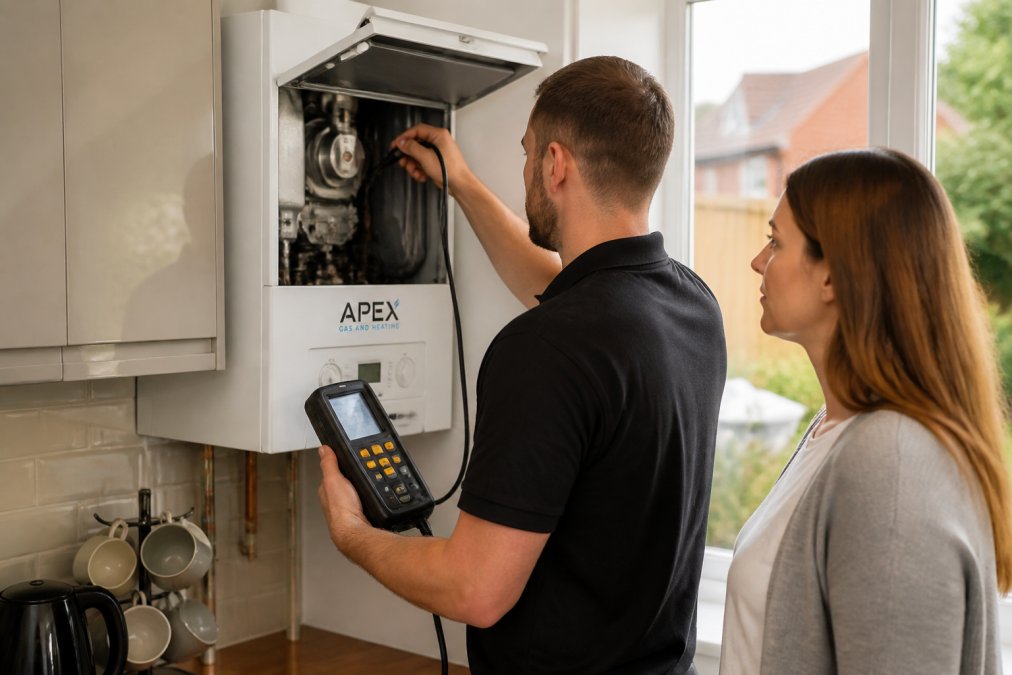
The service identifies other faults early: worn components, pressure problems, leaking condensate traps, and inefficient combustion. Many issues develop slowly. A tenant might notice the boiler cycling more frequently or radiators warming slowly but won’t report it because the system still works. By the time it fails completely, damage is extensive.
The engineer also checks the flue, the pipe venting combustion gases outside. A blocked or damaged flue forces exhaust back into the property, creating a CO risk. Regular servicing keeps the flue clear and functional.
Request a copy of the service report after each annual inspection. It documents the boiler’s condition, any repairs made, and concerns flagged. This record protects you if a tenant later claims the boiler was unsafe, you have proof it was serviced and compliant.
How Long Does a Boiler Service Take
A standard boiler service typically takes 60 to 90 minutes. The engineer inspects the boiler externally and internally, cleans components, tests safety controls, performs the flue gas analysis, and documents everything. For straightforward boilers in good condition, you’re at the lower end of that range.
If the engineer discovers a fault, the appointment extends. A simple fix might add 30 minutes. More complex repairs, like replacing a heat exchanger, can take several hours and may require a follow-up visit.
Coordinating Tenant Access and Compliance Documentation
You must give tenants at least 24 hours’ notice of the service visit. You need to coordinate access across multiple properties, ensure tenants are home or arrange key access, and manage paperwork afterwards.
Once complete, you have 30 days to provide the Landlord Gas Safety Record (CP12) to your tenant. If you manage multiple properties, you’re juggling multiple service dates and deadlines simultaneously. A single missed deadline breaches the Gas Safety (Installation and Use) Regulations 1998 and can result in local authority enforcement action.
Use a property management system or spreadsheet to log:
- Service date scheduled
- Tenant notification date and method
- Engineer attendance confirmation
- Certificate received date
- Certificate provided to tenant date
- Next service due date (12 months from service date)
For landlords in areas like Crawley managing multiple rentals, batch scheduling with the same Gas Safe engineer on a single day reduces tenant disruption and simplifies tracking.
Planning Around Tenant Disruption
While the service is non-intrusive, tenants don’t need to vacate, heating doesn’t need switching off, schedule during reasonable hours (8 a.m. to 5 p.m. on weekdays). Avoid winter months when tenants rely most on heating, unless the boiler is faulty. Scheduling in summer or early autumn minimises complaints and reduces emergency call-out risk during peak heating season.
Provide tenants with a brief explanation of what the service involves and how long it takes. Many assume the engineer will drain the system or cause disruption; clarifying that it’s routine and non-invasive improves cooperation.
Send tenants a service reminder two weeks before the scheduled date, then a final confirmation 48 hours before. Include the engineer’s name, company, and contact number. This reduces missed appointments and ensures tenants are prepared to grant access.
Boiler Maintenance Checklist for Landlords
Use this checklist to ensure your annual service covers all essential maintenance areas:
- Flue gas analysis: CO levels tested and recorded
- Heat exchanger inspection: Checked for cracks, corrosion, or scaling
- Combustion head cleaning: Burner jets cleaned for efficient fuel combustion
- Ignition and safety controls tested: Pilot light, ignition system, and safety shutoff mechanisms verified
- System pressure check: Boiler pressure set to manufacturer specification (usually 1-1.5 bar)
- Condensate trap inspection: Drain checked for blockages and proper operation
- Flue blockage check: Flue pipe inspected for debris, damage, or obstruction
- Gas supply integrity: Connections checked for leaks using gas detection fluid
- Thermostat and controls calibrated: Temperature sensors and controls verified for accuracy
- Boiler exterior cleaned: Casing wiped down to remove dust and debris
- Documentation completed: Safety certificate issued and provided to tenant within 30 days
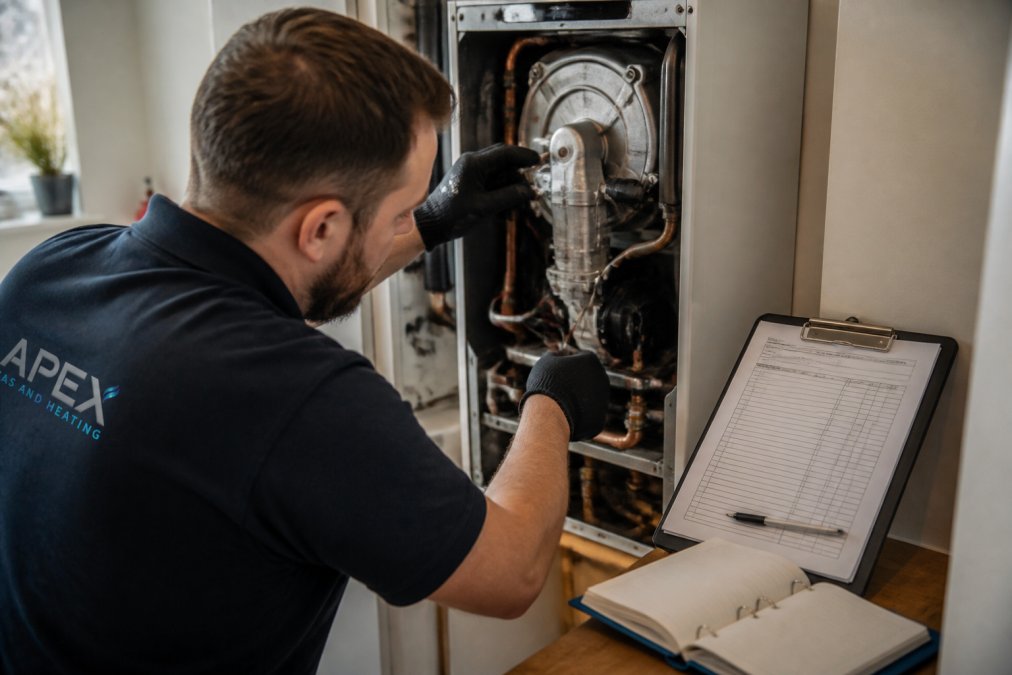
Keep a record of each service for every property. Document the date, engineer’s name, any repairs completed, and the next service date. This record protects you if a dispute arises and proves to local authorities that you’re meeting your legal obligations.
Many landlords use a spreadsheet or property management system to track servicing dates across multiple properties. Setting a reminder three months before the anniversary of the previous service ensures you don’t miss the deadline.
Arrange landlord servicing and certificates →
The annual service checklist isn’t optional, it’s the standard set by Gas Safe and enforced by local authorities. A thorough engineer will work through every item. If an engineer claims a service takes 15 minutes, they’re not doing it properly.
Extending Boiler Lifespan and Reducing Heating Bills
A well-maintained boiler lasts longer and runs more efficiently. Regular servicing removes scale and debris that accumulates inside the heat exchanger, improving heat transfer and reducing energy consumption. A boiler never serviced gradually loses efficiency, working harder to deliver the same heat and consuming more gas.
A boiler serviced annually maintains 90% of its original efficiency for years. One neglected drops to 70-80% within five years. Over a decade, the difference in gas consumption is substantial.
Annual servicing extends the boiler’s working life by several years. Worn components are identified and replaced before they cause cascading damage. For example, a worn seal in the heat exchanger allows water to leak into the combustion chamber. Caught early during a service, it’s a simple repair. Ignored, it leads to corrosion and eventual boiler failure. The difference between a minor repair and a full replacement is the annual service.
Many boiler manufacturers, including Worcester and Glowworm, recommend annual servicing to maintain warranty validity. If you skip a service and the boiler fails, the manufacturer may refuse to cover the repair.
Protecting Your Warranty and Managing Insurance Implications
Most boiler warranties require annual servicing by a Gas Safe registered engineer as a condition of cover. If you claim a warranty repair and the manufacturer discovers the boiler hasn’t been serviced, they can deny the claim.
Check your boiler’s warranty documentation. It will specify servicing requirements, the type of engineer who can perform the service, and any exclusions. Worcester and Glowworm boilers typically require annual servicing by an approved installer to maintain full warranty coverage. Baxi and Vaillant have similar clauses. Proof of servicing protects you against future disputes.
Insurance Claims and Service Records as Evidence
Your landlord insurance policy likely includes boiler breakdown cover, but most policies include a servicing condition. The insurer requires proof of annual servicing to validate claims. If a boiler fails and you can’t produce a service record, the insurer may refuse to pay for repairs or replacement.
When you submit a claim, the insurer will ask for:
- Copies of all Gas Safety Certificates (CP12s) for the past two to three years
- Service reports from the engineer
- Proof of tenant notification
- Photographs of the boiler and any visible damage
If you can’t produce these documents, the insurer has grounds to deny the claim based on non-compliance with policy terms. Keep service records in a dedicated folder, digital and physical copies, alongside your insurance policy documents and warranty paperwork.
Linking Service Records to Property Value and EPC Ratings
A well-serviced, efficient boiler improves your property’s Energy Performance Certificate (EPC) rating; a neglected boiler running inefficiently lowers it. When you sell or refinance the property, the EPC rating affects its market value and your ability to secure favourable mortgage terms.
Maintaining annual service records demonstrates to potential buyers, lenders, and valuers that the property has been properly maintained. This is particularly valuable if you’re selling a rental property or refinancing a portfolio.
Documenting Your Compliance for Local Authority Inspections
Local authorities conduct periodic inspections of rental properties to verify compliance with housing standards, including gas safety. If an inspector visits and asks for your Gas Safety Certificates, you must produce them on demand. Failure to do so can result in an enforcement notice, fines, or prohibition from letting properties.
Organise your records by property and by year. Keep at least two years of certificates for each property. If you’re managing properties in areas like Crawley, maintain a master spreadsheet listing all properties, service dates, certificate issue dates, and expiry dates. This allows you to quickly verify compliance during an inspection.
If an inspector finds that you’ve missed a service or failed to provide a certificate to a tenant, they can issue a compliance notice requiring you to remedy the breach within a specified timeframe.
If your insurance requires annual servicing and you skip a year, you may void your boiler cover entirely. Even if the boiler failure is unrelated to the missed service, the insurer can use non-compliance as grounds to deny the claim. If a local authority discovers you’ve missed a service, they can issue an enforcement notice and impose fines. Service records are your primary defence against both insurance disputes and regulatory action.
Service records are not just maintenance documentation, they are legal evidence of compliance. Keep them organised, accessible, and backed up digitally. When you need them for an insurance claim, local authority inspection, or property sale, they protect you and demonstrate responsible landlordship.
Conclusion
An annual boiler service is the intersection of legal obligation, tenant safety, and financial protection. Landlords who treat it as a tick-box exercise miss the real value: the service catches problems before they become emergencies, extends the boiler’s lifespan, and keeps your insurance and warranty valid.
Apex Gas & Heating Ltd provides comprehensive boiler servicing and Gas Safety Certificates for landlords across Sussex and Surrey. Our Gas Safe registered engineers perform the full maintenance checklist, issue your CP12 certificate, and provide detailed service reports. For landlords managing multiple properties, we coordinate scheduling to minimise disruption. Get a quote for your annual boiler service and ensure your rental properties remain safe, compliant, and efficient.
Frequently Asked Questions
Is it a legal requirement for landlords to have an annual boiler service?
Landlords must provide a Gas Safety Certificate (CP12) annually under the Gas Safety (Installation and Use) Regulations 1998. While the legal requirement is specifically for the safety certificate, an annual boiler service is the standard way to obtain it. The Gas Safe registered engineer performing the service inspects all gas appliances, including the boiler, and issues the certificate if everything meets safety standards. Failure to provide this certificate can result in fines up to £6,000 and criminal liability.
What should a professional boiler service include for a rental property?
A comprehensive annual boiler service includes visual inspection of the boiler and flue, checking the combustion process through flue gas analysis, inspecting the heat exchanger for wear, testing system pressure and safety controls, examining the condensate trap, and checking all gas connections for leaks. The engineer will also inspect any other gas appliances in the property. After completion, they issue the Landlord Gas Safety Record (CP12), which documents that all safety checks have passed and the system is safe to operate.
How does regular servicing prevent boiler breakdowns in rental properties?
Annual servicing identifies worn components, scale buildup, and early fault signs before they cause complete system failure. During the service, engineers clean internal parts, test safety controls, and check system pressure and efficiency. By catching problems early, landlords avoid costly emergency repairs during winter months when tenants rely on heating most. Preventative maintenance also extends the boiler's operational lifespan, reducing the likelihood of unexpected breakdowns that could leave tenants without heating and create emergency repair costs.
Can regular boiler maintenance extend the lifespan of a heating system?
Yes. Annual servicing maintains boiler efficiency, prevents scale and sludge accumulation, and ensures all components operate within manufacturer specifications. Regular maintenance helps keep the heat exchanger clean, reduces strain on the pump and controls, and identifies wear before it becomes critical. Most boilers last 10-15 years with proper maintenance, compared to shorter lifespans when servicing is neglected. Maintaining the manufacturer warranty through annual servicing also protects your investment, as many warranty terms require regular professional servicing.
Leave a Reply